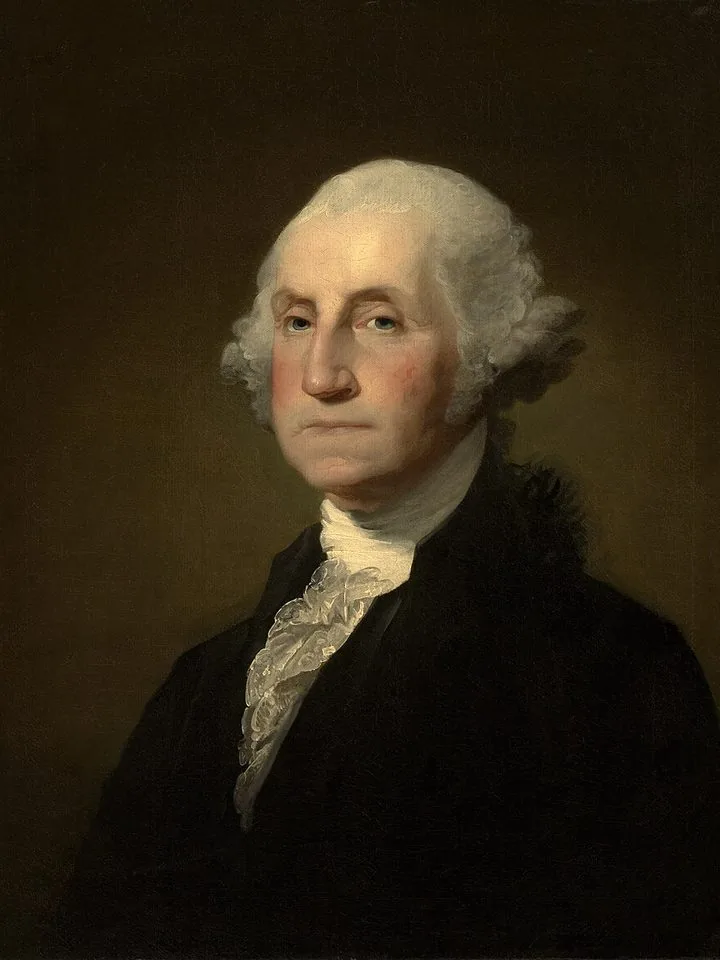
The story
37/90ths of a dollar
On 13 January 1784, the Treasury wrote to George Washington to tell him he had shortchanged himself. He was 51, three weeks out of uniform and home at Mount Vernon for the winter.
The letter came from James Milligan, Comptroller of the Treasury in Philadelphia. His office had checked the general's expenses for the whole war, from June 1775 to December 1783, against the vouchers. The statement ran to twenty-four pages.
The United States, Milligan reported, owed Washington a little over 727 dollars. That was more than Washington had claimed for himself, “by a fraction of 37/90ths of a dollar.” Accounts were kept in ninetieths of a dollar then, and his had been checked down to them.
There had been two mistakes, running in opposite directions. He had missed a warrant for 50 guineas, a gift to Washington College paid on his behalf, which counted against him. And he had never charged interest on 591 31/90 dollars of his own money, which counted for him. Once both were put right, the books came out in his favor.
The cherry tree story first appeared in print in 1806, after his death, and it is a legend. This one is in the Treasury's files.
He had measured things all his life. At 17 he was licensed as a surveyor, paid to measure land exactly and write the figures down. On 16 June 1775, when Congress chose him, at 43, to command the Continental Army, he made a promise about money that ran through the next eight years.
“I do not wish to make any proffit from it: I will keep an exact Account of my expences; those I doubt not they will discharge & that is all I desire.”
He turned down a salary. He claimed his expenses, and he promised to account for every one of them. That is the promise of someone who expects to be checked and intends to pass. Most people dread an audit. Vaults half welcome one, because it is the only way to prove the books were honest.
On 18 February 1784 he wrote back. He called the 50-guinea correction “perfectly just” and owned that he should have included it. On the interest, his explanation was almost comic in its honesty: “as the principal was rescued from error, & brought into a subsequent accot, I never thought about interest.” He had simply not thought to charge the public for the use of his own money.
The same careful habits had another side. His books also counted the people he enslaved at Mount Vernon, as property, and the independence he prized rested on their unpaid work. Both things are on the record.
On 14 December 1799, at 67, he was dying. He told his secretary, Tobias Lear, to “arrange & record all my late Military letters & papers,” and to “arrange my accounts & settle my books.” He asked that his body not be put into the Vault too soon.
With almost no breath left, the most famous man in America was still thinking about the ledger. He wanted it closed properly.
The Vault pattern in his life
- Keeps the record exact
- His war accounts were checked to the ninetieth of a dollar and came out in his favor.
- Takes nothing that isn't owed
- He refused a salary in 1775 and claimed only his expenses, which he promised to account for exactly.
- Finishes what he started
- Dying, he asked for his accounts to be arranged and his books settled.
The Vault: You hold the record, finish what you started, and say almost none of it out loud.
Are you a Vault too?
Free, no email needed. Find out which house is yours.
Take the free test
The book
The Vault: A Story of Your People
His story and fourteen more, from a palace library in Han dynasty China to a home in Franco's Madrid, grouped by the situations every Vault runs into: work, love, friendship, money, the body, purpose and power.
More famous Vaults
Questions people ask
What personality type was George Washington?
His life fits the Vault, one of the houses at Grand Personalities: someone who holds the record, finishes what they started, and says almost none of it out loud. Closest four-letter code: ISTJ.
Did George Washington take a salary during the Revolutionary War?
No. In June 1775 he told Congress he wanted no profit from the command and would keep an exact account of his expenses. When the Treasury audited that account in 1784, it found it owed him slightly more than he had claimed.
Is the cherry tree story about George Washington true?
No. It first appeared in print in 1806, after his death, and is a legend. His exact war accounts, by contrast, are in the Treasury's files.
Portrait: Gilbert Stuart, 1803 · Public domain · Source
