Famous Arenas
Anne Hutchinsonthe ArenaENTP
England and Massachusetts, 1591–1643 · midwife, Bible teacher, dissenter
The story
Name one, Sir
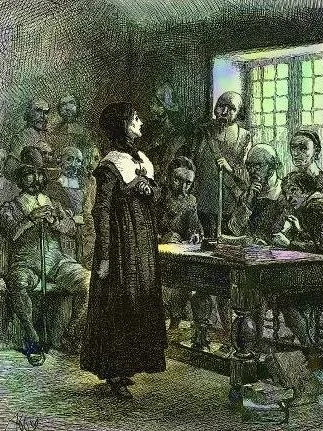
On 7 November 1637, Anne Hutchinson, 46, stood before the General Court of Massachusetts Bay at Newtown, the town now called Cambridge. Governor John Winthrop presided. Her accusers sat among her judges, and she had no lawyer.
She had come to Boston from Lincolnshire in 1634. She was a midwife, deeply read in scripture and a gifted talker, and each week people gathered at her house to talk over the Sunday sermons. In time she began to say which ministers preached true grace and which did not. A woman was teaching, and judging the clergy.
Winthrop said she had “troubled the peace of the commonwealth and the churches,” and that her meetings were “not tolerable nor comely in the sight of God nor fitting for your sex.”
She answered by asking for the charge. “I hear no things laid to my charge.” Winthrop said he had told her some already, and could tell her more. “Name one Sir,” she said.
Three words, perfectly polite, and very hard to answer. It is the move Arenas reach for by instinct: ask the question that makes the other side show its hand.
She kept asking. When they pressed her about the meetings, she called them a matter of conscience. Winthrop replied, “Your conscience you must keep or it must be kept for you.” When they demanded she justify herself, she asked, “Why do you call me to teach the court?” “We are your judges,” he told her, “and not you ours.”
On the second day she asked that the ministers speaking against her give their evidence on oath, and they hesitated. Her witnesses spoke for her. John Cotton, the minister she most admired, would not confirm the charges. After nearly two days, the most powerful men in the colony still had no clear offense to name.
Then she asked leave to explain how she knew what she knew. God had shown her, she said. Asked how she could tell it was the spirit, she pointed to Abraham, who knew God's voice when it told him to sacrifice his son. “By an immediate voice,” said the deputy governor. “So to me,” she answered, “by an immediate revelation.”
“You have power over my body but the Lord Jesus hath power over my body and soul.”
She meant every word, and it was the one thing that court could not let stand. A claim of direct revelation put her beyond the reach of ministers and magistrates alike. She had handed them the verdict herself.
They banished her “as being a woman not fit for our society.” She asked one last question: “I desire to know wherefore I am banished?” Winthrop replied, “Say no more, the court knows wherefore and is satisfied.”
She spent the winter under house arrest, was cast out of the Boston church in March 1638, and moved her family to Rhode Island, then to New Netherland. In August 1643, at 52, she was killed there with six of her children during Kieft's War.
For two days she won by asking questions, the way Arenas do. She lost on the day she stopped asking and told the room what she believed.
The Arena pattern in her life
- Wins by asking sharp questions
- “Name one Sir” left the governor of Massachusetts without a specific charge to give her.
- Turns the question back
- Pressed to justify herself, she asked the court, “Why do you call me to teach the court?”
- Can't leave the truth unsaid
- Close to acquittal, she told her judges God had spoken to her “by an immediate revelation.”
The Arena: You argue to find out. Ten ideas an hour, and you were never attacking the person.
Are you an Arena too?
Free, no email needed. Find out which house is yours.
Take the free test
The book
The Arena: A Story of Your People
Her story and thirteen more, from an empress's household in Kyoto around the year 1000 to a tavern in Prague in 1911, grouped by the situations every Arena runs into: work, love, friendship, money, the body, purpose and power.
More famous Arenas
Questions people ask
What personality type was Anne Hutchinson?
Her life fits the Arena, one of the houses at Grand Personalities: someone who argues to find out, throws out ten ideas an hour, and was never attacking the person. Closest four-letter code: ENTP.
Why was Anne Hutchinson banished?
The General Court of Massachusetts Bay banished her in November 1637 for holding religious meetings in her home and criticizing the colony's ministers. The verdict came after she told the court that God had spoken to her “by an immediate revelation.”
How did Anne Hutchinson die?
She was killed in August 1643, aged 52, with six of her children, in an attack on her household in New Netherland during Kieft's War.
Portrait: Edwin Austin Abbey, Anne Hutchinson on Trial, 1901 · Public domain · Source
