
The story
The tiger's lair
In the year 73, at about 41, Ban Chao noticed that the king of Shanshan had cooled toward him.
Ban Chao was an envoy of Han China, sent with thirty-six men to Shanshan, a desert kingdom near Lop Nur in what is now Xinjiang. His task was to win the king for the Han and away from the Xiongnu, the great nomad power that wanted the same kingdom. Thirty-six men can guard an embassy and carry gifts. They cannot fight a war.
At first the king was warm. Then, from one day to the next, his courtesy thinned.
Most people feel a signal like that and explain it away: the shorter reply, the greeting that comes half a beat late. Forges feel it and ask what has changed. Ban Chao guessed at once that another embassy had arrived, from the Xiongnu, with a better offer.
He did not ask whether it was true. He questioned a palace attendant as though he already knew, and the man, caught off guard, told him the rest. The Xiongnu envoys were there.
Now waiting meant losing. If the king went over to the Xiongnu, the thirty-six would be at his mercy. So Ban Chao gave his men a line that is still a Chinese proverb.
“He who does not enter the tiger's lair will never catch its cubs.”
That night, by the Han account, they fell on the Xiongnu camp with fire in a high wind. Ban Chao showed the king the envoys' heads, and the king, faced with a rival destroyed overnight, submitted to the Han and sent hostages.
It should be told plainly. It was a massacre of envoys in the dark, and only the Han side of it has come down to us. A fast, correct read can serve a cruel end as easily as a kind one.
What makes his life unusual is everything around that night. He was born in 32 into a family of scholars; his brother Ban Gu and his sister Ban Zhao would complete the great history of the Han dynasty. He spent years as a government copyist, writing out documents, work made for a patient person. He was not one. He threw away his brush, and the phrase became a saying of its own. He was past 40 before he found the work he was made for. If your own life seemed to start late, he is one of yours.
Then he stayed in the west for about thirty years. Those years were not night raids. They were letters, envoys and alliances kept: the slow business of holding what one night had won. In 91 he was made Protector General of the Western Regions.
At about 70 he asked to come home. In the words his biography gives him, he did not dare hope to reach Jiuquan; he only wished to pass through the Jade Gate alive.
He came home to Luoyang in 102 and died the following month. The man who had walked into the tiger's lair asked, at the end, only for a gate.
The Forge pattern in his life
- Reads the room before anyone speaks
- He sensed the king's cooling courtesy and guessed that a rival embassy had arrived.
- Acts before the window closes
- He struck the Xiongnu camp that same night, before the king could change sides.
- Stays for the slow part
- He spent about thirty years in the west, holding what one night had won.
The Forge: You move first, fix it live, and get bored of any meeting about the meeting.
Are you a Forge too?
Free, no email needed. Find out which house is yours.
Take the free test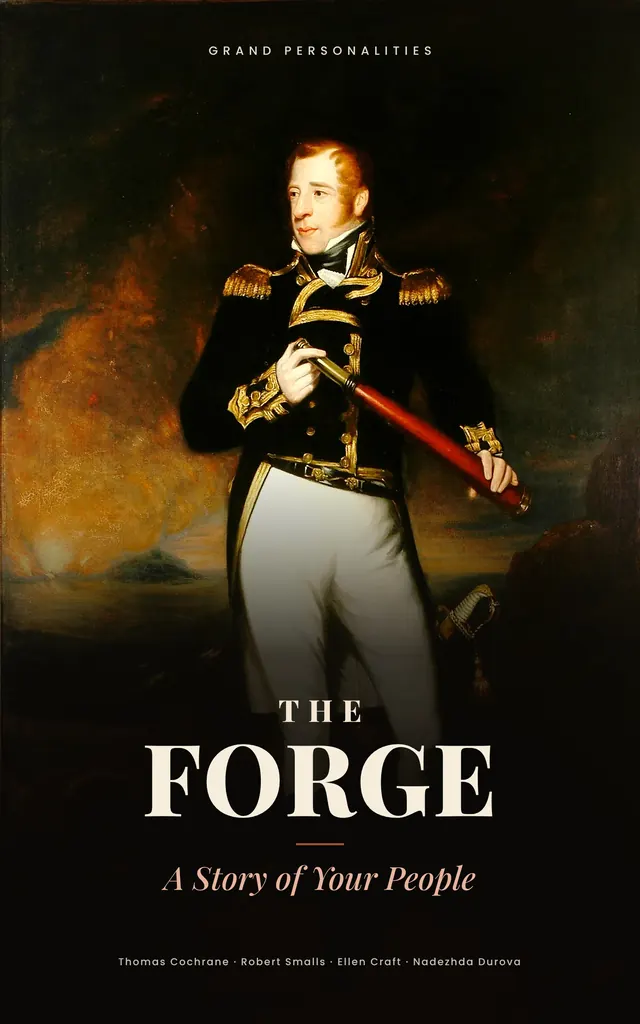
The book
The Forge: A Story of Your People
His story and fourteen more, from a desert kingdom in the first century to a Gestapo office in the south of France in 1944, grouped by the situations every Forge runs into: work, love, friendship, money, the body, purpose and power.
More famous Forges


Questions people ask
What personality type was Ban Chao?
His life fits the Forge, one of the houses at Grand Personalities: someone who moves first, fixes it live and gets bored of any meeting about the meeting. Closest four-letter code: ESTP.
What did Ban Chao do in Shanshan?
Sent there as an envoy in 73 with thirty-six men, he found that a rival Xiongnu embassy had arrived, attacked it at night and showed the envoys' heads to the king, who then submitted to the Han.
Why is Ban Chao linked to the saying about throwing away the brush?
He began as a government copyist, and the idiom 投筆從戎, “throw away your writing brush and join the military”, comes from his decision to leave the desk for a soldier's life.
Shown: the Forge house art.