Famous Bridges
Clara Bartonthe BridgeENTJ
Massachusetts, 1821–1912 · teacher, organiser, Red Cross founder
The story
Through to the triumphant close
In December 1868, at 46, Clara Barton was in the middle of a speech when her voice gave out.
She had spent two years on the lecture circuit, more than two hundred talks across the Northeast and Midwest about what she had seen in the Civil War. Behind the talks sat a bigger job: the search for the men who never came home.
In March 1865, with President Lincoln's approval, she had opened an office to answer the families of missing soldiers. Letters came in by the thousand, each one a family waiting. By the time the office closed, it had answered 63,182 of them and identified 22,000 missing men. Many of the answers were the worst news a family can receive. They went out anyway.
It was the kind of work Bridges are built for: a huge, shapeless problem, turned into a system and run all the way to the end.
She had started life as a painfully shy farmer's daughter, born on Christmas Day 1821 in North Oxford, Massachusetts. At 30 she opened a free school in Bordentown, New Jersey, with six pupils. Within a year it had more than two hundred. When the town gave the school its own building in 1853, it hired a man to run it at twice her salary. She resigned and went to build something else.
Now the builder had stopped mid-sentence. “Nervous prostration had declared itself,” she said later. She did not recover quickly. Bridges can bear almost anything if there is something to do about it, and recovering from exhaustion is mostly waiting.
In the end her doctors decided for her.
“Finally, by my physicians I was ordered to Europe, and in early September, '69, I was able to go.”
Look at the verbs. She was ordered. She was able to go. Even leaving sounds like one more task she had finally managed to finish.
A later biographer saw the same shape across her whole life. Again and again, he wrote, she “carried an enterprise completely through to the triumphant close”, and when it was done, collapsed. Her body waited, almost politely, until the job was over, then sent the whole bill at once.
The rest turned out to be a door. In Switzerland she learned about the International Red Cross, a new movement for the relief of the wounded in war. When war came to France in 1870, the woman sent abroad to do nothing was soon working among civilians in Strasbourg, Paris and Belfort.
She brought the idea home. On 21 May 1881, at 59, she founded the American Red Cross, at an age when many people are winding down. The collapse at 46 had been the middle of her story.
She died on 12 April 1912, at 90. She had been sent away to stop, and she came back carrying the work of her next forty years.
The Bridge pattern in her life
- Turns chaos into a system
- Her office answered 63,182 letters and put names to 22,000 missing men.
- Builds from nothing, fast
- Her free school grew from six pupils to more than two hundred in a year.
- Finishes first, collapses after
- Her voice gave out mid-speech in 1868, and her doctors had to order her to rest.
The Bridge: You see the end state, name the order of operations, and start moving people toward it.
Are you a Bridge too?
Free, no email needed. Find out which house is yours.
Take the free test
The book
The Bridge: A Story of Your People
Her story and thirteen more, from a village in the viceroyalty of Peru in 1780 to a Los Angeles inquest room in 1928, grouped by the situations every Bridge runs into: work, love, friendship, money, the body, purpose and power.
More famous Bridges
Questions people ask
What personality type was Clara Barton?
Her life fits the Bridge, one of the houses at Grand Personalities: someone who sees the end state, names the order of operations and starts moving people toward it. Closest four-letter code: ENTJ.
How many letters did Clara Barton answer about missing soldiers?
Her Office of Correspondence with Friends of the Missing Men answered 63,182 letters and identified 22,000 missing men before it closed in 1869.
How did Clara Barton find out about the Red Cross?
After she lost her voice mid-speech in 1868, her doctors sent her to Europe to rest. In Switzerland she learned about the International Red Cross, and in 1881, at 59, she founded the American Red Cross.
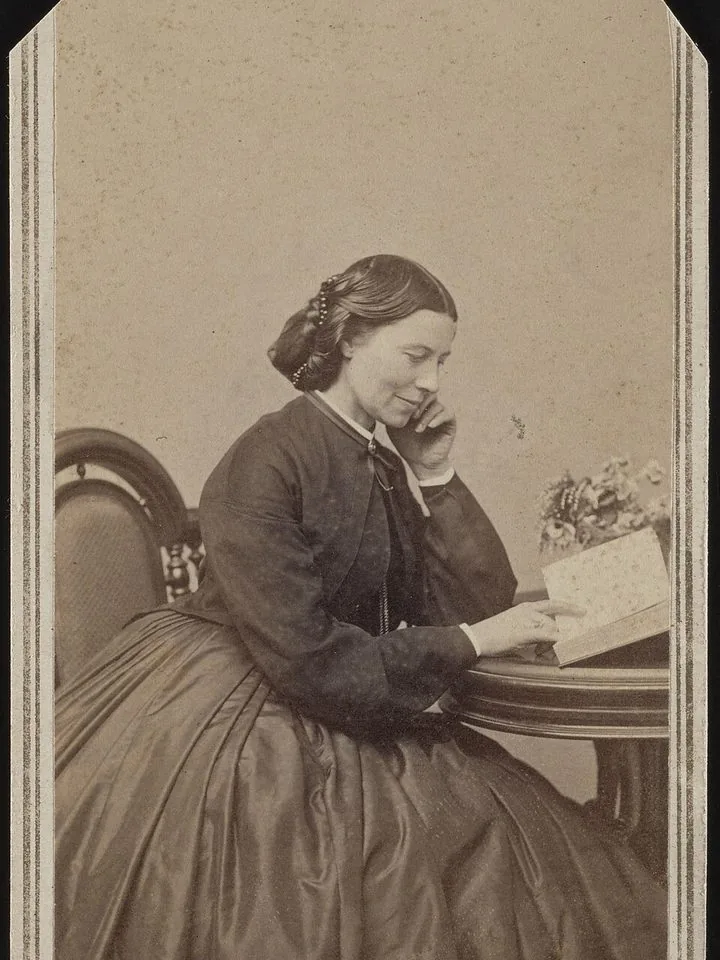
Portrait: Photograph, about 1865 · Library of Congress · No known restrictions · Source
