The story
The gallery decides
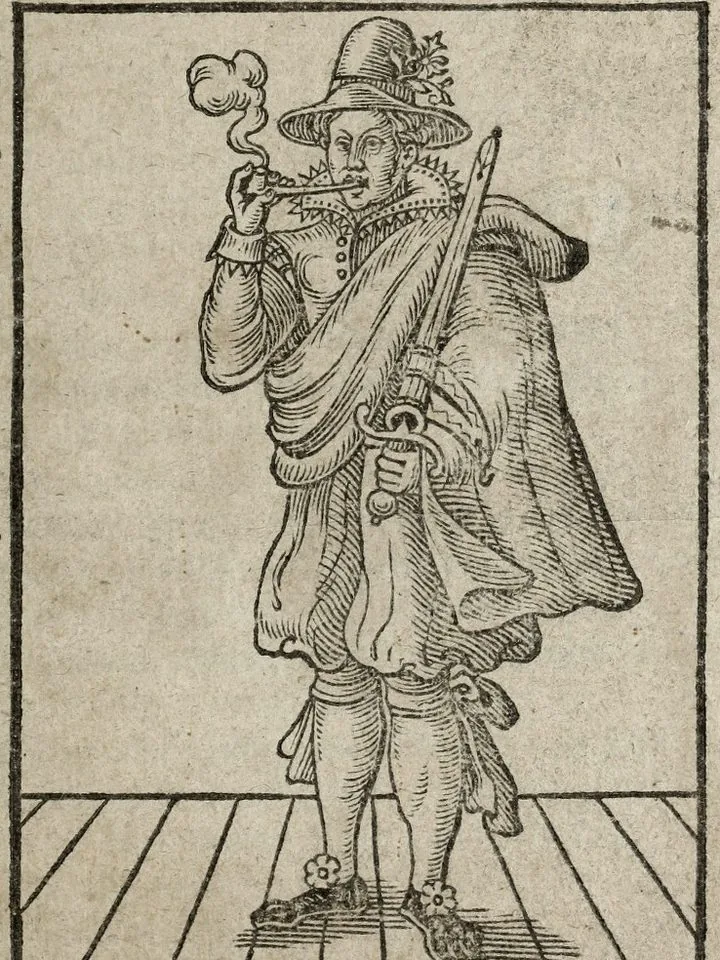
In 1611, at about 26, Mary Frith sat down on the stage of the Fortune playhouse in London, dressed as a man, and spoke to the house.
By her own later confession she wore boots and a sword. She told the crowd she knew many of them took her for a man. Anyone who doubted it, she said, could come round to her lodging and find out she was a woman. Then she picked up a lute and sang. Nobody wrote down which song.
Everyone in that playhouse had heard the rumor. By saying it first, out loud, on the one spot where every eye was on her, she took it out of their mouths and put it in hers. Bonfires do this with gossip: they get to the joke first.
To see why she was there, look at what was playing. The Fortune's company had a new comedy, The Roaring Girl, by Thomas Middleton and Thomas Dekker. Its heroine was a Londoner called Moll who dressed as a man, and nobody could miss who Moll was meant to be. A male actor was playing her. So Mary Frith came and sat on the stage built for the people pretending to be her.
She had been born around 1584 into a shoemaker's family in the Barbican. At about 16 she was charged with stealing two shillings and elevenpence. She went about in men's clothes, in taverns, tobacco shops and playhouses, and London gave her a nickname from the pickpocket's trade.
She was no simple heroine. In later years, by her own account, she worked as a fence for stolen goods, and that did real harm to real people.
On Christmas Day 1611 she was arrested for going about in men's clothes. A church court heard her confession, the playhouse and the lodging joke included, and sentenced her to public penance for her evil living.
Penance was theater too, and the church designed it that way: a crowd, a pulpit, a script of sorrow. On Sunday 9 February 1612 she stood at Paul's Cross, the open-air pulpit at St Paul's, while London looked on.
Within days the letter-writer John Chamberlain sent the news to a friend abroad.
“She wept bitterly and seemed very penitent, but it is since doubted she was maudlin drunk.”
The rumor went further: she had tippled off three quarts of sack, a strong sweet wine, before she came. Either she was truly sorry, or drunk and putting on a show. Bonfires know a third answer. You can mean a thing completely and perform it at the same time.
Whichever it was, the court had planned a humiliation and she made it a scene the town talked about. That is the price of playing your punishment to the gallery. The gallery gets to decide whether you meant it.
She married Lewknor Markham in 1614 and died on Fleet Street on 26 July 1659, at about 74. Three years later a sensational Life appeared, full of things she probably never said.
Playwrights wrote her, a clerk recorded her and a gossip reviewed her. The one time she spoke for herself in front of everyone, she was sitting on a stage with a lute, inviting London round to see the truth.
The Bonfire pattern in her life
- Beats the gossip to the joke
- She told a playhouse full of strangers to come to her lodging if they doubted she was a woman.
- Plays every scene to the crowd
- At her penance at Paul's Cross she wept so well the town argued over whether she meant it.
- Lives in the present, loudly
- She went about London in men's clothes, in taverns, tobacco shops and playhouses, for years.
The Bonfire: You raise the temperature of a room on purpose. Present tense, full volume, real warmth.
Are you a Bonfire too?
Free, no email needed. Find out which house is yours.
Take the free test
The book
The Bonfire: A Story of Your People
Her story and fourteen more, from Tang China and Elizabethan London to Tehran, Havana and the Montreal waterfront, grouped by the situations every Bonfire runs into: work, love, friendship, money, the body, purpose and power.
More famous Bonfires
Questions people ask
What personality type was Mary Frith?
Her life fits the Bonfire, one of the houses at Grand Personalities: someone who raises the temperature of a room on purpose, in the present tense, at full volume and with real warmth. Closest four-letter code: ESFP.
Why was Mary Frith called Moll Cutpurse?
Moll was a common form of Mary, and a cutpurse was a thief who cut purses from people's belts. She was charged with theft at about 16, and later worked for years as a fence for stolen goods.
Was The Roaring Girl about Mary Frith?
Yes. Thomas Middleton and Thomas Dekker's comedy, published in 1611 and played at the Fortune, has a heroine called Moll who dresses as a man, modeled on her. Frith herself once sat on the Fortune's stage in men's clothes and sang.
Portrait: Unknown artist, printed by Nikolas Okes, 1611 · Public domain · Source
