Famous Arenas
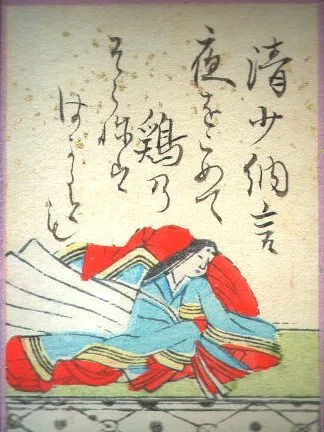
Sei Shōnagonthe ArenaENTP
Japan, c. 966–after 1017 · lady-in-waiting, poet, author of The Pillow Book
The story
The seaweed
Some time in the late 990s, at about 30, Sei Shōnagon answered a friend's anxious question by sending him a piece of seaweed.
She was a lady-in-waiting to Empress Teishi in Heian-kyō, the city now called Kyoto, and she was writing what became The Pillow Book. Almost everything known about her comes from its pages, in her own voice. She admits there that when she first came to court, around 993, she was so shy she was always close to tears.
The shyness wore off. Arenas often find that a quick reply is the fastest way out of a corner, and hers became the quickest at court.
One of her friends was Fujiwara no Yukinari, a great calligrapher. One night he left her early, and the next morning blamed a crowing cock for hurrying him away. She did not believe in his rooster. She wrote back with an old Chinese tale of a fake cock-crow that tricked guards at the Hangu Pass into opening their gate before dawn.
Yukinari parried. The barrier he had in mind, he replied, was Ōsaka, Meeting Hill, a name that in poetry meant lovers meeting. She closed the exchange with a poem.
“Though you fake a cock-crow while the night is still deep, the barrier of Meeting Hill will never let you through.”
It was a fencing match in four touches, and both of them loved it. The poem was later chosen for the anthology One Hundred Poets, One Poem Each, as number 62. The friendship came out stronger. For two people like that, this is what affection sounds like.
The seaweed was another matter. She had left court for a while and did not want anyone to know where she was. One of the few who knew was Tachibana no Norimitsu, a close friend and probably her former husband. Courtiers kept pressing him. Once, to stop himself giving her away, he had crammed his mouth with seaweed from the table.
Cornered again, he wrote and asked her plainly what he should say. She sent back a piece of seaweed wrapped in paper. Keep eating, it meant. Keep your mouth shut.
Norimitsu did not get it. So she sent a poem to explain, about divers hidden under the waves. He would not even read it. He had asked a plain question under pressure, and twice he had been handed a puzzle.
Soon afterward he was promoted to a post in Tōtōmi province, and that, she wrote, was the end of their friendship. There was no great quarrel. A friendship that had survived a secret did not survive two riddles.
Her rival Murasaki Shikibu, author of The Tale of Genji, later wrote that Sei Shōnagon was terribly pleased with herself, scattering Chinese characters that did not hold up when you looked closely. Arenas hear versions of that verdict all their lives. The sparkle that delights one friend strikes someone else as showing off.
She set down both stories herself, the win and the loss, and she let Norimitsu keep his dignity. With Yukinari, the riddle was the gift. With Norimitsu, the gift would have been a plain answer.
The Arena pattern in her life
- Quickest reply in the room
- When Yukinari blamed a crowing cock for his early exit, she shot back with a Chinese tale of a fake one.
- Sparring as a form of affection
- Her barbed poem to Yukinari deepened the friendship and became number 62 of One Hundred Poets.
- Answers plain questions with riddles
- A friend under pressure asked what to say, and she sent him seaweed, then a poem he refused to read.
The Arena: You argue to find out. Ten ideas an hour, and you were never attacking the person.
Are you an Arena too?
Free, no email needed. Find out which house is yours.
Take the free test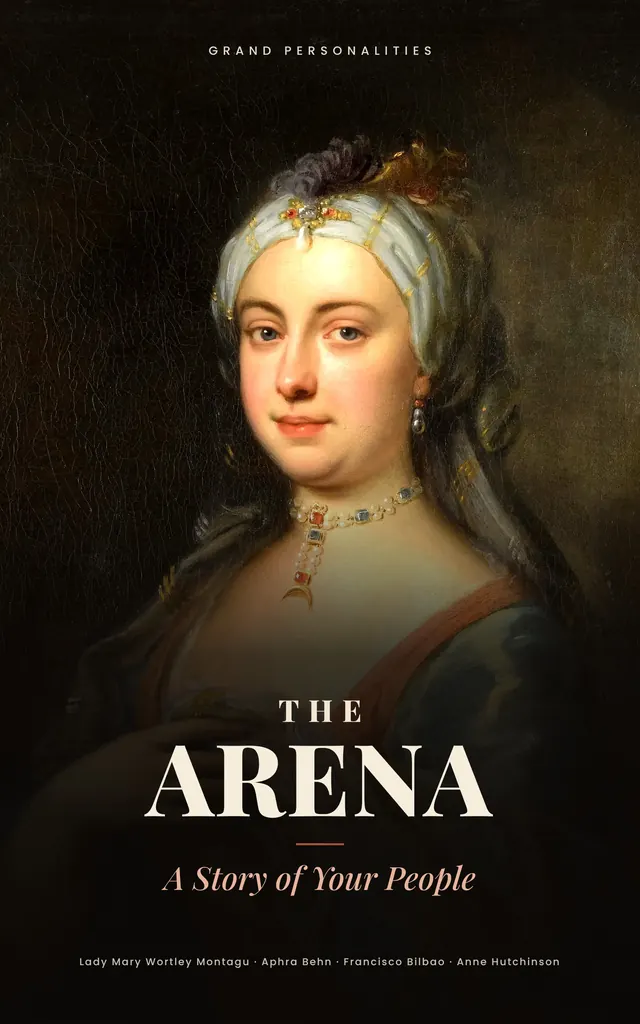
The book
The Arena: A Story of Your People
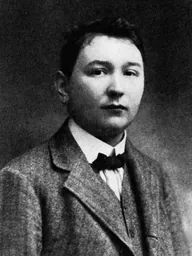
Her story and thirteen more, from an empress's household in Kyoto around the year 1000 to a tavern in Prague in 1911, grouped by the situations every Arena runs into: work, love, friendship, money, the body, purpose and power.
More famous Arenas

Questions people ask
What personality type was Sei Shōnagon?
Her life fits the Arena, one of the houses at Grand Personalities: someone who argues to find out, throws out ten ideas an hour, and was never attacking the person. Closest four-letter code: ENTP.
What is Sei Shōnagon known for?
The Pillow Book, her collection of lists, sketches and stories from the household of Empress Teishi in Kyoto in the 990s. Her poem about the barrier at Meeting Hill is number 62 in One Hundred Poets, One Poem Each.
What did Murasaki Shikibu say about Sei Shōnagon?
In her diary, the author of The Tale of Genji called her very pleased with herself, scattering Chinese characters that did not stand up to a close look. The two women probably never served at court at the same time.
Portrait: Unknown, ca. 1000 · Public domain · Source
