Famous Forges
Thomas Cochranethe ForgeESTP
Scotland, 1775–1860 · sea captain, politician, navy commander
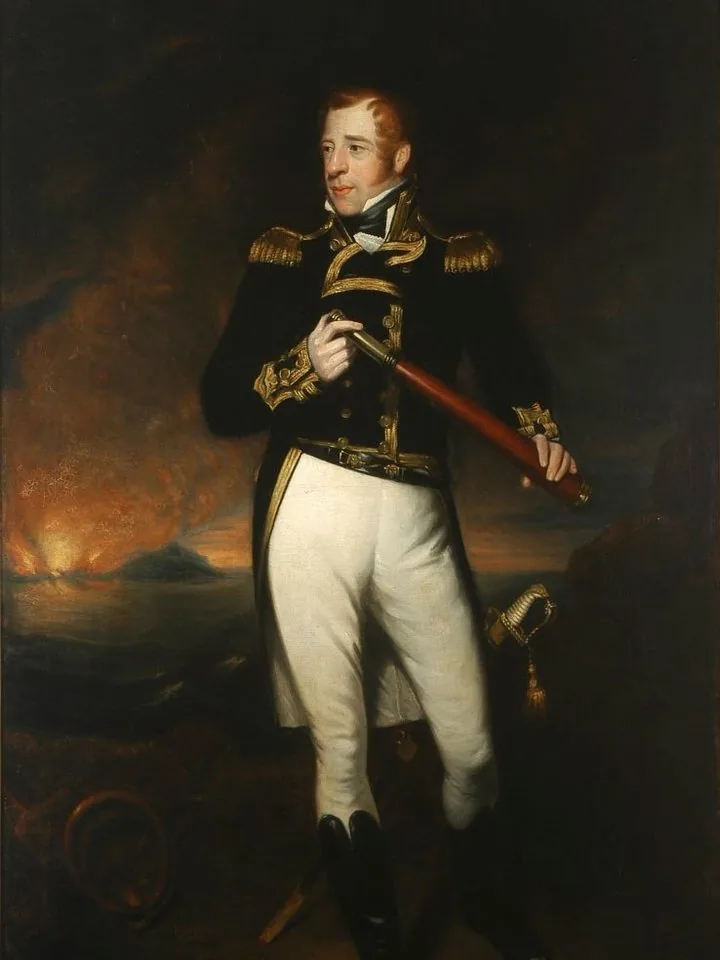
The story
Too close to be hit
On 6 May 1801, off Barcelona, Thomas Cochrane took his little brig Speedy straight at a Spanish frigate that should have blown her out of the water. He was 25.
The Speedy carried fourteen four-pounder guns and, that morning, 54 men. The Spanish frigate Gamo carried 32 guns and a crew of 319. That was more than twice the guns and nearly six times the men. A brig that size is supposed to run.
Known for most of his career as Lord Cochrane, he came from an impoverished branch of the Scottish nobility: a title, and little money behind it. He had a name to make, and that morning he made it with arithmetic.
He did not run, and he did not fight at the range the frigate wanted. He closed, until the Speedy lay so near that the Gamo's guns, mounted high, could not be brought low enough to hit her deck. The broadsides tore through the brig's sails and rigging and passed over the men below.
From the outside it looked like luck. Forges get called lucky all their lives. Usually they have simply done the sums faster than anyone watching, and shown nobody the working.
The Spanish crew massed to board, where three hundred men would settle it in minutes. Each time, Cochrane drew off and fired into the crowd, then closed again. They tried three times and gave up.
Then he boarded them. He took the whole crew across and left only the surgeon aboard the Speedy. His brother Archibald led one party over the bow. Cochrane shouted back to the empty brig for more men, as if he had them, and had the Spanish flag hauled down. Believing their officers had surrendered, the Gamo's crew stopped fighting.
Fifty-four men had taken a ship crewed by more than three hundred. The Spanish second-in-command, mortified, asked Cochrane for a certificate saying he had done all he could to defend his ship. Cochrane gave him one, worded so it could be read two ways.
He had “conducted himself like a true Spaniard.”
At sea, the rules were physics: range, angle, the reach of a gun. On land the rules were made by people, and the people were measuring him.
By 1814 he was a famous captain and a Member of Parliament. In June that year, at 38, he was convicted in the Great Stock Exchange Fraud and sentenced to a year in prison, and on 5 July the House of Commons expelled him. He spent years fighting the verdict.
The quickness that had won him a frigate made it easy to believe he had been quick in a worse way. Many Forges know the feeling: brilliant where the stakes are immediate, misread where the rules are social and the stakes are slow.
So he went where his speed counted. In November 1818 he arrived in Chile to command its navy, and in 1823 he took command of Brazil's. Half a world away, on a quarterdeck again, he was back in a room he understood.
He died in London in 1860, at 84. The morning off Barcelona still explained him best: fifty-four men, a frigate, and a captain who had done the sums before anyone saw him move.
The Forge pattern in his life
- Closes when others would run
- Outgunned more than two to one, he took the Speedy straight at the Gamo.
- Does the sums at speed
- He closed so near that the frigate's high-mounted guns could not reach his deck.
- Misread in rooms of rules
- Unbeatable at close range, he was convicted and expelled from Parliament in 1814.
The Forge: You move first, fix it live, and get bored of any meeting about the meeting.
Are you a Forge too?
Free, no email needed. Find out which house is yours.
Take the free test
The book
The Forge: A Story of Your People
His story and fourteen more, from a desert kingdom in the first century to a Gestapo office in the south of France in 1944, grouped by the situations every Forge runs into: work, love, friendship, money, the body, purpose and power.
More famous Forges
Questions people ask
What personality type was Thomas Cochrane?
His life fits the Forge, one of the houses at Grand Personalities: someone who moves first, fixes it live and gets bored of any meeting about the meeting. Closest four-letter code: ESTP.
How did Thomas Cochrane capture El Gamo?
On 6 May 1801 he brought the 14-gun Speedy so close to the 32-gun Gamo that the frigate's guns could not hit his deck, drove off three attempts to board, then boarded her with almost all of his 54 men. The Spanish crew of 319 surrendered.
Why was Thomas Cochrane expelled from Parliament?
In June 1814 he was convicted in the Great Stock Exchange Fraud and sentenced to a year in prison, and the House of Commons expelled him on 5 July 1814. He spent years fighting the verdict.
Portrait: James Ramsay, 1830 · Public domain · Source
