Which one are you?
INFJ vs INFPthe Lighthouse or the Aurora
By Grand Personalities · Updated
The difference: J vs P
The one difference that matters
On paper INFJ and INFP differ by one letter. In practice they run on different engines, and the letter is the smallest part of it. Picture a colleague telling the lunch table she’s leaving to open a bakery. The INFJ isn’t surprised. Weeks ago they noticed she’d stopped saying “next year”, and they already have a fair idea how her first winter will go. They say something warm and keep the rest. The INFP lights up at the nerve of it, asks what she’ll bake first, and spends the bus ride home wondering whether their own job is the honest one.
The INFJ (the Lighthouse on this site) leads with a silent forecast of how things will turn out, mostly for people, and backs it with close attention to how everyone in the room feels. Their feeling faces outward: is this going to be all right between us? The INFP (the Aurora) leads with an inner compass. Their feeling faces inward: is this true, and is it me? Pass both a leaving card for a manager nobody liked. The INFJ writes two kind sentences the manager will be glad to read, because the moment needs to go well. The INFP turns the pen over for a minute and writes “Good luck with the move”, the one line they can mean.
The J and P show up in how each one holds the future. The INFJ settles on one, often before they can prove it, and moves toward it. The INFP can picture several lives down to the afternoon light and is slow to close any of them, so a job taken for now can quietly become the job of seven years. Neither is tidier by nature. The INFJ simply finds an open question harder to live with.
Side by side
INFJ and INFP, compared
| INFJLighthouse | INFPAurora | |
|---|---|---|
| Hearing big news | Half expected it, and already sees how it will probably go. | Feels the courage of it, then quietly checks their own life against it. |
| A card they don’t mean | Finds the kind words the moment needs, and means the kindness. | Writes one line they can stand behind, or passes the card on. |
| A friend’s risky choice | Sees the ending early. Says it softly, once, or not at all. | Asks whether it’s really them, and imagines three other versions. |
| When a plan slips | Waits for a clean restart. Sometimes Monday takes a month. | Wasn’t gripping it. Something else has already caught their interest. |
| Under strain | Gets tidier: invitations declined, inbox cleared. Then a lost weekend. | Mild outside, red pen inside. Suddenly nobody can do anything right. |
| Praise | Thanks for the dinner lands. A compliment about them bounces off. | Praise for a quality feels like a debt they now have to repay. |
| The private argument | Mostly about other people: where they’re heading and what they need. | Mostly about themselves: who they are and whether they’re living it. |
| When hurt piles up | Files each let-down quietly, then closes the door without warning. | Says nothing for months, then it all comes out over something small. |
Six questions
How to tell which one you are
- 01When I watch a friend make a choice I’m unsure about, what am I actually seeing?If you see the ending, how this is likely to play out in a year, you’re probably the INFJ. If you’re asking whether the choice fits who they really are, and picturing the other lives they could have instead, the INFP.
- 02Can I say something kind that I don’t fully feel?If you can find the warm words a moment needs and feel fine about it, because keeping things good between people is the point, you’re probably the INFJ. If anything you don’t mean sticks in your throat, so you’d rather say one small true thing or nothing at all, the INFP.
- 03What do I do when everyone in the room agrees on something I think is wrong?If you read who else is uneasy, weigh whether speaking up would help, and often raise it privately later, you’re probably the INFJ. If you simply won’t go along, quietly and completely, long after the louder people have given in, the INFP.
- 04What happens when a plan falls apart halfway through the week?If you can’t bear to patch it and would rather begin again from scratch at the start of next week, even when next week turns into next month, you’re probably the INFJ. If you weren’t holding it that tightly and something more interesting has already taken its place, the INFP.
- 05What does stress do to me before anyone notices?If you tighten first, cutting plans and clearing the inbox until people praise your discipline, then crash all at once, you’re probably the INFJ. If you stay mild on the outside while everyone around you starts looking careless, and a sarcastic line slips out that surprises the room, the INFP.
- 06What do I think about on a long walk alone?If it’s mostly other people, where a friend’s marriage is going or what your sister isn’t saying, you’re probably the INFJ. If it’s mostly yourself, who you are, whether you’re living by your own standards and what you’re meant to make, the INFP.
Mistyping
Why people mix them up
INFJ and INFP are among the most often swapped types, because from outside they look the same: gentle, private, idealistic and immovable on a point of principle. Both sort things out alone and say the clearest thing late. Tests make it worse by asking whether you have strong values or feel things intensely, which both answer yes to. The INFJ label also carries a certain glamour online, so plenty of INFPs settle on it, while some INFJs with a strong personal code decide they must be INFP. Both also idealize people early and feel the crash when the real person turns up, which makes their love lives sound alike in any online quiz.
The trap is reading J and P as neat and messy. An INFP with a color-coded planner is still an INFP if every choice gets checked against an inner sense of right. An INFJ with a chaotic flat is still an INFJ if they read where people are heading and adapt to keep the peace. A sharper clue is how each one loses themselves. The INFJ shapes to other people and fights for everyone’s fairness except their own. The INFP stays so loyal to their inner standard that they wait to be understood without explaining. Judge by months, not a mood. Types are patterns, and someone near the line will recognize both.
Love
The INFJ and the INFP in love
An INFJ picks a partner slowly and then backs the person that partner is capable of becoming. Years later they can quote the plan their partner mentioned on a second date, and they’ll have been quietly clearing the way for it. The catch is that they reply to what wasn’t said. Their partner insists the day was fine, and the INFJ answers the worry underneath. The read is usually accurate, and the partner still feels caught out. Once a row starts, the INFJ can see how it will end and leaves the room to think. The INFJ means that pause as a truce; the partner experiences it as the worst part of the argument. Afterward the INFJ needs time alone, and that part isn’t up for negotiation. Then comes a slow, honest talk about what they’ve been carrying.
An INFP wants the whole of a partner, the frightened and worn-out version as much as the charming one, and wants to be known that thoroughly back. In the first months an INFP is often half in love with a version of the person they built in their head, and the lasting love begins when that version gives way and they pick the real one anyway. A passing remark about their taste in music or the way they’ve done up a room can land hard, because those things sit close to who they are. The truest things an INFP tells a partner are often written late at night, after the conversation itself got only their calm face. Partners also tend to look after the INFP who shows, the calm and easygoing one. So they book the big night out when the INFP needed an evening alone, and get thanked for it anyway.
Work
The INFJ and the INFP at work
An INFJ will perform well in nearly any role for a year or two, but stays only where they believe in the purpose. When a restructure or a new director hollows out the reason for the work, the motivation can vanish in a week. They’re at their best where reading people over years is the core skill: mentoring, writing, strategy, advising, care. Workplaces that reward the fastest opinion in the meeting tend to underrate them, because the INFJ’s best contribution usually arrives as one considered sentence after everyone else has finished. Their other risk is the solo plan. An INFJ will carry a project nobody asked them to carry, never ask for help, burn out on it, and then quietly resent colleagues for not helping.
INFPs need work that says something true, and they’ll take the awkward path over the comfortable one to get it. Their voice is recognizable, so they shine where words or making matter: writing, design, counseling, teaching, anything with a real person at the end of it. Their trouble is the gap between the piece in their head and the one on the desk; drafts go in a drawer when the real version comes out smaller. In meetings they often wait so long to answer that the moment closes, and colleagues assume the topic didn’t matter to them.
Together
When an INFJ meets an INFP
Neither is the other’s best match on this site: the Lighthouse’s is the Bonfire (ESFP), and the Aurora’s is the Garrison (ESTJ). INFJs and INFPs can spend an hour in a café saying almost nothing and both call it a good afternoon. The risk is that both sort problems out alone. The INFJ files a disappointment and goes quiet; the INFP rehearses the argument at night and says nothing. A problem can sit unspoken for a year while each assumes the other has noticed. As friends they’re the pair still writing proper birthday letters to each other twenty years on.
FAQ
Questions people ask
What is the difference between INFJ and INFP?
The difference between INFJ and INFP is where their feeling points. INFJs read other people and where situations are heading, and adjust to keep things right between people. INFPs check everything against their own values and won’t say what they don’t mean. Both are quiet and idealistic, so the gap shows in group decisions, cards and toasts, and how each one handles an open future.
How do I know if I’m an INFJ or an INFP?
Notice what you think about when you’re alone. INFJs mostly think about other people and where their lives are going; INFPs mostly think about who they are and whether they’re living by it. Waiting for a clean restart after a plan slips points to INFJ, and a job taken “for now” that’s now years old points to INFP. The free Grand Personalities test is a good next step if both still fit.
Are INFJ and INFP compatible?
Neither is the other’s best match on this site. INFJs and INFPs read each other quickly and want the same depth from a relationship. The risk is that both process problems alone.
Are INFPs more emotional than INFJs?
INFPs aren’t more emotional than INFJs; their feelings are organized differently. An INFP’s feelings work as a private compass about what’s right for them. An INFJ’s attention goes to other people’s feelings first, which is why INFJs often find it harder to name what they want for themselves.
What are the cognitive functions of INFJ vs INFP?
INFJ runs Ni-Fe-Ti-Se and INFP runs Fi-Ne-Si-Te. Put simply, the INFJ’s first instinct is a hunch about where things are going, and their second is the atmosphere between people. The INFP leads with personal values and then explores possibilities outward. The two types don’t share a single function, which is why types one letter apart can feel so different from the inside.
Why do so many INFPs think they’re INFJ?
Many INFPs test as INFJ because quizzes ask about strong values, intensity and idealism, which fit both types. Organized INFPs also read the J as neatness and pick it. The better clue is whether your feelings mostly track other people and the room, which points to INFJ, or your own sense of right and wrong, which points to INFP.
Still torn between INFJ and INFP?
The free test settles it in a few minutes. No email needed.
Take the free testThe Bibles
Read both openings. Yours is the one that reads like your week.
Each type has its own Bible: the patterns that type keeps repeating, and the plays that answer them. The opening chapter of every Bible is free to read.
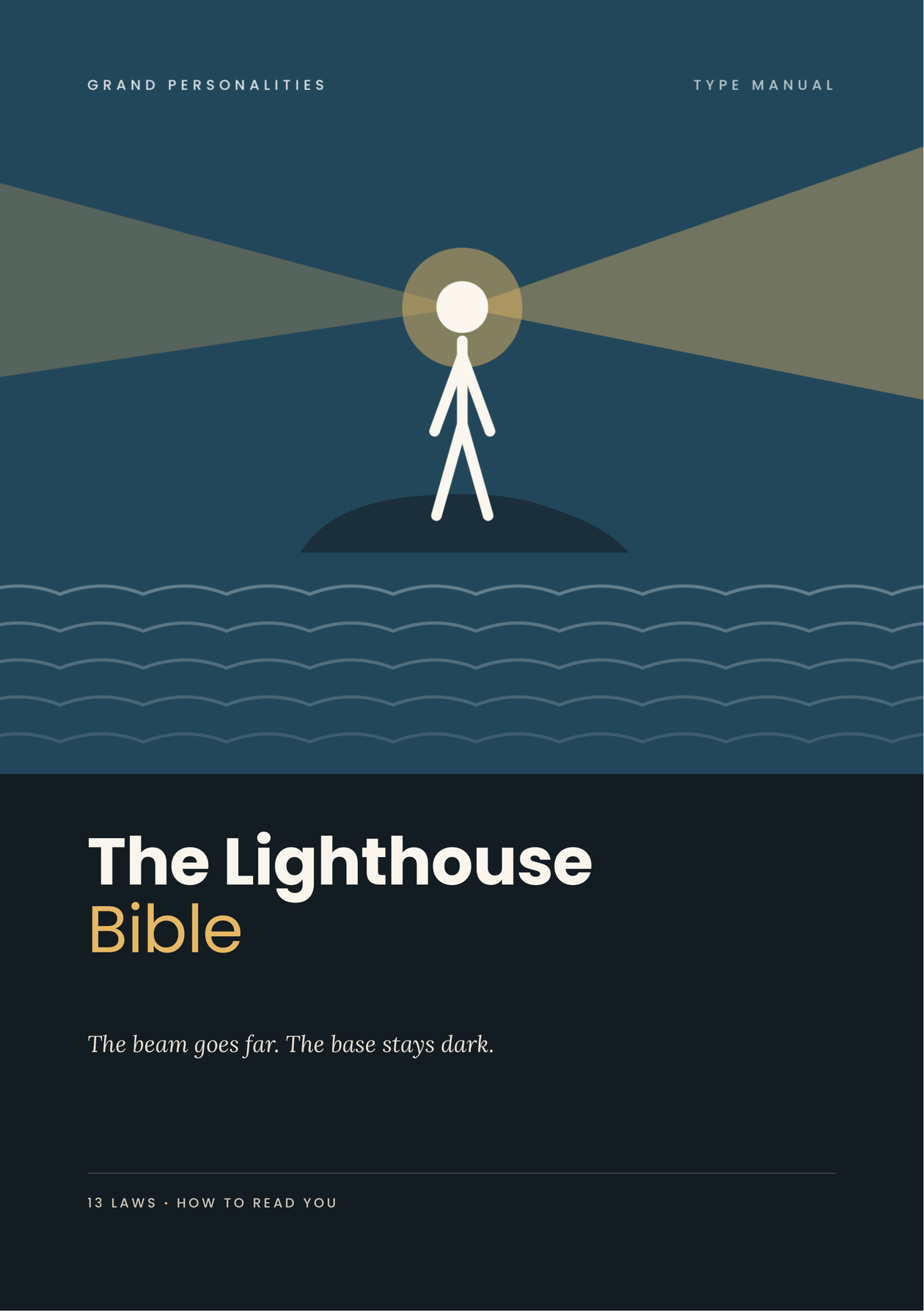
If you’re the INFJ
The Lighthouse Bible
The beam goes far. The base stays dark.

If you’re the INFP
The Aurora Bible
Nothing by day. Then the whole sky at once.
- The LighthouseINFJQuiet, certain, and already three moves into a future you can feel but can’t prove yet.Read the free INFJ profile
- The AuroraINFPYou feel the whole room and keep most of it. What you make of it comes out later, whole.Read the free INFP profile
Famous INFJs in historyINFJFamous INFPs in historyINFP
Also compared
Compatibility