Which one are you?
INFJ vs INTJthe Lighthouse or the Observatory
By Grand Personalities · Updated
The difference: F vs T
The one difference that matters
INFJ and INTJ lead with the same kind of mind: a quiet, long-range sense of where things are going, built from small signals nobody else bothered to add up. The difference is what each one is watching. A friend announces she’s moving in with someone she met three months ago. Both of them saw it coming. The INFJ noticed she goes quiet whenever he mentions his ex, and already has a feeling about how the second year looks. The INTJ noticed the apartment is an hour from her office and the lease has no break clause, and has already worked out what that costs her if it ends.
The INFJ (the Lighthouse on this site) turns that foresight on people and pairs it with close attention to the mood between them. So their next question is how to say it, or whether to say it at all, and many warnings never leave their head. The INTJ (the Observatory) turns it on systems and pairs it with a drive to organize the outside world. So their next move is a fix, delivered as a conclusion. The INFJ asks the friend “Are you happy?” and listens to the pause. The INTJ asks “Have you read the contract?” and means it just as kindly.
Both get called hard to read, for different reasons. The INFJ is called intense or mysterious, because weeks of quiet end in one serious sentence that shows they were watching all along. The INTJ is called arrogant, because they hand over a verdict with none of the working. Their care runs in different directions too. The INFJ remembers how a friend takes bad news and plans the conversation around it. The INTJ remembers which of that friend’s problems is still unsolved and turns up with a solution.
Side by side
INFJ and INTJ, compared
| INFJLighthouse | INTJObservatory | |
|---|---|---|
| Seeing ahead | Where a person or relationship is heading, and how it will feel. | Where a plan, process or market is heading, and what will break. |
| Bad news to deliver | Waits for a safe moment, softens it, sometimes never says it. | States the conclusion plainly. How it sounded reaches them last. |
| A friend in trouble | Answers the hurt the friend hasn’t mentioned yet. | Takes the problem away and comes back with options. |
| What goes on file | The effort nobody noticed. The time nobody asked how they were. | The same failure twice. A call that didn’t survive a second look. |
| A new boss | Needs to believe in where the boss is taking things. | Quietly checks whether the boss’s reasons hold up. |
| In a group decision | Notices who’s uneasy and what the choice will cost them. | Finds the one problem feeding all the others. |
| Learned on purpose | Talking about themselves, and treating their own wants as reasons. | Warmth: the follow-up question, looking glad to see people. |
| Under stress | Tidier, then a lost weekend. Looks a lot like the INTJ. | More contingencies, then a lost night. Looks a lot like the INFJ. |
Six questions
How to tell which one you are
- 01When I can tell how something will end, what am I looking at?If it’s people, a friend’s new romance or a colleague who is about to quit, you’re probably the INFJ. If it’s systems, a project timeline that won’t hold, a process that will fail by spring, a decision with a hidden cost, the INTJ.
- 02What do I do with a hard truth someone needs to hear?If you hold it until it’s safe and useful to say, and the moment often never comes, you’re probably the INFJ. If you say it as soon as it’s clear and only later find out how it landed, the INTJ.
- 03When someone close says I never make time for them, how do I answer?If your first instinct is to check the “never” against the facts and offer dates, you’re probably the INTJ. If you hear the hurt under it straight away and answer that, sometimes before they’ve finished the sentence, the INFJ.
- 04What makes me quietly drop someone?If it’s a pile of small things, effort they didn’t notice, the question they never asked back, until one day their story has ended in your head, you’re probably the INFJ. If it’s being let down the same way twice, after which they simply get less of your time and fewer real opinions, the INTJ.
- 05What wears me out fastest at work?If it’s losing faith in why the work matters, or carrying colleagues’ private worries you can’t use, you’re probably the INFJ. If it’s waste, processes that exist only because they always have, or working in a group on the wrong problem, the INTJ.
- 06What part of being around people did I have to learn deliberately?If warmth was the project, learning the follow-up question and how to look glad at the door, you’re probably the INTJ. If warmth came easily and what you had to learn was talking about yourself without reading their face for boredom, and treating your own wants as worth defending, the INFJ.
Mistyping
Why people mix them up
INFJ and INTJ get confused because they share the lead habit and the stress pattern. Both go quiet, plan years ahead, keep a small circle and would take one long conversation over a party. Under pressure both tighten first and then lose a night or a weekend to screens, food or doing nothing. So the stress questions in a test can’t separate them, and the T/F questions often get misread as “Do you have feelings?” An INTJ who loves their people answers like an F. An INFJ in an analytical job, where logic is what gets rewarded, answers like a T.
A cleaner test is what you do with what you see. INFJs protect people from it until the moment is right. INTJs act on it and explain later, if at all. Another clue sits in what each one keeps to themselves. The INFJ fights hard for everyone else’s fairness and rarely for their own wants, so people decide they have principles and no preferences. The INTJ gives friends excellent advice and rarely mentions a problem of their own until it’s already solved, so it arrives as news. Even their silences differ. An INFJ’s quiet is usually them deciding whether saying something would help; an INTJ’s is usually them finishing the model before they speak. Look at which of these you’ve been doing for years rather than last month. Types describe habits, and anyone near the line will see some of both.
Love
The INFJ and the INTJ in love
The INFJ would rather wait years than settle, and when they choose, they commit to who the person could become. That’s generous and risky. They idealize early, then feel let down when the real person appears, and the partner never knew they were being measured. In a fight the INFJ doesn’t shout. They go quiet, and the partner feels marked without seeing the marks. Arguments often start because the INFJ answers the question a partner didn’t ask, replying to the hurt underneath “I’m fine”.
The INTJ watches, decides, and then stays loyal without repeating it, because the decision feels obvious from inside. Their weak spot is treating a complaint as a claim to be checked. A partner says the INTJ is always working late, and the INTJ points out it was only three evenings this month, which is true, wins the point and misses what was asked: where the partner sits on their list. Then they rerun the fight alone for days, conceding things the partner never hears about. Both types need time alone after a fight. The INFJ needs to come back to a slow, honest talk.
Work
The INFJ and the INTJ at work
At work the INFJ is often the colleague people take aside, so they tend to know which colleague is scared for their job and which one has an interview elsewhere, and can’t repeat any of it where it would help. They do well in strategy, developing people, writing, design and advising, anywhere reading people over years is the actual job. The finished version of a project already exists in their head, which makes the rough real one hard to look at, and a plan that slips midweek often waits for a clean restart rather than a patch. Because they say little in meetings, workplaces that reward the quickest opinion can overlook them for years. Their risk is a plan they carry alone, never asking for help, until they burn out and resent the colleagues who didn’t offer.
The INTJ is happiest on a problem that will take a year and actually matters, and would happily spend a month alone on the problem that matters rather than a week in workshops on the one that doesn’t. In a list of twenty problems they find the one causing the other nineteen, and panic and hype barely move them, so teams lean on them when a decision matters. Their slow calls often pay off two years later and get mistaken for luck, and pointing that out feels vain to them. Waste wears them down faster than hard work does. Their risk is impatience: they can look down on colleagues who reach the same conclusion a month later, and those colleagues feel it even when nothing is said.
Together
When an INFJ meets an INTJ
Neither is the other’s best match on this site: the Lighthouse’s is the Bonfire (ESFP), and the Observatory’s is the Beacon (ENFJ). They’re a well-known pairing in personality circles, often described as two versions of the same mind. The appeal is real: both think in years, both want depth, both can share a long silence without strain, and each feels understood without having to be walked there. Where they split is the fourth letter. The INTJ’s reasons land cold on the INFJ, who files the hurt without a word. The INFJ’s quiet distance gets read by the INTJ as a problem to analyze rather than a person to reach. Because both withdraw after friction, nobody starts the repair. As friends they can go months without speaking and pick up mid-thought, which suits them both.
FAQ
Questions people ask
What is the difference between INFJ and INTJ?
The difference between INFJ and INTJ is what their foresight is aimed at. Both see where things are heading early, but INFJs watch people and weigh how to say it kindly, while INTJs watch plans and systems and move straight to a fix. The gap shows most in how each one delivers bad news and what each one notices first.
How do I know if I’m an INFJ or an INTJ?
Look at what your predictions are usually about. INFJs mostly sense where friends, relationships and teams are heading; INTJs mostly sense where projects, processes and decisions are heading. INFJs also tend to hold a hard truth back until the moment is right, while INTJs say it and learn later how it sounded. Taking the site’s free test can settle it if you recognize yourself in both.
Are INFJ and INTJ compatible?
Neither is the other’s best match on this site. INFJ and INTJ share long-range thinking and a need for depth, so the early connection can feel easy. The friction is that INTJ reasons can feel cold to an INFJ, and both types withdraw after conflict, so often nobody starts the repair.
Are INFJs just emotional INTJs?
No. INFJs use logic well, but they apply it after reading the people involved, and their decisions weigh what a choice will do to a life years from now. INTJs organize around what works and fold feelings in later, sometimes too late. The F and T describe what each type weighs first, not whether either one can think or feel.
What are the cognitive functions of INFJ vs INTJ?
INFJ runs Ni-Fe-Ti-Se and INTJ runs Ni-Te-Fi-Se. Both lead with the same sense of where things are heading and share the same last function, which is why their stress looks so alike. The middle is swapped: the INFJ turns next to the mood between people, the INTJ to organizing the outside world efficiently.
Why do INFJs often test as INTJ?
INFJs often test as INTJ when their work rewards analysis, or when they read the F questions as “Are you emotional?” and answer no. Both types are reserved, strategic and private, so most test items fit both. The better clue is whether your first instinct with a problem is to protect the people in it, which points to INFJ, or to fix the system behind it, which points to INTJ.
Still torn between INFJ and INTJ?
The free test settles it in a few minutes. No email needed.
Take the free testThe Bibles
Read both openings. Yours is the one that reads like your week.
Each type has its own Bible: the patterns that type keeps repeating, and the plays that answer them. The opening chapter of every Bible is free to read.
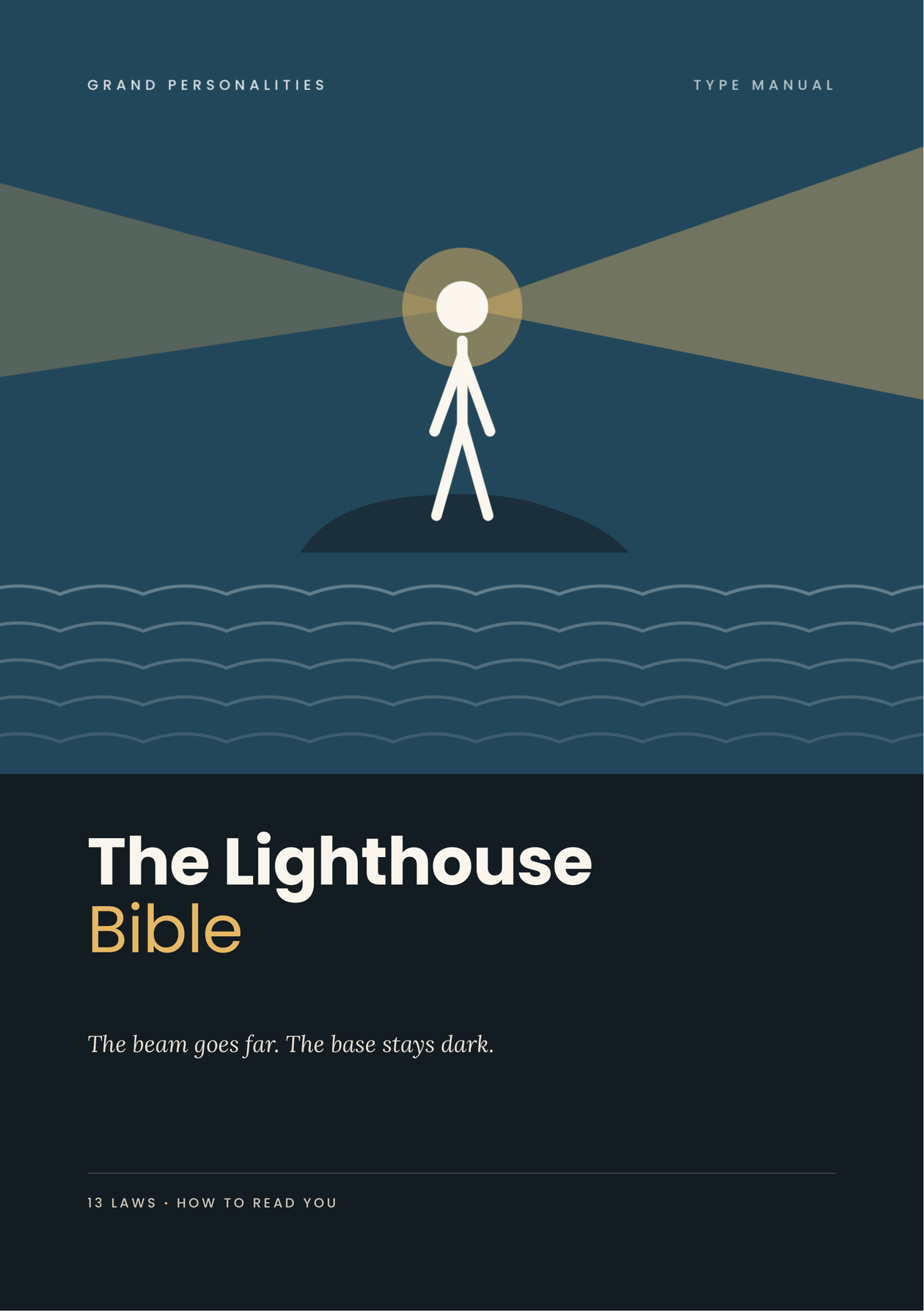
If you’re the INFJ
The Lighthouse Bible
The beam goes far. The base stays dark.
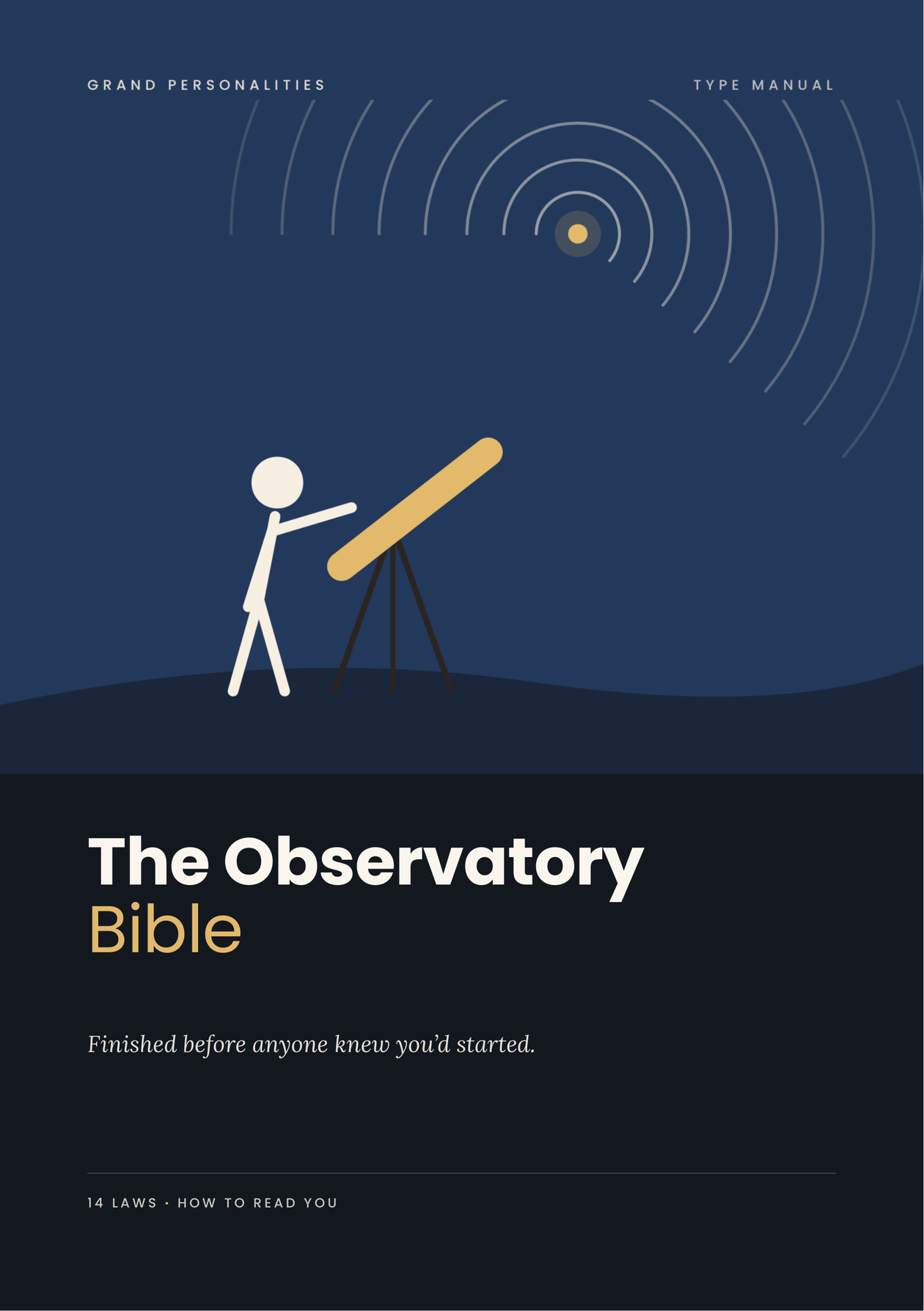
If you’re the INTJ
The Observatory Bible
Finished before anyone knew you'd started.
- The LighthouseINFJQuiet, certain, and already three moves into a future you can feel but can’t prove yet.Read the free INFJ profile
- The ObservatoryINTJYou build the whole model before you speak, then defend it like it cost you something. It did.Read the free INTJ profile
Famous INFJs in historyINFJFamous INTJs in historyINTJ
Also compared
Compatibility