Which one are you?
INFP vs INTPthe Aurora or the Labyrinth
By Grand Personalities · Updated
The difference: F vs T
The one difference that matters
INFP and INTP share the same middle: both wander between ideas, keep options open, start more than they finish and need long stretches inside their own heads. What separates them is the judge sitting at the front. Picture a friend reading out the speech she’s written for her father’s sixtieth. The INFP hears the one paragraph where she’s being polite instead of honest, and says gently that the story about his old bicycle is the part that sounds like her. The INTP notices the story puts the bicycle in a year before he could ride, and that the closing joke hangs on a word with two meanings.
The INFP (the Aurora on this site) judges by an inner sense of right: how people should be treated, what’s worth making, who they themselves are. The INTP (the Labyrinth) judges by an inner sense of logic: whether the parts fit, whether the word is exact, whether the claim survives its best objection. Both are stubborn in the same quiet way, about different things. Ask the INFP to laugh along at a cruel joke about a colleague and they won’t, however much the table pushes. Ask the INTP to accept a rule because “that’s how we do it here” and they may comply, then stop taking the person who said it seriously.
Their kindness and their cold spots fall in opposite places. The INFP stays kind to people they can’t stand, because for them kindness is a rule rather than a mood. The INTP forgives someone who hurt them with a good explanation, and tunes out someone who simply made no sense. Grief shows it too. The INFP writes the message after a funeral that the family keeps in a drawer for years. The INTP is dry and useful at the service, sorting the lifts and carrying chairs, then cries alone a week later at a film they’d already called manipulative.
Side by side
INFP and INTP, compared
| INFPAurora | INTPLabyrinth | |
|---|---|---|
| A friend’s draft | Finds what’s alive in it, and says so first. | Finds what doesn’t hold, and stops at the third flaw. |
| Digs in when | Asked to go along with something unkind or unfair. | Told to follow a rule nobody can explain. |
| The unfinished drawer | It came out smaller than the version in their head. | Once they understood it, finishing felt like copying out. |
| Someone cries | Takes it all in. The friend’s bad day becomes the INFP’s bad week. | Goes still, reaches for a tissue, finds the right words days later. |
| Asked “Are you happy?” | Wants to answer properly, later, ideally in writing. | “Yes,” followed by two exceptions, to be accurate. |
| A strong feeling | Treats it as evidence that their read is right. | Argues with it, then meets it later, alone. |
| Under strain | Mild outside, red pen inside. Everyone else looks careless. | Their mind slows, and the slowness scares them more than the problem. |
| Work they love | Prices it at nothing when a friend offers to pay. | Explains it more clearly than the people who taught them. |
Six questions
How to tell which one you are
- 01When a friend shows me something they’ve made, what do I find first?If you find what’s alive in it, and what it says about them, you’re probably the INFP. If you find the weak joint, the claim that doesn’t follow, and you see looking that closely as a compliment, the INTP.
- 02What makes me dig my heels in?If it’s being asked to join in with something unkind or unfair, and no argument will move you, you’re probably the INFP. If it’s a claim or a rule that doesn’t add up, and you’d happily argue the logic for an hour, the INTP.
- 03Why is that project still sitting unfinished?If it’s because the real thing came out clumsier than the one in your head and looking at it hurts, you’re probably the INFP. If it’s because you worked out how it goes and finishing it now feels like copying out, the INTP.
- 04When someone I love cries in front of me, what happens inside?If their feeling floods into you and you carry it for days, often without telling them, you’re probably the INFP. If your mind goes blank, your face freezes and you reach for the one practical thing in sight, then rehearse the right sentence all week, the INTP.
- 05How do I usually show someone I love them?If it’s through the true thing said carefully, often in a message written late at night, you’re probably the INFP. If it’s through close attention to how their mind works, with questions they sometimes mistake for an interrogation, the INTP.
- 06What does a bad month look like from inside?If you stay outwardly calm while a sharp, critical voice takes over and everyone around you starts looking incompetent, you’re probably the INFP. If your thinking slows to a crawl, you read the same page four times, and the fog frightens you more than whatever caused it, the INTP.
Mistyping
Why people mix them up
INFP and INTP get swapped because they share so much: both chase possibilities, both like the familiar once it’s settled, both are slow to finish and quick to wander. Both are quiet with strangers and loyal for years once someone is let in. Online, the split usually gets drawn as “feels a lot” versus “thinks a lot”, and that’s the trap. INTPs feel plenty; they just meet the feeling late and alone. INFPs think hard, about values and meanings rather than mechanisms. So an emotional INTP tests as INFP, and an INFP with a science degree tests as INTP. Both types also keep folders of nearly finished work and both resist a shared calendar, which makes the lifestyle questions in most tests useless for telling them apart.
A better question is what you’re protecting when you dig in. The INFP is protecting a standard of how people should be treated, and of who they are. The INTP is protecting accuracy. Watch who gets tuned out, too. An INFP rarely drops someone for being illogical, but a cruel remark about someone absent can change how they see a person for good. An INTP will forgive a hurtful remark with a good reason behind it, and quietly stop hearing someone after one moment of nonsense. Listen to your own language as well. INFPs tend to say “That doesn’t feel right”; INTPs tend to say “That doesn’t follow.” Over months, one of those sentences will be yours far more often than the other. Types are patterns rather than boxes, and people close to the line will hear themselves in both.
Love
The INFP and the INTP in love
INFPs love intensely and want to be seen whole, including the parts they usually hide. Hurt builds quietly. Each thing is too small to raise, so it gets argued out at night instead, with the INFP writing both sides, and the partner’s side gets a little less reasonable each round. Then something minor tips it, months come out at once, and the partner defends the one small thing they can see. A passing comment about their taste or their work can sting for weeks, because both sit so close to who they are.
INTPs fall for a mind and show affection by paying close attention to it. Their questions are how they say they care, which is why a partner can hear cross-examination where the INTP meant interest, especially when they bring a feeling home and get asked what caused it. Their honesty has an odd cost too. Asked if they’re happy, an INTP adds two exceptions to be precise, and the exceptions are what the partner remembers. When a partner cries, the INTP’s face goes still because there’s nothing for their mind to work on, and the right words arrive days after they were needed. The complaint an INTP hears most at home tends to be about distance rather than fights: a whole dinner where they nodded along while working on something else behind their eyes.
Work
The INFP and the INTP at work
An INFP does best in a job with a purpose they can name and room for a voice that’s recognizably theirs: writing, design, counseling, teaching, any job where the person at the end matters. They’ll hold firm on a point of principle in a meeting long after louder colleagues have folded. People keep what they write, from a leaving card to a difficult email that somehow made everyone feel fairly treated. Their risk is underpricing. Work they love they’ll do for a coffee, because naming a figure feels like a claim about its worth that they can’t quite stand behind.
The INTP wants a hard problem and freedom over the method. They judge ideas on their reasons, so a junior’s suggestion gets the same hearing as the director’s, and once they understand a system they can explain it plainly to anyone. Their risk is treating flaw-finding as the whole job and leaving the rebuilding to someone else, who quietly resents it.
Together
When an INFP meets an INTP
Neither is the other’s best match on this site: the Aurora’s is the Garrison (ESTJ), and the Labyrinth’s is the Beacon (ENFJ). As friends, they can wander through an idea for an evening, neither in a hurry to land, and both are comfortable with a long quiet. The strain arrives when the INTP turns the inspection on something the INFP holds close. A question about whether a feeling makes sense sounds to the INFP like a question about whether they make sense. And the INFP’s “it just feels wrong” gives the INTP nothing to work with, so they push for a reason, which makes it worse. Each also gives the other something useful: the INTP gives the INFP’s instincts reasons they can defend in public, and the INFP reminds the INTP that a correct answer can still be unkind. Neither of them will book the restaurant.
FAQ
Questions people ask
What is the difference between INFP and INTP?
The difference between INFP and INTP is the test each one applies first. INFPs ask whether something is right and true to who they are; INTPs ask whether it’s logically sound. Both are curious, private and slow to commit, so the gap shows when they dig in, give feedback or face someone else’s tears.
How do I know if I’m an INFP or an INTP?
Notice what makes you refuse. If it’s unkindness or unfairness, you’re probably an INFP; if it’s a claim that doesn’t add up, probably an INTP. Your feedback is another clue: INFPs find what’s alive in someone’s work, INTPs find what doesn’t hold. The free test here can help if neither answer is clear-cut.
Are INFP and INTP compatible?
Neither is the other’s best match on this site. INFP and INTP share curiosity and a love of long, open conversations. The friction comes when INTP questions land on INFP values.
Do INTPs have feelings?
INTPs have strong feelings, but they rarely meet them in the moment. An INTP is often calm and practical during a crisis and moved later, alone, by something smaller. That delay is why INTPs get called cold and why some emotional INTPs wrongly decide they must be INFP.
What are the cognitive functions of INFP vs INTP?
INFP runs Fi-Ne-Si-Te and INTP runs Ti-Ne-Si-Fe. They share the same middle two, which is why both wander between ideas and lean on the familiar. The lead differs: the INFP leads with personal values, the INTP with an inner logic check. Their least-used sides are opposite too, which is why INFP stress turns critical and INTP stress turns to fog and, if it tips over, to tears or anger.
Can an INFP be logical?
Yes, INFPs can be very logical; they just put values first when deciding what matters. An INFP will reason carefully about a moral question or a piece of writing, and under long stress their organized, critical side can take over completely. INFP describes what someone weighs first, not what they’re capable of.
Still torn between INFP and INTP?
The free test settles it in a few minutes. No email needed.
Take the free testThe Bibles
Read both openings. Yours is the one that reads like your week.
Each type has its own Bible: the patterns that type keeps repeating, and the plays that answer them. The opening chapter of every Bible is free to read.

If you’re the INFP
The Aurora Bible
Nothing by day. Then the whole sky at once.
If you’re the INTP
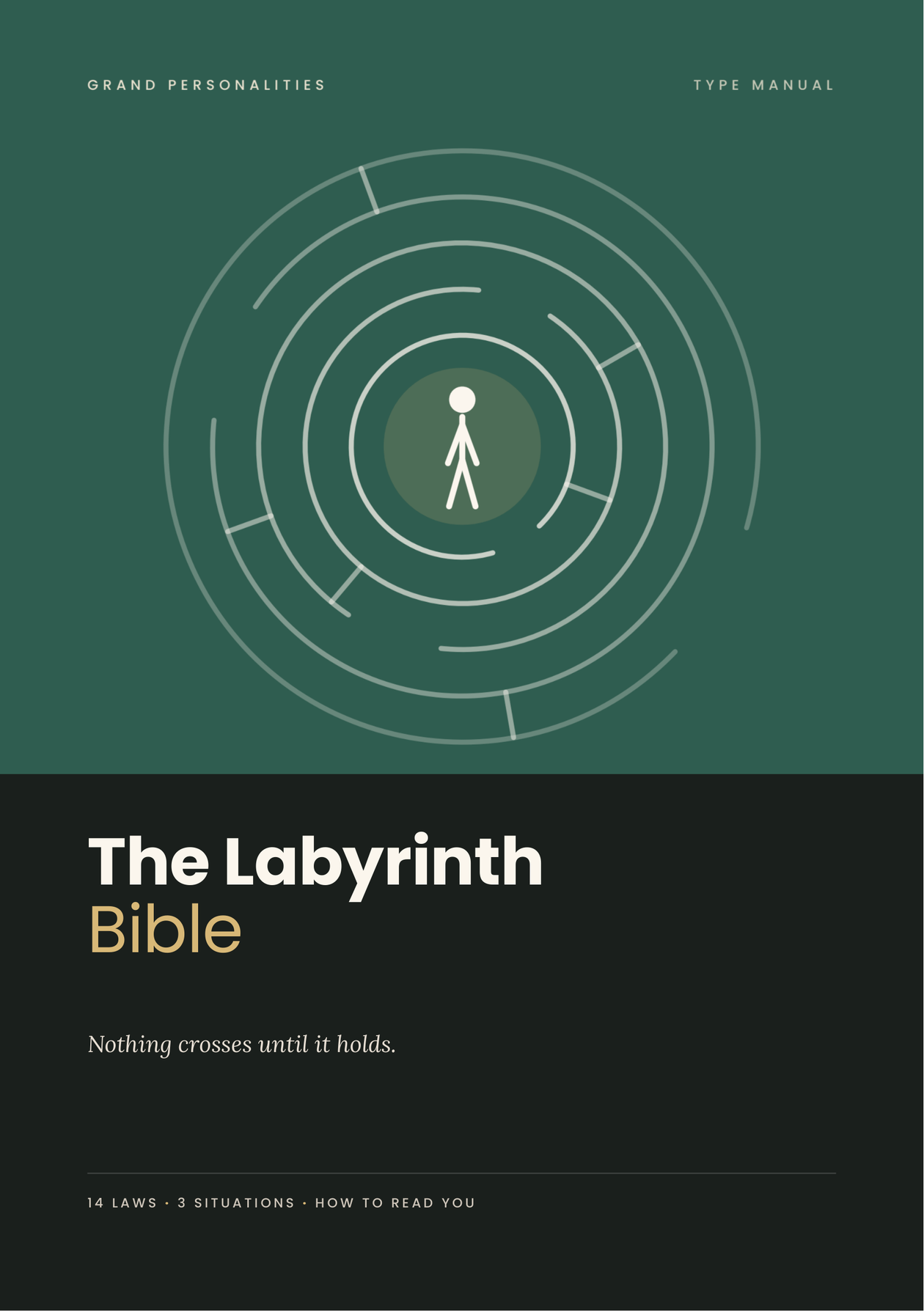
The Labyrinth Bible
Nothing crosses until it holds.
- The AuroraINFPYou feel the whole room and keep most of it. What you make of it comes out later, whole.Read the free INFP profile
- The LabyrinthINTPYou take the idea apart because loving it isn’t the same as it being true.Read the free INTP profile
Famous INFPs in historyINFPFamous INTPs in historyINTP
Also compared
Compatibility