Which one are you?
INTJ vs INTPthe Observatory or the Labyrinth
By Grand Personalities · Updated
The difference: J vs P
The one difference that matters
INTJs and INTPs share three letters, and it shows: both go quiet, think hard and trust reasons over volume. The fourth letter is about what happens when the thinking ends. Picture both of them spending a Sunday reading about moving their pension. By evening the INTJ has picked a provider, filled in the transfer form and stopped thinking about it. The INTP now understands exactly how the fees work, has found a mistake in a comparison site’s math, and hasn’t opened an account.
The INTJ (the Observatory on this site) thinks in order to decide. They build the whole model in private, throw out the weak versions and come out with one answer and a plan. The INTP (the Labyrinth) thinks in order to understand. They take an idea apart to see if it holds, starting with the ones they like best, and a finished conclusion is still something they’re willing to test. Friends notice it in small ways. Ask the INTJ whether the new route to work is quicker and you get “Yes, by ten minutes.” Ask the INTP and you get “Usually, unless the bridge is up.”
Both get called cold, for opposite reasons. The INTJ hands people a verdict with no reasons attached. The INTP hands them reasons with no verdict. And J vs P has nothing to do with tidiness here: plenty of INTJs have a chaotic desk and a five-year plan, and plenty of INTPs keep a spotless flat and still won’t commit to a date for the party. In a group chat about a trip, the INTJ replies with the cheapest flight and a date to book it by. The INTP replies with one sharp question about the hotel, and somebody else ends up booking.
Side by side
INTJ and INTP, compared
| INTJObservatory | INTPLabyrinth | |
|---|---|---|
| In a meeting | Knows early where it should end up and quietly steers it there. | Looks absent, still chasing a point from twenty minutes ago. The answer arrives two days later. |
| Asked “Will it work?” | “Yes, if we do these three things.” | “Probably. It turns on two things.” |
| A friend’s plan | Rebuilds it into a better plan, with dates. | Finds three flaws, then stops when the interest runs out. |
| Unfinished work | Rare. The result was the point. | A folder of nearly finished things. Understanding was the point. |
| What grates | A process that exists only because it always has. | Someone saying “always” when they mean “twice”. |
| Shared calendar | Probably set it up, and keeps it current. | Resists it, then misses the dentist. |
| Under stress | More backups, skipped lunches, nothing done for fun. | Sharper, then quiet, then foggy: lost keys, three jobs started. |
| Showing care | Takes the problem away, returns weeks later with a way out. | Spends an evening helping them think the decision through. |
Six questions
How to tell which one you are
- 01When someone asks me for a straight yes or no, what comes out?If you give the yes or no and then the plan to make it happen, you’re probably the INTJ. If you give the honest shape of it (“probably, and it turns on two things”) and watch the other person look disappointed, the INTP.
- 02What do I do when someone raises a clever objection to something I’ve already settled?If you check whether it changes the outcome and, when it doesn’t, feel irritated that the matter is being reopened, you’re probably the INTJ. If part of you lights up and you start taking your own position apart in front of them, the INTP.
- 03What happens to my projects once I understand how they work?If you finish them, because the result was the point all along, you’re probably the INTJ. If they sit in a folder nearly done, because understanding was the interesting part and finishing feels like copying out, the INTP.
- 04Where is my mind in a long meeting?If you decided early where the meeting should end up and spend it nudging people there, you’re probably the INTJ. If you’re still turning over something someone said twenty minutes ago, and the good answer reaches you two days later, the INTP.
- 05What annoys me more: a wasteful process or a careless word?If a process that exists only because it always has makes you want to redesign it on the spot, you’re probably the INTJ. If someone saying “always” when they mean “twice” bothers you for the rest of the conversation, the INTP.
- 06What does my stress look like from the outside?If it looks like a better plan, with more contingencies, skipped lunches and nothing done for fun, until a night lost to snacks and screens, you’re probably the INTJ. If you get sharper, then quiet, then foggy, reading the same paragraph four times and starting three small jobs without finishing one, the INTP.
Mistyping
Why people mix them up
These two get mixed up more than almost any other pair, because the first three letters cover most of what people see: quiet, analytical, more interested in whether something is true than whether it’s popular. Online tests then try to separate them with questions about schedules and tidy rooms. An INTJ with a messy kitchen answers honestly and gets told they’re an INTP. An INTP whose job runs on deadlines answers about their working week and gets told they’re an INTJ.
The better test is what happens in your head when a question gets hard. INTJs narrow toward one answer, sometimes too early, and then defend it like it cost them something. INTPs widen, adding exceptions and possibilities, and are comfortable leaving a question open for weeks. There’s a second trap. An INTJ in the research phase of a big decision can look endlessly curious, and an INTP talking about a subject they took apart years ago can sound completely certain. Another clue is how each one drops people. The INTJ quietly gives less time to someone who let them down the same way twice. The INTP stays friendly but stops hearing someone after one moment that made no sense, such as a rule defended with “because I said so”. Judge by the usual pattern over months, not by one week. Types are patterns, not destiny, and someone near the line will see themselves in both.
Love
The INTJ and the INTP in love
INTJs don’t fall casually. They watch someone for a while, decide, and the decision holds. Love shows up as attention: something a partner mentioned in spring gets acted on in autumn. The trouble is that their commitment feels obvious to them, so they think they’ve already said it. When a partner asks for reassurance, the INTJ hears a settled question being reopened and answers with reasons. The reasons are right and still land cold. After a fight they go off alone first, and want to explain what went on inside later. A partner may find the INTJ has researched the boiler, the mortgage and the vacation without once saying “I was worried about you.” What they say is “I looked into it.”
INTPs fall for a mind, usually after a conversation that went somewhere unexpected, and they’re slow to say so. Once in, they stay, and years later they’re still curious about how their partner thinks. Their questions are how they show affection, which goes wrong when a partner brings a feeling home after a long day and gets asked what caused it and whether it fits. Partners of INTPs rarely complain about disagreement. They complain about absence: the evening the INTP was on the sofa but their mind was on a problem, somewhere the partner couldn’t follow. After a fight the INTP often changes their view and expects that to count as an apology.
Work
The INTJ and the INTP at work
The INTJ wants hard problems, long horizons and real stakes: strategy, systems, planning, anything where getting it right matters more than saying it fast. They redesign processes that survive only out of habit, and in the first weeks with a new boss they quietly check whether the boss’s reasons survive a second look. Much of their best work is a problem that never happened, which is hard to get credit for. As colleagues they’re easy to trust and hard to read. Asking someone how they reached a decision is genuine interest for an INTJ, but it can land like an audit. And a boss who fails their private check gets public agreement while the real questions go to someone else.
The INTP is most useful at the two ends of a problem: early, when it has no shape yet, and late, when something is broken and nobody knows why. Debugging, analysis, research and investigation suit them. They want the problem and freedom over the method; a weekly meeting about the route kills their interest. In meetings they can be doing the most useful thinking in the room and look as if they’ve left. Their weak spot is the finish: once they understand how something works, completing it feels like copying out. And because they won’t say “definitely”, the project often goes to whoever did.
Together
When an INTJ meets an INTP
Neither is the other’s best match on this site: both the Observatory’s and the Labyrinth’s is the Beacon (ENFJ). Together they’re two careful minds with very good arguments. They can spend a whole dinner on whether a theory holds and both go home pleased. The strain comes from the fourth letter. The INTP keeps reopening what the INTJ thinks is closed, and the INTJ’s “I’ve decided” can sound to the INTP like “because I said so”, the kind of answer that makes an INTP stop listening. Meanwhile nobody books the boiler service, because one of them is planning something bigger and the other is still comparing engineers. As friends they’re at their best on a shared project, where the INTJ sets the direction and the INTP tests it while there’s still time to change course.
FAQ
Questions people ask
What is the difference between INTJ and INTP?
The difference between INTJ and INTP is what each does with a conclusion. INTJs settle on an answer and organize a plan around it; INTPs keep testing the answer in case a better objection turns up. Both are quiet and analytical, so the gap shows most in decisions, deadlines and unfinished projects.
How do I know if I’m an INTJ or an INTP?
Notice what you do when someone asks you for a yes or no. INTJs give one and the plan behind it; INTPs give “probably” and the two things it depends on. A folder of nearly finished projects points to INTP, and irritation when a settled matter is reopened points to INTJ. If you’re still unsure, take the free test on this site.
Do INTJs and INTPs get along?
Neither is the other’s best match on this site. As colleagues and friends, INTJs and INTPs usually get along well: they respect each other’s minds and enjoy a hard argument. The friction is that INTPs reopen questions INTJs consider settled.
Which is smarter, INTJ or INTP?
Neither. INTJ and INTP describe how someone prefers to think and decide, not how much ability they have. An INTJ’s strength is seeing where things are heading and planning for it; an INTP’s is naming the exact assumption, number or word that breaks an argument. Both types include brilliant people and ordinary ones.
Are INTJs more organized than INTPs?
INTJs are usually more organized about plans and decisions, though not always about their homes. The J in INTJ means they deal with the outside world by settling things. The P in INTP means they prefer options kept open, so INTPs often resist shared calendars and fixed deadlines even when their desk is neat.
What are the cognitive functions of INTJ vs INTP?
INTJ runs Ni-Te-Fi-Se and INTP runs Ti-Ne-Si-Fe. In plain words, the INTJ leads with one picture of where things are going, then organizes the outside world to get there. The INTP leads with an inner check of whether something is logically sound, then explores outward through possibilities. That is why INTJ thinking converges and INTP thinking keeps branching.
Can you be both INTJ and INTP?
Nobody is both INTJ and INTP at once, but some people sit near the line and recognize themselves in each. A deadline-heavy job, a stressful year or a long research phase can make one look like the other for a while. Look at your pattern over months: whether you usually close questions or keep them open.
Still torn between INTJ and INTP?
The free test settles it in a few minutes. No email needed.
Take the free testThe Bibles
Read both openings. Yours is the one that reads like your week.
Each type has its own Bible: the patterns that type keeps repeating, and the plays that answer them. The opening chapter of every Bible is free to read.

If you’re the INTJ
The Observatory Bible
Finished before anyone knew you'd started.
If you’re the INTP
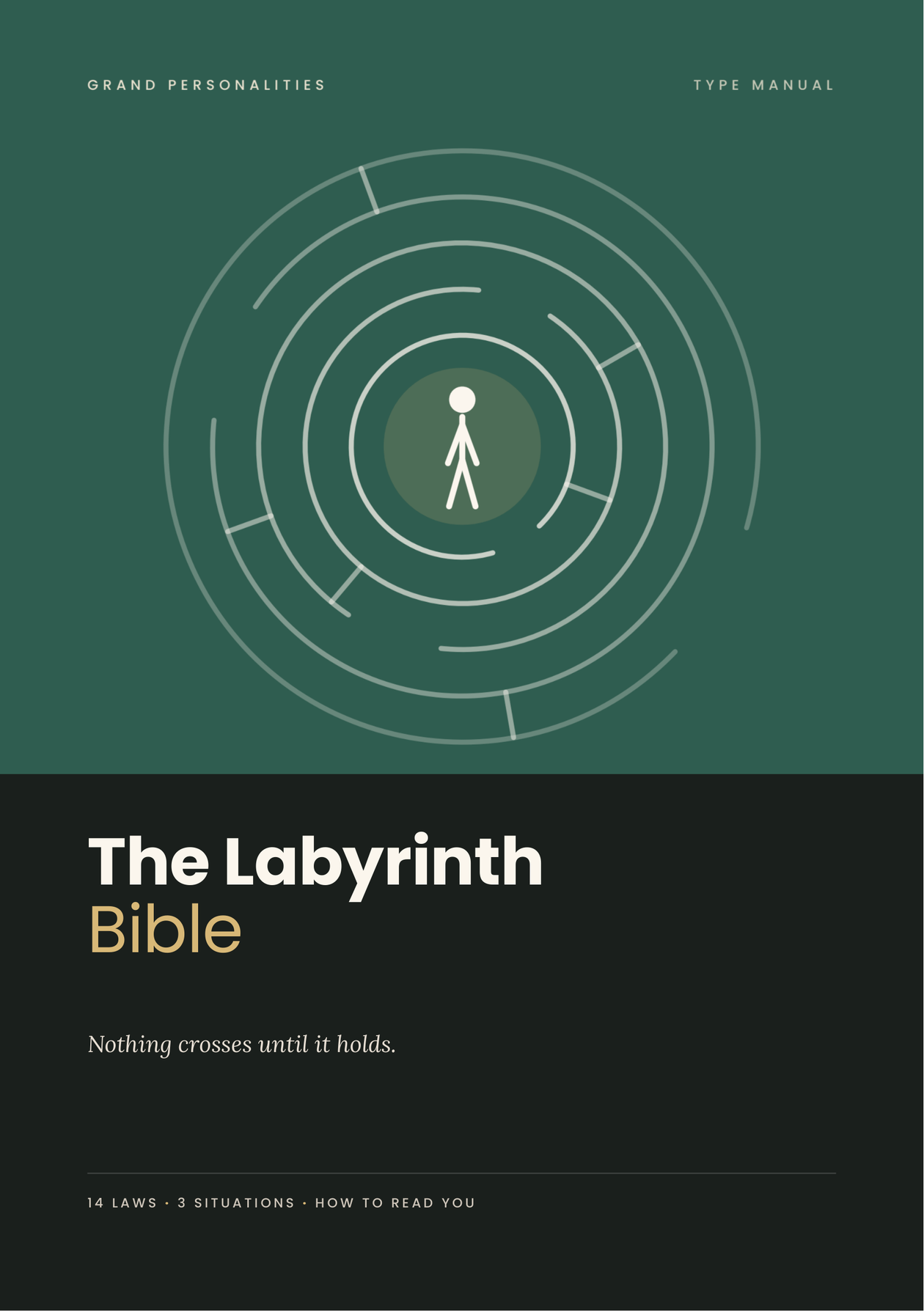
The Labyrinth Bible
Nothing crosses until it holds.
- The ObservatoryINTJYou build the whole model before you speak, then defend it like it cost you something. It did.Read the free INTJ profile
- The LabyrinthINTPYou take the idea apart because loving it isn’t the same as it being true.Read the free INTP profile
Famous INTJs in historyINTJFamous INTPs in historyINTP
Also compared
Compatibility