Which one are you?
ISTJ vs INTJthe Vault or the Observatory
By Grand Personalities · Updated
The difference: S vs N
The one difference that matters
ISTJs and INTJs share the I, T and J: both think before they speak, both like things decided, and both keep their word. The middle letter is about what they check a new idea against. Picture a friend asking both of them whether to take a job abroad. The ISTJ asks what the contract says about notice, whether anyone has looked at the tax side, and mentions a cousin who made the same move and what it cost. The INTJ asks where the friend wants to be in five years, and whether this job gets them closer or just gets them somewhere else. Both give good advice. One is built from what happened; the other from what will happen.
The ISTJ (the Vault on this site) holds the record. They know when the insurance renews, what was promised in spring and why a system at work was set up the way it was. Anything new gets checked against what came before: when was this tried, what did it cost, who kept their word. That makes them hard to fool and slow to be impressed, though the same change shown working beside the old way can win them over in an afternoon. The INTJ (the Observatory) builds a model of the future. A few early signals show them where something is heading, and they act while acting early still pays. They care less about how a thing was done before than about whether it’s the right thing to be doing at all.
You can see the gap when an office brings in a new booking system. The ISTJ asks who will own the records, keeps the old spreadsheet running alongside it for a month, and catches the two bookings that would otherwise have vanished. The INTJ has already decided whether the new system will still be in use in two years, and if the answer is no, sees the whole rollout as wasted effort. Both get called rigid. The ISTJ resists change that hasn’t proved itself; the INTJ resists a plan aimed at the wrong target.
Side by side
ISTJ and INTJ, compared
| ISTJVault | INTJObservatory | |
|---|---|---|
| A new idea at work | “When was this tried, and what happened?” | “Where does this leave us in three years?” |
| Making a big decision | Gathers what’s known, compares it with past cases, then decides. | Builds the model privately, discards the weak versions, then decides. |
| A long-standing routine | Keeps it going because it works and people rely on it. | Keeps it only while it still serves the goal. |
| Their memory | Exact: dates, promises, where the spare key lives. | Hazy on details, sharp on how the pieces fit together. |
| Free time | Rests properly only once nothing is left open on the list. | Happy with a week alone and one hard problem. |
| Under stress | Checks again, then again. Shoulders knot up overnight. | More backups, skipped lunches, then a night lost to screens. |
| Their word | Kept to the date. Managers quote it upstairs without asking. | Kept once the plan is settled. Reopening it irritates them. |
| What wears them down | Change for its own sake, and promises to them left unkept. | Waste, and having to argue a finished plan all over again. |
Six questions
How to tell which one you are
- 01When someone proposes a change, what’s my first question?If it’s some version of “has this been done before, and how did it go?”, you’re probably the ISTJ. If it’s “what is this actually for, and where does it lead?”, the INTJ.
- 02What do I remember best?If you remember specifics, such as the date of the last service, what someone promised in March and the exact wording of the email, you’re probably the ISTJ. If the details blur but you remember how a whole situation fitted together and why it went the way it did, the INTJ.
- 03How do I feel about the way something has always been done?If its long record counts in its favor, and you’d want to see the new way working beside it before you switch, you’re probably the ISTJ. If “we’ve always done it this way” makes you want to start again from a blank page, the INTJ.
- 04When I think about next year, what do I see?If you see a list, with what needs renewing, who is owed what and which jobs will come around again, you’re probably the ISTJ. If you see a direction, a few signals and where they point, with the details still to be filled in, the INTJ.
- 05What happens when I’m given an open task with no example to follow?If it can sit untouched for days because there’s no format and nothing to check it against, while a clear job gets done fast, you’re probably the ISTJ. If the open brief is the part you like best, because you get to design the thing from scratch, the INTJ.
- 06What does a day off with nothing planned do to me?If it leaves you flat or uneasy, and you only rest once every loose end is tied, you’re probably the ISTJ. If an empty, quiet day is close to ideal and you spend it happily inside one difficult idea, the INTJ.
Mistyping
Why people mix them up
ISTJs and INTJs are mixed up because from outside they behave alike: reserved, organized, blunt when asked, loyal once committed and unimpressed by noise. Both finish what they start and both get called cold. Tests then lean on questions about imagination, which is where it goes wrong. An ISTJ who books vacations a year ahead and reads history for fun can look future-minded and get told they’re an INTJ. An INTJ in a detail-heavy job, such as audit or engineering, answers about their working day and gets told they’re an ISTJ. Thinking about the future doesn’t make someone an N; what matters is what the thinking is built from.
The better test is the source of your confidence. ISTJs are sure because they’ve seen it: this worked last time, that person kept their word. INTJs are sure because they’ve modeled it: the parts fit, so it will go this way. Under pressure the difference sharpens. The ISTJ rechecks the thing they clearly remember checking, because one small slip raises the question of what else was missed. The INTJ adds another contingency to the plan and stops doing anything for fun. Read your pattern over a long stretch, not one unusual month. These types describe tendencies rather than limits, and someone close to the line will recognize both.
Love
The ISTJ and the INTJ in love
ISTJs (Vaults) show love as maintenance: tire pressures checked before a motorway drive, the bills settled, something a partner wished for two years ago quietly sorted. Saying “I love you” on cue feels hollow to them, so they say it seldom and a bit awkwardly, while in private they’re far softer than outsiders imagine. Trouble tends to start when a partner learns from a friend that the ISTJ had an awful week. The ISTJ meant to protect them; the partner feels left outside. After a row an ISTJ wants company without conversation, someone nearby doing something ordinary.
INTJs (Observatories) choose slowly and commit hard, then assume the commitment is obvious and doesn’t need repeating. Their particular trap is answering a feeling with evidence. A partner says “you’re never around for me,” the INTJ hears a factual claim, replies with dates and wins the argument while missing the question underneath, which was about where the partner ranks. Then they go quiet and replay the row alone for days, needing time by themselves when a partner may need closeness first. The ISTJ’s care is upkeep of the life the couple has now, and the INTJ’s is a plan for the life they’re heading toward. Neither volunteers the warm words often.
Work
The ISTJ and the INTJ at work
ISTJs thrive when they own a defined area and get time to do it right: finance, records, operations, the systems or code everyone else leans on, anywhere errors cost money. They deliver what the brief asked for, on the day, double-checked, and can be passed over for a colleague who padded theirs with extras nobody wanted. Their word holds so reliably that other people spend it for them. Promises made to them are kept far more loosely: the pay rise gets mentioned once, and the ISTJ never brings it up again either. Their quiet danger is becoming the only one who understands how something runs, which feels secure and makes every long vacation and every promotion harder to get.
INTJs are at their best on difficult problems with distant payoffs: strategy, design, analysis, long-range planning. They prefer working alone on the problem that matters to joining a team chasing the wrong one, and a procedure nobody can justify makes them itch to rebuild it. Their trap is planning in private, then resenting having to argue the plan again with people who were never consulted. When a slow call of theirs pays off years later, it tends to look like luck. On a team the two cover each other well. The INTJ decides where the work should go; the ISTJ makes sure it arrives intact, with nothing dropped on the way.
Together
When an ISTJ meets an INTJ
Neither is the other’s best match on this site: both the Vault’s and the Observatory’s is the Beacon (ENFJ). That says something about both: each does best beside a warm partner who brings their private thinking out into the open. Two quiet, decided people get on with little fuss. Neither needs constant talk, both keep their word, and each trusts the other’s competence early. The friction is about change. The INTJ wants to replace a system that works well enough; the ISTJ wants proof before giving up something reliable, and can read the INTJ’s confidence as guesswork. The INTJ, in turn, can find the ISTJ’s questions about precedent slow. They also share a blind spot: both store up a grievance rather than say it, so a problem can be months old before either mentions it.
FAQ
Questions people ask
What is the difference between ISTJ and INTJ?
The difference between ISTJ and INTJ is where their certainty comes from. ISTJs trust what has worked before and check new ideas against past experience; INTJs trust a model of where things are heading and judge ideas by where they lead. Both are reserved, decisive and reliable, so the difference shows most in how each reacts to change.
How do I know if I’m an ISTJ or an INTJ?
Notice your first question when someone proposes a change. If it’s “has this been tried, and how did it go?”, you lean ISTJ. If it’s “what is this for, and where does it lead?”, you lean INTJ. A sharp memory for dates and promises points to ISTJ; a feel for how a whole system fits together points to INTJ. The free test on this site can help confirm it.
Do ISTJs and INTJs get along?
Neither is the other’s best match on this site; both name the ENFJ (Beacon) as their best. ISTJs and INTJs usually get along well, because both are quiet, dependable and dislike fuss. Friction comes over change, since the INTJ wants to redesign what the ISTJ would keep until something better has proved itself.
Who is more stubborn, ISTJ or INTJ?
ISTJs and INTJs are stubborn about different things. The ISTJ holds on to a method that has worked and wants evidence before switching. The INTJ holds on to a conclusion they have already modeled and dislikes reopening it. Show an ISTJ the new way working beside the old and they may change in an afternoon; give an INTJ a better reason and they will change too, usually without announcing it.
What are the cognitive functions of ISTJ vs INTJ?
ISTJ runs Si-Te-Fi-Ne and INTJ runs Ni-Te-Fi-Se. They share the same two middle functions and differ only at the ends. The ISTJ leads with Si, which compares the present with a careful record of the past; the INTJ leads with Ni, which reaches for where events are heading. Both then organize the outside world with Te, which is why they can look so alike.
Can an ISTJ be mistaken for an INTJ?
An ISTJ is often mistaken for an INTJ, and the reverse. Both are private, organized and blunt, and an ISTJ who plans far ahead or an INTJ in a detail-heavy job can answer test questions like the other type. The clearest sign is whether your judgment rests on experience or on a model of the future.
Still torn between ISTJ and INTJ?
The free test settles it in a few minutes. No email needed.
Take the free testThe Bibles
Read both openings. Yours is the one that reads like your week.
Each type has its own Bible: the patterns that type keeps repeating, and the plays that answer them. The opening chapter of every Bible is free to read.
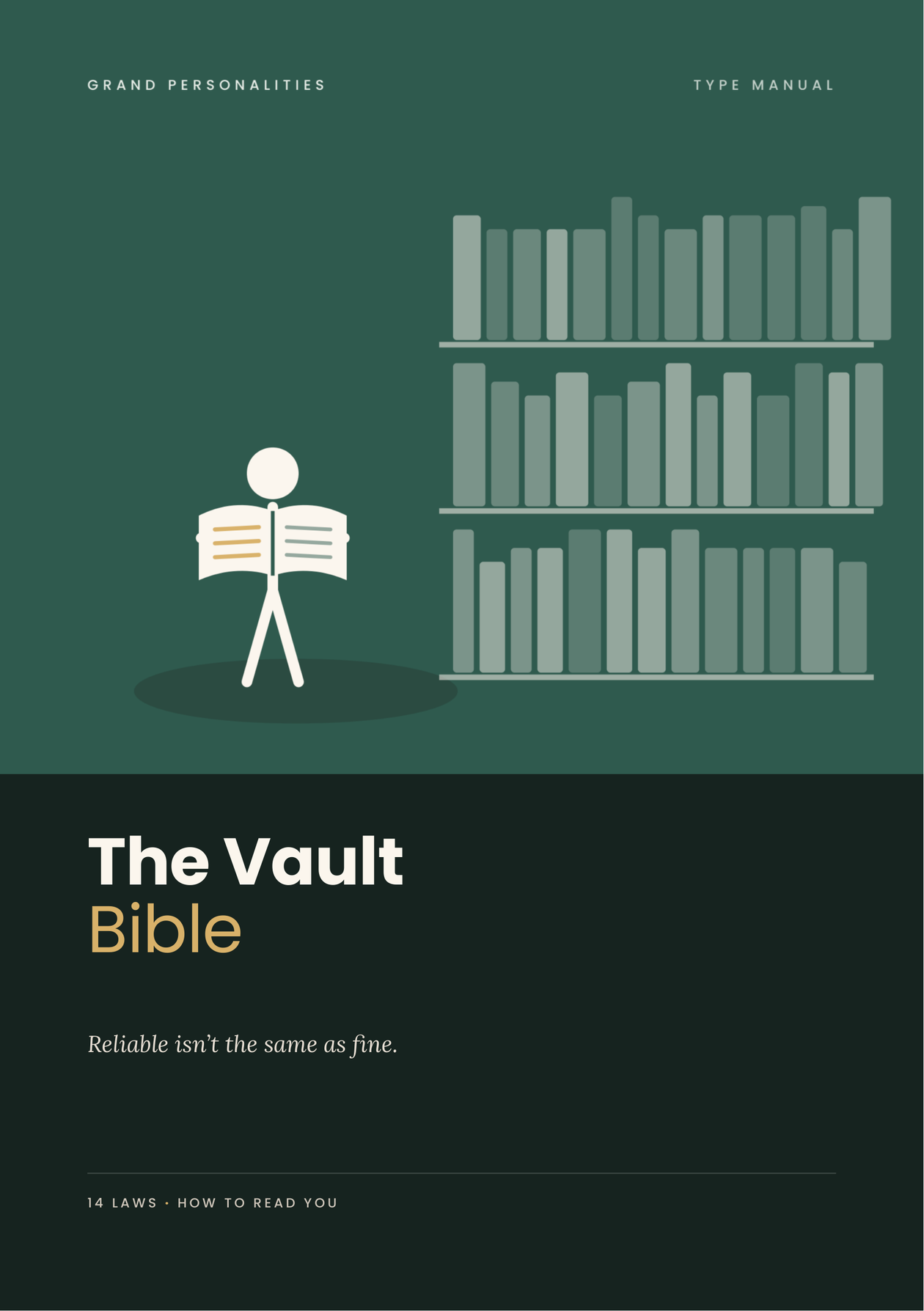
If you’re the ISTJ
The Vault Bible
Reliable isn't the same as fine.

If you’re the INTJ
The Observatory Bible
Finished before anyone knew you'd started.
- The VaultISTJYou hold the record, finish what you started, and say almost none of it out loud.Read the free ISTJ profile
- The ObservatoryINTJYou build the whole model before you speak, then defend it like it cost you something. It did.Read the free INTJ profile
Famous ISTJs in historyISTJFamous INTJs in historyINTJ
Compatibility