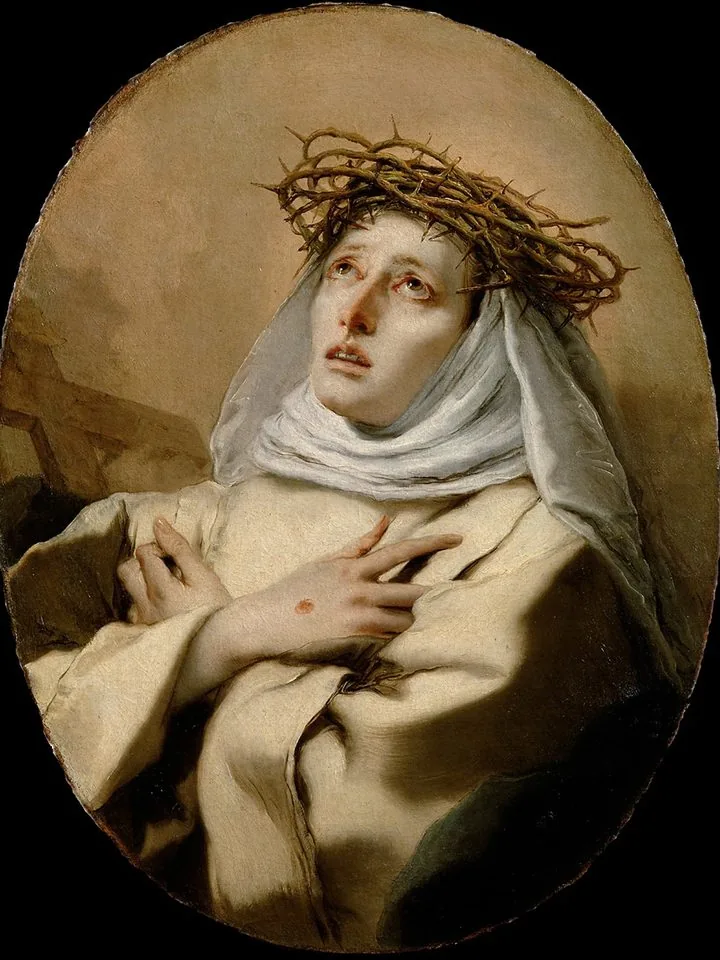
The story
I will it
One morning in June 1375, Catherine of Siena went to the place of execution in her city and waited for a young man who had asked her to be there. She was 28. Before he arrived, she lay down and put her own neck on the block.
He was a young man from Perugia, condemned for speaking against the government of Siena. Tradition names him Niccolò di Toldo. Catherine had visited him in prison, and by her account he made his confession there. He was terrified, and he made her promise to be with him at the end.
Early that morning she went to him and took him to hear Mass. He received communion, which, she wrote, he had never received before. He was still afraid. He kept his head on her breast and begged her to stay with him.
Most people who comfort someone in that hour keep a little distance. Catherine went on ahead and put herself, for a moment, exactly where he would be. Beacons often comfort this way, from beside, sharing the sufferer's place as far as they can.
When he came, she bent down and reminded him of the blood of the Lamb. She wrote that his mouth said nothing but “Jesus” and “Catherine.” As he said them, she received his head into her hands, her eyes fixed on the goodness of God, and said two words: “Io voglio.” I will it.
She left the crowd and the executioner out of her letter. She wrote down where his head had lain, what his mouth said, where her eyes were fixed, and what she said.
She had been born Caterina Benincasa on 25 March 1347, a dyer's daughter. She never became a nun and held no office. Even so, people gathered round her, and her followers called themselves her family. She sent hundreds of letters, to popes, to warring cities and to her young followers, and pressed Pope Gregory XI to bring the papacy back to Rome from Avignon.
To one young follower, Stefano Maconi, she wrote a line still quoted today, usually loosened into “set the world on fire.” Her own words were more exact: “If you are what you ought to be, you will set fire to all Italy.”
Then the Church split between rival popes. Late in 1378 Pope Urban VI called her to Rome, and she went. By the start of 1380 she was 32 and worn out, and she could no longer eat. Through Lent she walked to St Peter's every day to pray, then went back to work for a divided church.
“You would see a dead woman going to St Peter's; and I go in again to labour in the little ship of Holy Church.”
She saw her own exhaustion clearly and described it in a single breath. In the next breath she went back in. Beacons know that sentence from the inside.
She died in Rome on 29 April 1380. She was 33.
At the block, “I will it” meant she would not look away. In Rome, the same two words carried her to St Peter's each morning on a body that had nothing left to give.
The Beacon pattern in her life
- Stands beside the person suffering
- She laid her own neck on the block before he arrived, then received his head into her hands.
- Gathers people into a family
- A dyer's daughter with no office, she drew followers who called themselves her family and wrote to popes.
- Gives until nothing is left
- Unable to eat in 1380, she still walked to St Peter's every day and went back to work.
The Beacon: You say the thing the room is feeling, then organize it into something people will follow.
Are you a Beacon too?
Free, no email needed. Find out which house is yours.
Take the free test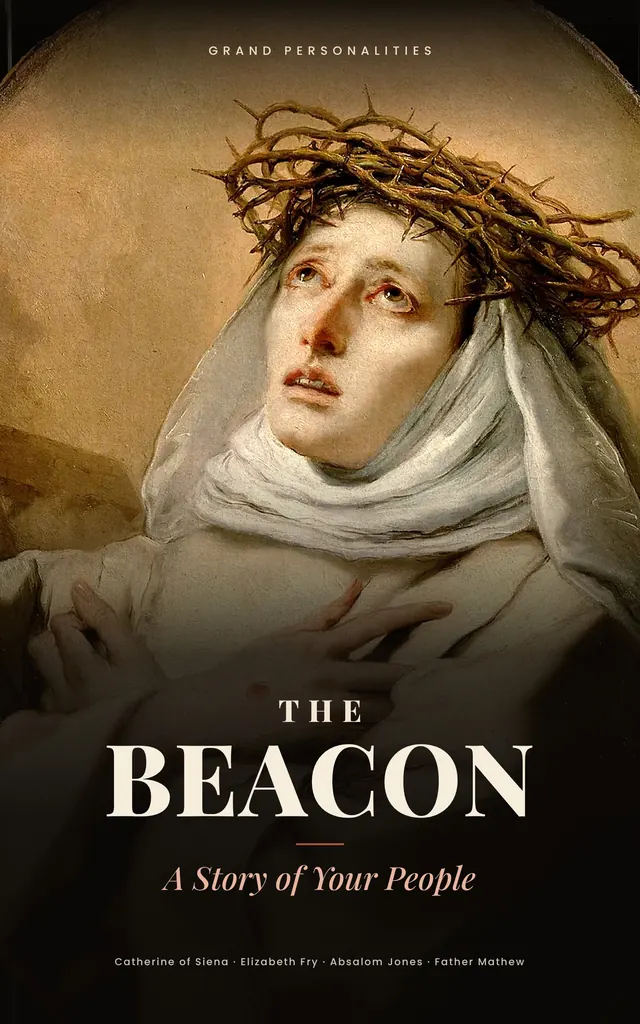
The book
The Beacon: A Story of Your People
Her story and fifteen more, from fourteenth-century Siena to twentieth-century Korea and from Hudson Bay to Buenos Aires, grouped by the situations every Beacon runs into: work, love, friendship, money, the body, purpose and power.
More famous Beacons
Questions people ask
What personality type was Catherine of Siena?
Her life fits the Beacon, one of the houses at Grand Personalities: someone who says the thing the room is feeling, then organizes it into something people will follow. Closest four-letter code: ENFJ.
What did Catherine of Siena do at Niccolò di Toldo's execution?
In June 1375 she waited for the condemned young man at the block, laying her own neck on it first. When he died, saying “Jesus” and “Catherine,” she received his head into her hands.
Did Catherine of Siena say “set the world on fire”?
Her words, in a letter to her young follower Stefano Maconi, were “If you are what you ought to be, you will set fire to all Italy.” The “whole world” version is a later loosening.
Portrait: Giovanni Battista Tiepolo, about 1746 · Public domain · Source
