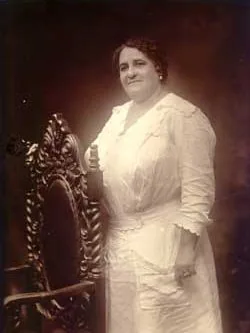
The story
Nickels into dollars
In August 1901, Maggie Lena Walker stood before the annual convention of the Independent Order of St. Luke in Richmond, Virginia, and told its members what they were going to build. She was 37.
The order was a Black mutual-aid society, and most of its members had very little money. She asked them to put it together.
“Let us put our moneys together,” she told them, “let us use our moneys; let us put our money out at usury among ourselves, and reap the benefit ourselves.”
Listen to the pronouns. Let us, our, ourselves. In a few sentences, a crowd of people who each had little became one body that had something. She even picked up “usury”, the ugly word for lenders who bled the poor, and turned it round. This time the interest would come home to them.
Her plan was a whole small economy: a savings bank to hold the money, a newspaper to carry the news, and a store to keep the spending in the community.
She knew what it meant to have little. Born on 15 July 1864, she was the daughter of a formerly enslaved woman who kept the family going by taking in laundry, and as a girl Maggie helped with the work. She joined the order as a teenager, started its branch for children in 1895, and in 1899 took charge of an order in financial trouble. She doubled its membership in her first year.
The newspaper, the St. Luke Herald, appeared in 1902. In November 1903 the St. Luke Penny Savings Bank opened its doors, with Walker as its president. She was the first African American woman in the United States to charter a bank.
By one account, about 280 deposits came in on the first day, and one of them was for 31 cents. That coin was the whole idea. No deposit was too small to count, and the person with change in a pocket stood in the same line as the person with savings.
“Let us have a bank that will take the nickels and turn them into dollars.”
It is a Beacon's gift at its most practical. Walker could have tried to carry her community on her own back. She organized it to carry itself, so the rescue belonged to everyone who put something in.
Not every plan lasted. The store opened in 1905 and closed in 1911. In 1915 her son Russell shot her husband, Armstead, mistaking him for an intruder, and was later acquitted. By 1928 she was using a wheelchair. She kept working.
When the Depression came, she merged her bank with two others in 1930 to form the Consolidated Bank and Trust Company, which carried on for decades after her.
She died on 15 December 1934, at 70. Her house in Richmond is now the Maggie L. Walker National Historic Site. In 1901 she had looked at a room full of people with very little money and seen a bank.
The Beacon pattern in her life
- Names what a group could become
- In 1901 she told members with little money that they would found their own bank, newspaper and store.
- Speaks for everyone as “we”
- “Let us put our moneys together,” she said, and a crowd became one body.
- Organizes people to carry themselves
- She built a bank where the smallest deposit counted, so the rescue belonged to everyone who put in.
The Beacon: You say the thing the room is feeling, then organize it into something people will follow.
Are you a Beacon too?
Free, no email needed. Find out which house is yours.
Take the free test
The book
The Beacon: A Story of Your People
Her story and fifteen more, from fourteenth-century Siena to twentieth-century Korea and from Hudson Bay to Buenos Aires, grouped by the situations every Beacon runs into: work, love, friendship, money, the body, purpose and power.
More famous Beacons

Questions people ask
What personality type was Maggie Lena Walker?
Her life fits the Beacon, one of the houses at Grand Personalities: someone who says the thing the room is feeling, then organizes it into something people will follow. Closest four-letter code: ENFJ.
Was Maggie Lena Walker the first woman to charter a bank?
She was the first African American woman in the United States to charter a bank. The St. Luke Penny Savings Bank opened in Richmond, Virginia, in November 1903, with her as its president.
What happened to Maggie Lena Walker's bank?
During the Depression, in 1930, she merged it with two other Richmond banks to form the Consolidated Bank and Trust Company, which kept going for decades after her death in 1934.
Portrait: The Browns, about 1913 · Public domain · Source
