Famous Labyrinths
Cecilia Paynethe LabyrinthINTP
England and USA, 1900–1979 · astronomer, astrophysicist, professor
The story
Almost certainly not real
In January 1925, Cecilia Payne, 24, was finishing her doctoral thesis at Harvard when a letter came from Princeton. The central result of her work, it said, was impossible.
The writer was Henry Norris Russell, 47, the most powerful astronomer in America and one of the readers of her thesis. A word from him could make a young scientist's career, or end it.
She had been born on 10 May 1900 in Wendover, in England. At 19, at Cambridge, she heard Arthur Eddington lecture on his eclipse expedition, and the argument knocked down her whole picture of the universe. She later said her world had been so shaken that she came close to a nervous breakdown. Labyrinths often fall for a subject that way: all at once, from the foundations up.
Cambridge would teach her but would not give a woman a degree. So in 1923 she crossed the Atlantic to Harvard College Observatory, where the light of countless stars lay stored on glass photographic plates.
She set out to answer a plain question. What are the stars made of? Each element leaves dark lines in a star's light, but the strength of a line depends on the star's temperature as much as on how much of the element is there. Using the new physics of the atom, she untangled the two.
Her tables said something nobody expected. Most elements came out in roughly the proportions found on Earth. Hydrogen and helium came out enormously more abundant than everything else. The stars, her numbers said, were made mostly of hydrogen and helium.
Russell's letter, dated 14 January, called it “clearly impossible” that hydrogen should be a million times more abundant than the metals. He was the expert. She was a student whose future he could decide.
She could fight him and risk the whole thesis. She could cut the result and bury it. She found a third way, and wrote this:
“The enormous abundance derived for these elements in the stellar atmosphere is almost certainly not real.”
The words were hers, though they are often put in Russell's mouth. And in her table she left every number exactly where it was. The sentence bowed to authority. The data did not move. It is a very Labyrinth kind of courage: give way on the adjectives, never on the evidence.
The thesis was published that year as Stellar Atmospheres. In 1929 Russell reached the same result by another method, and he cited her. Even so, for years much of the credit went to him. The astronomer Otto Struve later called her work “undoubtedly the most brilliant Ph.D. thesis ever written in astronomy.”
She stayed at Harvard, underpaid for decades. In 1934 she married the astronomer Sergei Gaposchkin and became Cecilia Payne-Gaposchkin. In 1956 she became Harvard's first woman full professor, and the first woman to chair a department there.
In 1976 the American Astronomical Society gave her its Henry Norris Russell Lectureship, named for the man who had told her she was wrong. The numbers had been on the page all along.
The Labyrinth pattern in her life
- Takes the question apart carefully
- She separated temperature from abundance in starlight to work out what the stars are really made of.
- Keeps the data intact
- Pressed to disown her result, she softened one sentence and left every number in the table.
- Trusts evidence to win eventually
- She let the numbers wait on the page until Russell reached the same answer four years later.
The Labyrinth: You take the idea apart because loving it isn’t the same as it being true.
Are you a Labyrinth too?
Free, no email needed. Find out which house is yours.
Take the free test
The book
The Labyrinth: A Story of Your People
Her story and fourteen more, from a cave by an Ethiopian river to a monastery in Moravia and a radio laboratory in Sydney, grouped by the situations every Labyrinth runs into: work, love, friendship, money, the body, purpose and power.
More famous Labyrinths

Questions people ask
What personality type was Cecilia Payne?
Her life fits the Labyrinth, one of the houses at Grand Personalities: someone who takes the idea apart, because loving it isn't the same as it being true. Closest four-letter code: INTP.
What did Cecilia Payne discover?
In her 1925 doctoral thesis she showed that the stars are made mostly of hydrogen and helium, and that other elements appear in roughly the same proportions as on Earth.
Why didn't Cecilia Payne get credit for her discovery?
Henry Norris Russell, the leading American astronomer, told her the result was impossible, so she printed it with a cautious disclaimer. When he reached the same result in 1929 he cited her, but for years much of the credit went to him.
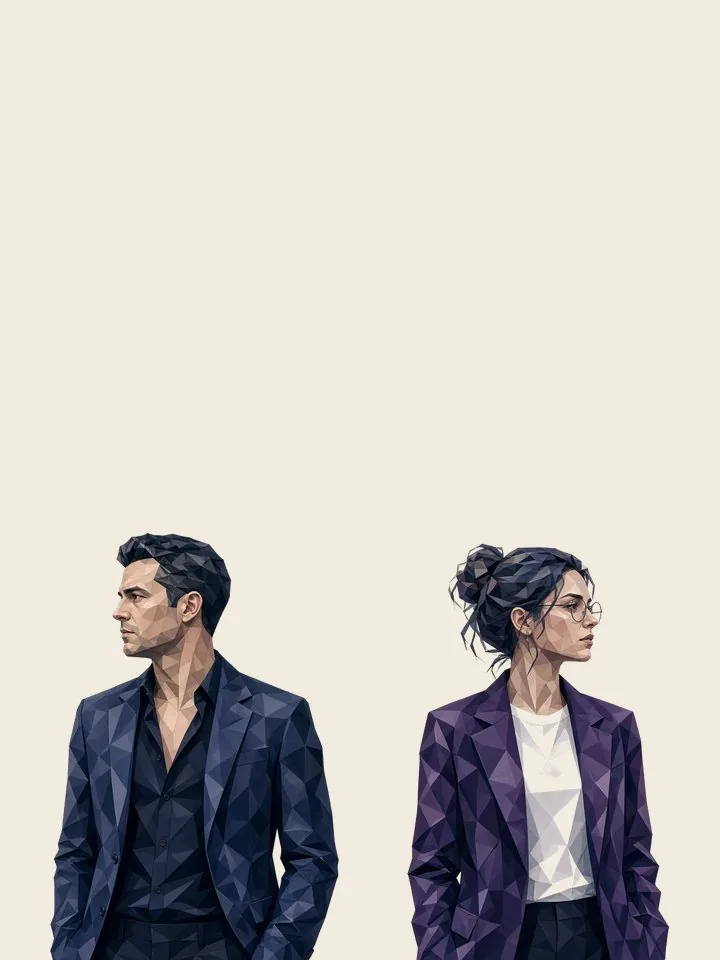
Shown: the Labyrinth house art.