Famous Labyrinths
Sophie Germainthe LabyrinthINTP
France, 1776–1831 · mathematician, physicist, letter writer

The story
Monsieur Le Blanc
In February 1807, in Paris, Sophie Germain, 30, sat down to tell Carl Friedrich Gauss who she really was.
For more than two years the most admired mathematician in Germany had been writing to a gifted young Frenchman called Monsieur Le Blanc. The letters had been hers all along.
She was born on 1 April 1776 in the rue Saint-Denis, into a Paris merchant family. Women could not study at the new École Polytechnique, so she got hold of the lecture notes and sent the great Joseph-Louis Lagrange her work under a man's name: Le Blanc, a former student there.
On 21 November 1804, at 28, she used the name again in a first letter to Gauss, about the theory of numbers. He answered. To him, Monsieur Le Blanc was a promising colleague, and their letters went back and forth between Paris and Brunswick as one mathematician to another.
Labyrinths will see why the arrangement suited her. A letter can be drafted, checked and redrafted. It reaches the other person as pure argument, before anyone has looked at you.
Then, in late 1806, Napoleon's armies took Brunswick. Germain remembered Archimedes, the great geometer of Syracuse, killed by a soldier when his city fell. She asked General Joseph-Marie de Pernety, a friend of her family serving with the army, to make sure Gauss came to no harm.
Pernety sent an officer to find him. Gauss was safe, and puzzled. He did not know the general, and he had never heard of a Mademoiselle Germain.
So she wrote to explain, with great care. She was, she told him, “not as completely unknown to you as you might believe.” She had taken the name of Le Blanc, fearing “the ridicule attached to a female scientist.” She hoped the truth would not cost her the regard he had shown her under a borrowed name.
Gauss answered warmly. He praised the courage it takes to go deeply into a science so few people love.
“…my admiration and astonishment at seeing my esteemed correspondent M LeBlanc metamorphose himself into this illustrious personage…”
Within two years, though, his letters stopped. His interests had moved away from numbers. She kept working. Twice she entered the Academy's contest on vibrating surfaces and fell short, and twice she went back to the equations. In January 1816, at her third attempt, she won the Paris Academy's prize for her theory of elastic surfaces, the first woman to win one. Around 1819 she wrote to Gauss again, with a bold plan of attack on Fermat's Last Theorem. No answer is known.
She died of breast cancer in Paris on 27 June 1831, at 55. She and Gauss never met.
For two years he read her mathematics and never knew her name. He learned it only because she had been afraid for his life.
The Labyrinth pattern in her life
- Lets the argument arrive first
- For two years she reached Gauss as Monsieur Le Blanc, judged on nothing but her mathematics.
- Shows care through careful arrangements
- Afraid for Gauss's life, she sent a general's officer to his door instead of writing to him as herself.
- Returns to the hard problem
- She entered the Academy's contest three times before her theory of elastic surfaces won.
The Labyrinth: You take the idea apart because loving it isn’t the same as it being true.
Are you a Labyrinth too?
Free, no email needed. Find out which house is yours.
Take the free test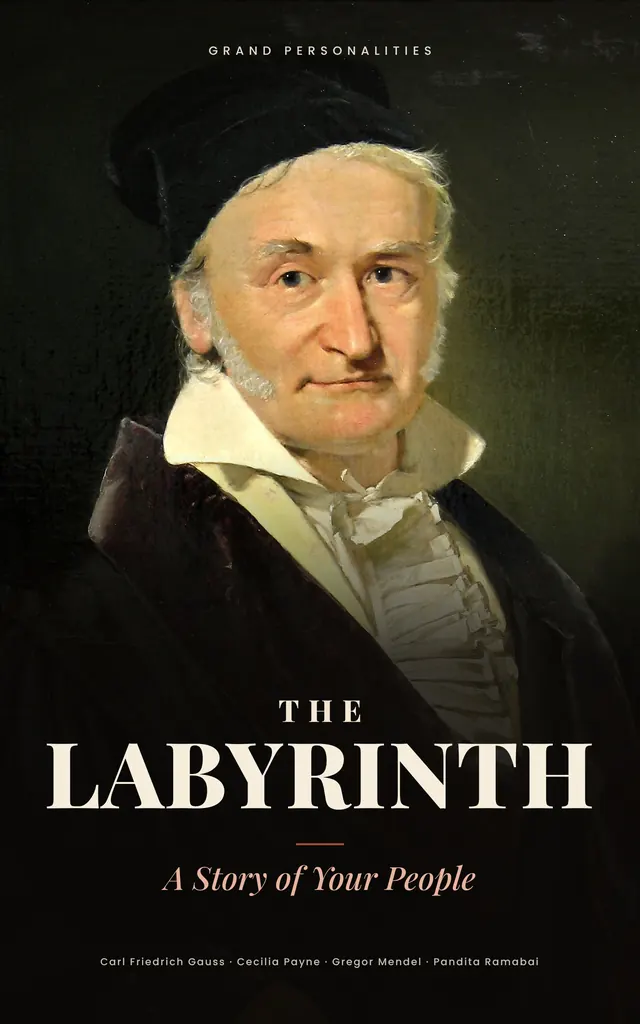
The book
The Labyrinth: A Story of Your People
Her story and fourteen more, from a cave by an Ethiopian river to a monastery in Moravia and a radio laboratory in Sydney, grouped by the situations every Labyrinth runs into: work, love, friendship, money, the body, purpose and power.
More famous Labyrinths

Questions people ask
What personality type was Sophie Germain?
Her life fits the Labyrinth, one of the houses at Grand Personalities: someone who takes the idea apart, because loving it isn't the same as it being true. Closest four-letter code: INTP.
Why did Sophie Germain use the name Monsieur Le Blanc?
As a woman she could not study at the École Polytechnique and feared being ridiculed, so she sent her work to Lagrange, and later to Gauss, under the name of a former student, Le Blanc.
What is Sophie Germain known for?
She did pioneering work on Fermat's Last Theorem, and in 1816 she became the first woman to win a prize from the Paris Academy of Sciences, for her theory of elastic surfaces. Sophie Germain primes are named after her.
Shown: the Labyrinth house art.