Famous Garrisons
Felipe Guaman Poma de Ayalathe GarrisonESTJ
Peru, c. 1535–c. 1616 · chronicler, artist, Andean nobleman
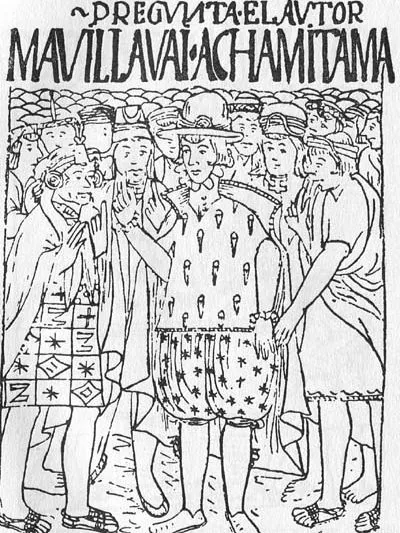
The story
A letter to a king who never answered
In 1615, somewhere in the Andes of Peru, an old man finished a letter to King Philip III of Spain. It ran to 1,189 pages, with 398 full-page drawings in pen and ink. Felipe Guaman Poma de Ayala called himself eighty years old.
He titled it El primer nueva corónica y buen gobierno: the first new chronicle, and good government. Guaman Poma (also written Huamán Poma) came from an Andean noble family that was not Inca, and he was fiercely proud of it. He lived under Spanish rule around Huamanga, in today's Ayacucho, and wrote in both Spanish and Quechua.
He had not always been the system's critic. As a younger man he worked as a Quechua translator for a Spanish churchman, Cristóbal de Albornoz, in a campaign to stamp out an Andean religious movement. Garrisons often start by serving an institution faithfully, by its own rules. The same habit of taking rules seriously is what later lets them see exactly where the institution breaks them.
In 1600 he lost his lawsuits over land and was banished from Huamanga. Some of the anger in his book may come from that loss. A man can be making his own case and telling the truth about a system at the same time.
Then he wrote. Over the next fifteen years or so he set down the history of the Andes from his own people's side, and a portrait of the colony as he saw it. Above all he wrote a manual.
He named abusive priests. He named local officials and the Spanish holders of grants over Andean labor. He did not stop at complaint. He set out good government measure by measure, and asked the king to put Andean people in positions of authority. It reads like the regulations for an entire kingdom.
And he drew. When two languages were not enough to make a king an ocean away see what he saw, he picked up the pen again. One drawing shows a friar kicking an Andean woman as she works at her loom.
His case was simple. The Spanish were the newcomers.
“It is our country, because God has given it to us.”
By his own account he carried the work across the country to Lima, and he wrote even the journey into the letter, an old man on the road with his life's work. He gave that part the plainest heading he could find: the author walks.
The manuscript probably left Peru around 1616. There is no sign Philip III ever saw it. Guaman Poma died at about that time and never learned what became of it. It is the ending Garrisons fear most: the full report, filed correctly, and then silence.
Somehow it reached Copenhagen and the Danish royal library. In 1908 a German scholar, Richard Pietschmann, recognized what it was, nearly three centuries after it left Lima. In 2001 the library put every page and drawing online, and in 2007 UNESCO added it to its Memory of the World register.
He wrote it for one reader, who never turned a page. Today anyone in the world can.
The Garrison pattern in his life
- Takes the rules seriously
- He served the colonial order by its rules before he wrote down exactly where it broke them.
- Writes the full manual
- 1,189 pages and 398 drawings setting out good government for Peru, measure by measure.
- Finishes without an answer
- He sent it to a king who never replied, and died not knowing its fate.
The Garrison: You take the duty nobody wants, name the date, and hold the line after everyone else drifts.
Are you a Garrison too?
Free, no email needed. Find out which house is yours.
Take the free test
The book
The Garrison: A Story of Your People
His story and fourteen more, from a manor in fifteenth-century Norfolk to an Arctic shore in 1884, grouped by the situations every Garrison runs into: work, love, friendship, money, the body, purpose and power.
More famous Garrisons
Questions people ask
What personality type was Felipe Guaman Poma de Ayala?
His life fits the Garrison, one of the houses at Grand Personalities: someone who takes the duty nobody wants, names the date and holds the line after everyone else drifts. Closest four-letter code: ESTJ.
What is Guaman Poma's Nueva corónica y buen gobierno?
A 1,189-page letter with 398 full-page drawings, finished around 1615 and addressed to King Philip III of Spain. It tells Andean history, records the abuses of colonial rule, and proposes how Peru should be governed.
Where is Guaman Poma's manuscript today?
In the Royal Danish Library in Copenhagen, where Richard Pietschmann recognized it in 1908. The library published a full digital copy online in 2001.
Portrait: Felipe Guamán Poma de Ayala, between 1615 and 1616 · Public domain · Source
