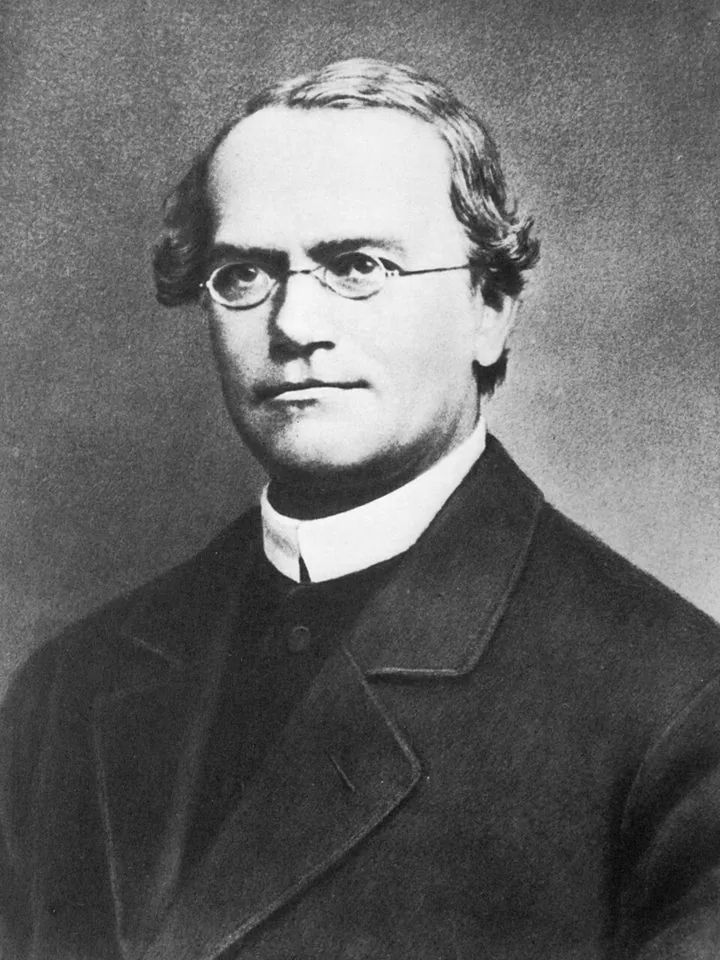
The story
Doubly dangerous
In 1874 the Austrian parliament put a new tax on the monasteries. Gregor Mendel, 51, abbot of St Thomas's in Brünn, decided it was unconstitutional and refused to pay.
The law was valid. He refused anyway, for the rest of his life.
He had been born in 1822 to a poor farming family in Austrian Silesia, and became an Augustinian friar, a teacher and a scientist. In the monastery garden he crossed varieties of peas, counted their offspring, and found in the numbers a regularity nobody had seen: the rules by which traits pass from parent to child. In 1865 he presented the work to the naturalists' society in Brünn.
Then he held back. One experiment, however clean, did not seem enough to him. On 18 April 1867, at 44, he explained his caution to the Munich botanist Carl Nägeli.
“…publication of one such isolated experiment was doubly dangerous; dangerous for the experimenter and for the cause he represented.”
So he set out to repeat his results in other plants, and tried, in his words, “to inspire some control experiments” from others. It is the Labyrinth virtue at its purest: never trust a single result, and ask someone else to check. It went wrong for a reason nobody then knew. Hawkweed, one of the plants he chose, mostly makes seeds without mixing its parents at all. Year after year it gave him numbers that would not agree.
In 1868 he was made abbot. Six years later came the tax. To Mendel it was unjust to tax one kind of institution while another went free. He protested, he appealed, he wrote. Several monasteries had objected at first. One by one they gave in, until he stood alone.
The last one standing can be a hero. He can also be the only person who hasn't noticed what everyone else has. Labyrinths are rarely fooled by other people's arguments. A case they have built themselves, carefully and alone, is much harder to see round. His reasoning held at every step. Only the premise at the bottom was wrong.
The authorities lost patience and took part of the monastery's property under state control to collect the tax themselves. He went on protesting until he was too ill to continue. His experiments had already stopped.
He died on 6 January 1884, at 61. Soon afterward his successor had his papers burned, reportedly to put an end to the tax quarrel.
It was the same habit, twice. In 1867 he would not trust one experiment, and that is why his counts still stand. In 1874 he would not accept a law he thought unjust, and that refusal took his last decade.
There was one difference. In 1867 the scientist asked other people to check him. In 1874 the abbot, as far as anyone knows, asked no one.
The Labyrinth pattern in his life
- Won't trust a single result
- He called publishing one isolated experiment “doubly dangerous” and set out to repeat it in other plants.
- Asks others to check him
- He wrote to Nägeli and tried “to inspire some control experiments.”
- Holds a principle to the end
- He fought a tax he believed unjust for ten years, after every other monastery had given in.
The Labyrinth: You take the idea apart because loving it isn’t the same as it being true.
Are you a Labyrinth too?
Free, no email needed. Find out which house is yours.
Take the free test
The book
The Labyrinth: A Story of Your People
His story and fourteen more, from a cave by an Ethiopian river to a monastery in Moravia and a radio laboratory in Sydney, grouped by the situations every Labyrinth runs into: work, love, friendship, money, the body, purpose and power.
More famous Labyrinths
Questions people ask
What personality type was Gregor Mendel?
His life fits the Labyrinth, one of the houses at Grand Personalities: someone who takes the idea apart, because loving it isn't the same as it being true. Closest four-letter code: INTP.
Why did Gregor Mendel stop his experiments?
After he became abbot in 1868, the monastery's affairs took over his time, and from 1874 he spent years fighting a new tax on monasteries that he believed was unconstitutional.
What happened to Gregor Mendel's papers?
After his death in 1884, his successor as abbot had his papers burned, reportedly to bring the tax dispute to an end.
Portrait: Photograph, about 1862 · Public domain · Source
