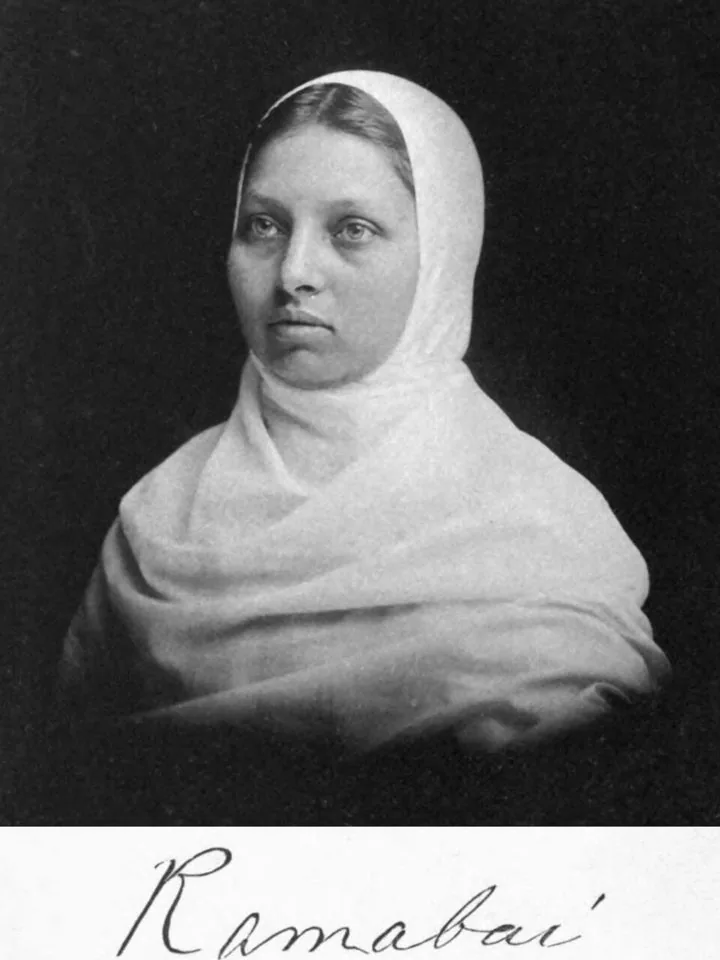
The story
A judgement of my own
On 12 May 1885, at Cheltenham in England, Pandita Ramabai, 27, wrote to the nun who had brought her into a new faith, and told her no.
Sister Geraldine, of the Anglican sisters at Wantage, had written two days earlier that “true liberty means obedience to law.” Ramabai saw what was being asked of her: to accept whatever those in authority decided, without reasons. “This however I cannot accept,” she replied.
She had learned early to question what she was told. Born in 1858 into a family of Brahmin scholars, she learned Sanskrit from her mother on the pilgrim roads of India. Famine took her parents and her sister. In Calcutta, at about 20, she was examined by the city's pandits and honored with titles, which is how she came to be known as Pandita Ramabai Sarasvati.
In 1880 she married a Bengali lawyer from outside her caste. Within two years he had died of cholera, and she was a widow of 23 with a baby daughter, Manorama. A high-caste widow was expected to withdraw from the world. Ramabai founded a women's association in Poona instead.
In 1883 she sailed for England, and that September, at Wantage, she and her daughter were baptized. At home a newspaper said she had “deceived and disappointed alike her friends and foes.” Following her own reasoning had pleased neither side.
Nor had she handed over her judgment with her old faith. She kept her vegetarian diet and her customs. She questioned doctrines she could not square with reason. “I like to be called a Hindoo, for I am one,” she told Geraldine.
The quarrel of 1885 began with something small. At Cheltenham Ladies' College, where she taught Sanskrit and studied, a male student asked to be taught by her. Two bishops objected, and Geraldine backed them. Labyrinths will know the moment: a large principle comes to a head over a small, concrete case, and giving way on the case would mean accepting the principle.
Her reply was courteous and immovable. She had already left one priesthood. “I have just with great efforts freed myself from the yoke of the Indian priestly tribe,” she reminded Geraldine, and she would not accept everything that came from priests as a command from God.
“I have a conscience, and mind and a judgement of my own.”
Through that summer she kept asking her teachers for reasons. All she wanted, she told Dorothea Beale, the head of the college, was for someone “to prove the deity of Christ by reasonably explained words of the Bible.”
In the end her answer to both priesthoods was a building. On 11 March 1889, in Bombay, she opened the Sharada Sadan, a home and school for widows, the women her society expected to disappear. It later grew into the Mukti Mission at Kedgaon.
She died on 5 April 1922, at 63. At 27, far from home, a widow with a small child, she had told the woman who brought her into the Church that she had a conscience, a mind and a judgment of her own. She spent the rest of her life using all three.
The Labyrinth pattern in her life
- Asks authority for its reasons
- When two bishops ruled against her teaching a male student, she would not accept it on their say-so.
- Examines the new faith too
- After her baptism she kept her diet and customs and questioned doctrines she could not square with reason.
- Puts the refusal in writing
- She answered her spiritual mother by letter, and kept arguing by post all that summer.
The Labyrinth: You take the idea apart because loving it isn’t the same as it being true.
Are you a Labyrinth too?
Free, no email needed. Find out which house is yours.
Take the free test
The book
The Labyrinth: A Story of Your People
Her story and fourteen more, from a cave by an Ethiopian river to a monastery in Moravia and a radio laboratory in Sydney, grouped by the situations every Labyrinth runs into: work, love, friendship, money, the body, purpose and power.
More famous Labyrinths

Questions people ask
What personality type was Pandita Ramabai?
Her life fits the Labyrinth, one of the houses at Grand Personalities: someone who takes the idea apart, because loving it isn't the same as it being true. Closest four-letter code: INTP.
What did Pandita Ramabai write to Sister Geraldine?
On 12 May 1885, urged to accept the authority of those over her in the Church, she declined, writing: “I have a conscience, and mind and a judgement of my own.”
What did Pandita Ramabai found?
In 1882 she founded a women's association in Poona, the Arya Mahila Samaj. On 11 March 1889 she opened the Sharada Sadan in Bombay, a home and school for widows that later grew into the Mukti Mission at Kedgaon.
Portrait: Frontispiece portrait · Public domain · Source
