The story
The head and front of my offending
On the evening of 25 April 1831, a letter reached Henry Derozio in Calcutta. He was 22, a week past his birthday, and that day he had resigned from the Hindu College rather than wait to be dismissed.
The letter came from H. H. Wilson, who sat on the college's committee. It asked him three things. Did he believe in a God? Did he think respect and obedience to parents no part of moral duty? Did he think it innocent for brothers and sisters to marry?
These were the town's rumors. Put together, they drew a monster: a young man teaching boys to drop God, defy their fathers and break the oldest taboo there is.
Henry Louis Vivian Derozio was born in Calcutta on 18 April 1809, into the mixed Portuguese and Indian community then called East Indian. He called India his native land and wrote a sonnet to it under that name. While still in his teens he was hired to teach English literature and history at the Hindu College.
He did more than teach his subject. He taught his students to argue. The debates spilled into his home, and the students formed a club of their own, the Academic Association. The young men around him came to be called Young Bengal.
This is the Wildfire gift at its purest. Nothing made those boys walk to their teacher's door. They went because there their questions counted and the conversation could go anywhere.
In 1831 that was dangerous. Questions about God, family and marriage reached into every household the students went home to. Orthodox parents said the young teacher was turning their sons against religion. On Saturday 23 April the college's managers met behind closed doors and resolved to let him go. No charge was put to him, and he was never heard.
Wilson had not been obliged to write, and his questions gave Derozio a chance to answer. Wildfires are often called careless with words. Derozio replied the next morning, 26 April, at length and point by point.
On the first charge he was exact: “I have never denied the existence of a God in the hearing of any human being.” He had shown his students the philosophers' doubts, he wrote, and the best replies to them. Reason had carried some of them one way and some the other.
“…if I am to be condemned for the Atheism of some, let me receive credit for the Theism of others.”
He had handed them a method and left the conclusions to them. Borrowing a line from Othello, he called that whole way of teaching “the head and front of my offending.” He denied the other charges flatly, and said plainly why he thought they had come for him: the managers had wanted him gone “not to satisfy popular clamour, but their own bigotry.”
There was no second act. He threw himself into editing a daily paper, the East Indian. That December cholera reached him, and he died in the last week of 1831, aged 22, eight months after the letter.
His students carried the method on without him. The managers took his post in one closed meeting. The letter he wrote the next morning is still answering for him.
The Wildfire pattern in his life
- Makes other minds feel worth something
- His students followed the debate to his home and formed a debating club of their own.
- Starts things at full speed
- By 22 he had taught a generation, published poems and taken on a daily paper.
- Stands by what he values
- He told Wilson the managers had acted from “their own bigotry”, and did not soften it.
The Wildfire: Fast, warm, everywhere at once. You start the thing and someone else usually files it.
Are you a Wildfire too?
Free, no email needed. Find out which house is yours.
Take the free test
The book
The Wildfire: A Story of Your People
His story and fourteen more, from a brewery in medieval Norfolk to a beach in New Guinea, grouped by the situations every Wildfire runs into: power, work, love, friendship, money, the body and purpose.
More famous Wildfires
Questions people ask
What personality type was Henry Derozio?
His life fits the Wildfire, one of the houses at Grand Personalities: someone fast, warm and everywhere at once, who starts the thing and usually leaves someone else to file it. Closest four-letter code: ENFP.
Why was Henry Derozio removed from Hindu College?
Orthodox Hindu parents feared he was turning their sons against religion and family, and in April 1831 the college's managers resolved to remove him without a hearing. He resigned on 25 April 1831 rather than wait for formal notice.
Who were Young Bengal?
Young Bengal, also called the Derozians, were the students Derozio taught to question and debate at the Hindu College in Calcutta. After his death they carried his habit of open argument into campaigns for reform and a free press.
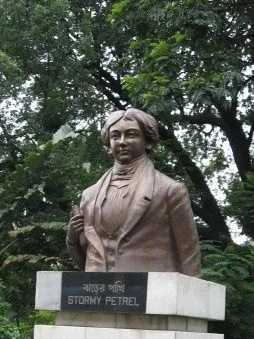
Portrait: Photo: P.K.Niyogi, 25 July 2007 · CC BY-SA 3.0 · Source
