Famous Garrisons
Ignaz Semmelweisthe GarrisonESTJ
Hungary and Austria, 1818–1865 · obstetrician, reformer, whistle-blower
The story
I will keep watch
In mid-May 1847, Ignaz Semmelweis gave the men of his ward a new rule. Before anyone touched a woman in labor, they would wash their hands in chlorinated lime. He was 28, an assistant at the First Obstetric Clinic in Vienna, and he had watched too many mothers die.
The hospital had two maternity divisions. In one, babies were delivered by medical students and their teachers. In the other, by midwives. In the first, women died of childbed fever far more often, and the students came to the delivery room straight from the autopsy room.
Nobody yet knew about germs. What Semmelweis had was a pattern, and after the death of a colleague, Jakob Kolletschka, he acted on it. It is the job Garrisons are handed most often, or hand themselves: see the step everyone else skips, and make it the rule.
The numbers moved at once. In April 1847 his division had lost 18.3 per cent of its mothers. In June it lost 2.2 per cent, and in July 1.2. In March 1848, and again in August, not one mother in his division died.
If anyone ever had the evidence on his side, it was Semmelweis in 1848. Then he did the thing that shaped the rest of his life. He barely wrote it down.
In 1850 he went home to Pest. For more than a decade, the man who had stopped the dying hardly put his case in print. Garrisons often do this. They practice the right way themselves and expect its rightness to be obvious. From the inside it feels like dignity. From the outside it looks like nothing at all, and the old way carries on.
When his book on childbed fever finally appeared, the leading men in his field were unmoved, and the silence broke all at once. In 1861 he printed Two Open Letters in Pest. He admitted that thousands upon thousands of mothers and infants had died who would not have died had he not kept silent. To Professor Späth of Vienna he set out the death figures, called them a massacre, and added a line nobody could mistake.
“The murdering must stop, and so that the murdering stops, I will keep watch.”
It is a sentry's sentence. To Professor Scanzoni of Würzburg he went further. If Scanzoni kept teaching the old doctrine without refuting the new one, Semmelweis declared him a murderer before God and the world. There were two possibilities, he wrote, and there was no third.
He was right about the hands, and the figures were real. But few people have ever been persuaded by being called a murderer. His opponents now had a way to talk about his tone instead of his numbers, and they took it.
On 30 July 1865 he was lured to an asylum in Vienna, where guards beat him. He died on 13 August, aged 47, of blood poisoning from an infected wound. It was the very kind of infection he had spent his life trying to stop.
The world came round to clean hands without him. The rule he set in May 1847 was right from the first morning.
The Garrison pattern in his life
- Spots the step others skip
- He traced the deaths to hands that came straight from the autopsy room.
- Makes the rule and enforces it
- From mid-May 1847, nobody touched a woman in labor without washing in chlorinated lime.
- Stands guard over the standard
- “I will keep watch,” he wrote, casting himself as the sentry on the wall.
The Garrison: You take the duty nobody wants, name the date, and hold the line after everyone else drifts.
Are you a Garrison too?
Free, no email needed. Find out which house is yours.
Take the free test
The book
The Garrison: A Story of Your People
His story and fourteen more, from a manor in fifteenth-century Norfolk to an Arctic shore in 1884, grouped by the situations every Garrison runs into: work, love, friendship, money, the body, purpose and power.
More famous Garrisons


Questions people ask
What personality type was Ignaz Semmelweis?
His life fits the Garrison, one of the houses at Grand Personalities: someone who takes the duty nobody wants, names the date and holds the line after everyone else drifts. Closest four-letter code: ESTJ.
Why was Ignaz Semmelweis ignored?
He barely published his findings for more than a decade, and when he finally made his case in 1861 he called leading opponents murderers in open letters, which let them argue about his tone instead of his numbers.
How did Ignaz Semmelweis die?
He was taken to an asylum in Vienna on 30 July 1865, where guards beat him. He died on 13 August 1865, aged 47, of blood poisoning from an infected wound.
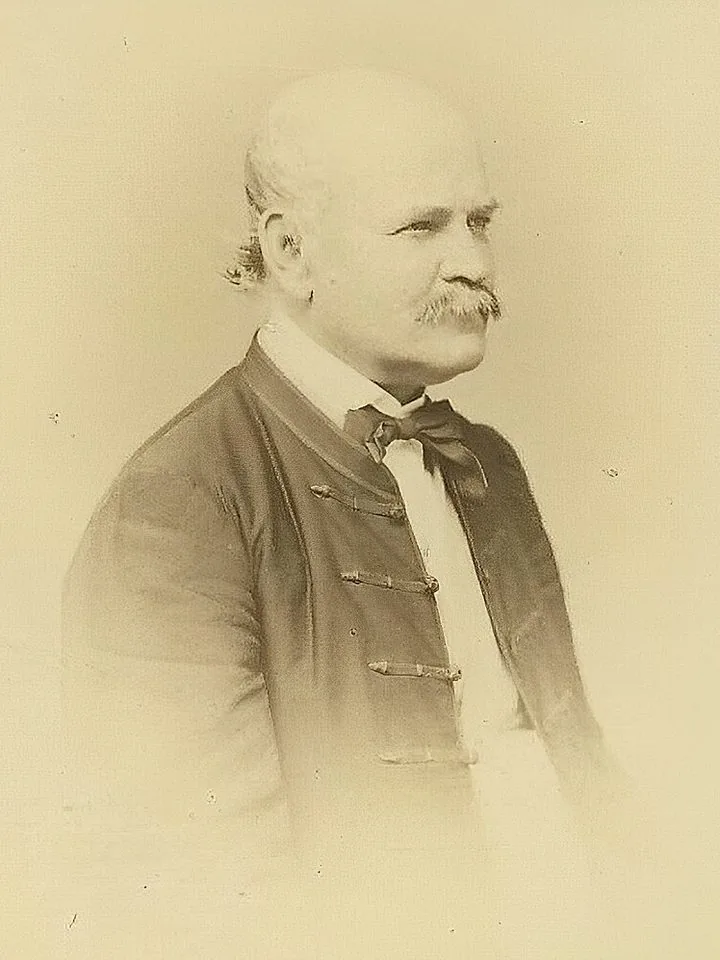
Portrait: József Borsos, 1860 · Public domain · Source
