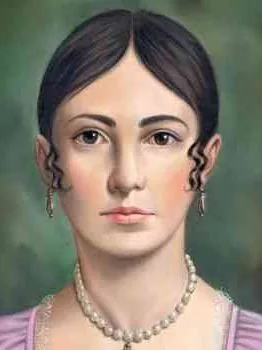
The story
Not only for love
In March 1813, in Mexico City, a royal judge showed Leona Vicario a letter written under a false name and asked who it was for. She was 23. She admitted the handwriting was hers. Then she stopped.
Mexico was still New Spain, and the war for its independence, begun in 1810, was in its third year. She was being held, cut off from everyone, in the Colegio de San Miguel de Belén. Her uncle and guardian, Agustín Pomposo Fernández de San Salvador, a royalist and a judge of the royal court, had talked her into coming back after she fled the city.
She was born in Mexico City on 10 April 1789, an heiress of Spanish descent with money of her own. She carried messages for the insurgents and spent her fortune on them, even paying gunsmiths to make weapons for the rebel armies.
Now the judge wanted names: who the letters were for and who belonged to the network. Asked to whom she had written, she said she could not say without compromising the people concerned. Pressed about one family, she said she would name no one, by one account even if they took her to the ultimate punishment.
Whatever was hers, the judge could have. Whatever belonged to someone else was not hers to give. Lighthouses tend to draw the line exactly there.
She was held for about six weeks. Then, one evening in late April, a group of insurgents came to the Colegio de Belén and got her out. Their names are on record: Francisco Arroyave, Antonio Vázquez and José Luis Rodríguez Alconedo. She had refused to name a single one of her people. Now some of them had come for her.
The cause took her fortune. The viceroy's government seized her property. She married the insurgent Andrés Quintana Roo, and after independence she asked the new Congress to return about 112,000 pesos. The treasury had no cash, so in 1823 it paid her in property: a house at Ocotepec and two in Mexico City.
In 1831, when she was 41, Lucas Alamán, one of the most powerful ministers in the government, suggested in print that her heroism had been a romance. She had followed her heart into the rebel camp, the story went, and been well paid for it since.
It was partly an attack on her husband's party. It still landed where Lighthouses are most easily hurt. A powerful man had explained her motives to the whole country, and got them wrong.
In 1813 she had answered a judge with silence. This time she answered in her column in El Federalista, with the accounts: what she had given, what she had received, and why. Then she spoke for every woman he had explained away.
“Confess, Señor Alamán, that love is not the only motive of women's actions.”
The silence and the reply came from the same place. Neither would let someone else decide what she had done, or why.
She died on 21 August 1842, at 53. Four days later she was named Benemérita y Dulcísima Madre de la Patria, the Well-Deserving and Sweetest Mother of the Homeland.
She had once kept every name to herself. At the end, she made sure her own was read correctly.
The Lighthouse pattern in her life
- Protects people who aren't present
- Questioned by a royal judge, she would not name a single fellow insurgent.
- Gives everything to a cause
- She spent her own fortune on the insurgency and lost the rest to confiscation.
- Answers when motives are misread
- When a minister said she had acted for love, she replied in print with the accounts.
The Lighthouse: Quiet, certain, and already three moves into a future you can feel but can’t prove yet.
Are you a Lighthouse too?
Free, no email needed. Find out which house is yours.
Take the free test
The book
The Lighthouse: A Story of Your People
Her story and fourteen more, from the court of a Han dynasty emperor to a government office in Ottawa, grouped by the situations every Lighthouse runs into: work, love, friendship, money, the body, purpose and power.
More famous Lighthouses

Questions people ask
What personality type was Leona Vicario?
Her life fits the Lighthouse, one of the houses at Grand Personalities: someone quiet and certain, already three moves into a future she can feel but can't prove yet. Closest four-letter code: INFJ.
What did Leona Vicario do for Mexican independence?
She carried messages for the insurgents, spent her inheritance on the cause and sent gunsmiths to make their weapons. Arrested in 1813, she refused to name her fellow conspirators and was rescued by insurgents a few weeks later.
What did Leona Vicario say to Lucas Alamán?
When Alamán suggested in 1831 that she had joined the independence struggle for love, she replied in El Federalista with an account of what she had given and received, and defended women's capacity to act from their own convictions.
Portrait: Comisión Nacional de Libros de Texto Gratuitos, 19th century · Public domain · Source
