The story
I alone cherish his talent
In the summer heat of about 726, a young poet lay over the body of his friend beside Dongting Lake, in central China. He was about 25. By his own account, when a tiger came near, he did not move.
This was Li Bai, also known as Li Po, who would become one of China's best-loved poets. The friend was Wu Zhinan, who had traveled with him from Shu, the far south-west. Li Bai told the story himself years later, in a letter: “A fierce tiger came near; I held my ground.”
He put on mourning and wept as if for a brother. He buried his friend by the lake for the time being and traveled on east. In the rich city of Yangzhou, he wrote, “in under a year I scattered more than three hundred thousand,” helping every down-and-out young gentleman he met. The figure is probably inflated. The boast still tells you what he valued.
Bonfires will know the gesture. The money goes out in a rush of good feeling, to whoever is in the room.
Years later he came back to the lake. He cleaned his friend's bones with his own hands, wrapped them, and carried them on foot, keeping them with him day and night. To give Wu Zhinan a proper burial east of Ezhou, near today's Wuhan, he had to beg loans.
That is the line that rings true. The man who scattered three hundred thousand had to borrow to bury his friend. The letter was a request for a post, written to impress an official named Pei, and a man trying to impress would never have invented the debt.
Fame came. In 742 he was summoned to the imperial court, and the older poet He Zhizhang called him a “banished immortal”, a heavenly being exiled to earth. In 744 he met Du Fu, eleven years younger and far more serious. They met once more in 745 and never again. Du Fu went on writing about him for years.
Then came disaster. During a great rebellion, in 756, Li Bai joined the staff of Prince Yong. The new emperor, the prince's own brother, crushed the prince's forces as rebels. Li Bai was imprisoned at Xunyang and sentenced to exile in Yelang, at the far edge of the empire.
In 759, on his way up the Yangtze gorges, he was pardoned. He turned for home and wrote one of his most famous poems, about a light boat that has already passed ten thousand mountains. It has no prison in it, only speed, color and crying gibbons.
Not everyone forgave him. Around 761 Du Fu wrote a poem about his old friend. He called the famous wildness a “feigned madness”. Then he refused to join the crowd.
“The whole world wants him killed; I alone cherish his talent.”
Li Bai died in 762, at about 61. A later legend says he drowned reaching from a boat for the moon's reflection, exactly the ending he would have written for himself.
With Wu Zhinan he gave everything, even money he had to borrow. With Du Fu he was the one who was kept, by a friend who saw through the act and loved him anyway.
The Bonfire pattern in his life
- Gives with both hands open
- By his own account he gave away more than 300,000 in Yangzhou in under a year.
- Turns life into legend
- He told tall tales about himself, and the court knew him as a “banished immortal”.
- Keeps faith at his own cost
- He carried his dead friend's bones on foot and borrowed money to bury them.
The Bonfire: You raise the temperature of a room on purpose. Present tense, full volume, real warmth.
Are you a Bonfire too?
Free, no email needed. Find out which house is yours.
Take the free test
The book
The Bonfire: A Story of Your People
His story and fourteen more, from Tang China and Elizabethan London to Tehran, Havana and the Montreal waterfront, grouped by the situations every Bonfire runs into: work, love, friendship, money, the body, purpose and power.
More famous Bonfires


Questions people ask
What personality type was Li Bai?
His life fits the Bonfire, one of the houses at Grand Personalities: someone who raises the temperature of a room on purpose. Present tense, full volume, real warmth. Closest four-letter code: ESFP.
Were Li Bai and Du Fu friends?
Yes. They met in 744 and again in 745, and never after. Du Fu kept writing about Li Bai for years, and around 761, when Li Bai was in disgrace, wrote that the whole world wanted him killed but he alone cherished his talent.
How did Li Bai die?
He died in 762, at about 61. The famous story that he drowned while reaching for the moon's reflection in the water is a later legend.
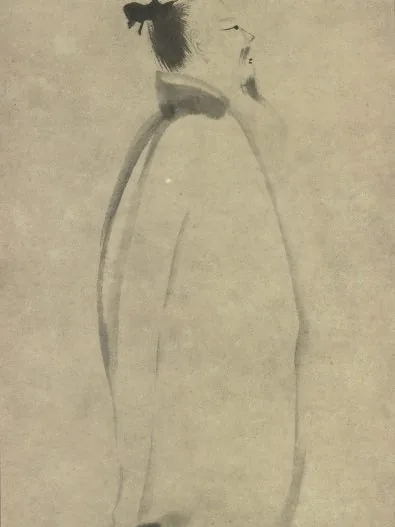
Portrait: Liang Kai, 13th century · Public domain · Source
