Famous Vaults
Manuel Belgranothe VaultISTJ
Buenos Aires, 1770–1820 · economist, general, creator of the flag

The story
A seat for the schoolteacher
On 31 March 1813, at army headquarters in Jujuy, General Manuel Belgrano wrote a letter turning down a fortune. He was 42.
His army had beaten the royalists at Tucumán in September 1812 and at Salta on 20 February 1813. The grateful Assembly in Buenos Aires voted him a sword with a gold hilt and forty thousand pesos in state property, his to own outright.
He was a soldier only by necessity. Trained in law, he had spent years as secretary of the merchants' board of trade in Buenos Aires, arguing for free schools, for girls as well as boys. The revolution of 1810 put him in uniform.
He was not always a man of procedure. In February 1812, at Rosario, he raised a new flag for the revolution without asking anyone, and was rebuked for it. It became Argentina's flag.
His reply to the Assembly opened with a principle. “Neither virtue nor talent has a price,” he wrote, and paying for them in money only degraded them. Riches, he added, were a reef on which any virtue that did not learn to despise them would run aground.
Plenty of people refuse a reward. Belgrano went one step further. He assigned the forty thousand pesos to endow four public primary schools, in Tarija, Jujuy, Tucumán and Santiago del Estero. The word he chose was dotación, an endowment, meant to pay out year after year.
Then he did what Vaults do best. He wrote the rules. On 25 May 1813, the third anniversary of the revolution, he issued twenty-two articles for the schools.
Each school got ten thousand pesos of capital, which should yield five hundred a year. Four hundred would pay the teacher. The other hundred would buy paper, quills, ink, books and catechisms for children whose parents could not afford them. The post would go by competitive examination, and every three years the town council could open it again. Nobody was to show off luxury, even if their parents could pay. In the last article he kept the right to send an inspector.
“The teacher shall be given a seat with the town council, and be held as a Father of the Country.”
He had just been offered a fortune for winning battles. At the town's public celebrations, his rules gave the place of honor to the schoolteacher.
Rules could not make an empty treasury pay. Buenos Aires promised five per cent a year until the property was sold, and then the war turned. Belgrano lost two battles late in 1813 and was replaced in command. The money did not come. He died in Buenos Aires on 20 June 1820, aged 50, in poverty.
The schools he had costed to the last hundred pesos waited. Santiago del Estero's opened in 1822 in a borrowed room, and Tarija's in 1825, before any money arrived. A boy from Tucumán named Juan Bautista Alberdi later wrote that he learned to read and write “in the public school that Belgrano founded.”
The last of the four to be properly built, in Jujuy, began classes in 2004, 191 years after his letter. The state had taken almost two centuries to keep its side. Belgrano had finished his in eight weeks.
The Vault pattern in his life
- Declines what money can't repay
- Voted forty thousand pesos for two victories, he wrote back that neither virtue nor talent has a price.
- Turns a gesture into rules
- Within eight weeks he had twenty-two articles covering capital, salary, ink for poor children and an inspector.
- Honors the steady, unseen work
- His rules gave the schoolteacher a seat with the town council as a Father of the Country.
The Vault: You hold the record, finish what you started, and say almost none of it out loud.
Are you a Vault too?
Free, no email needed. Find out which house is yours.
Take the free test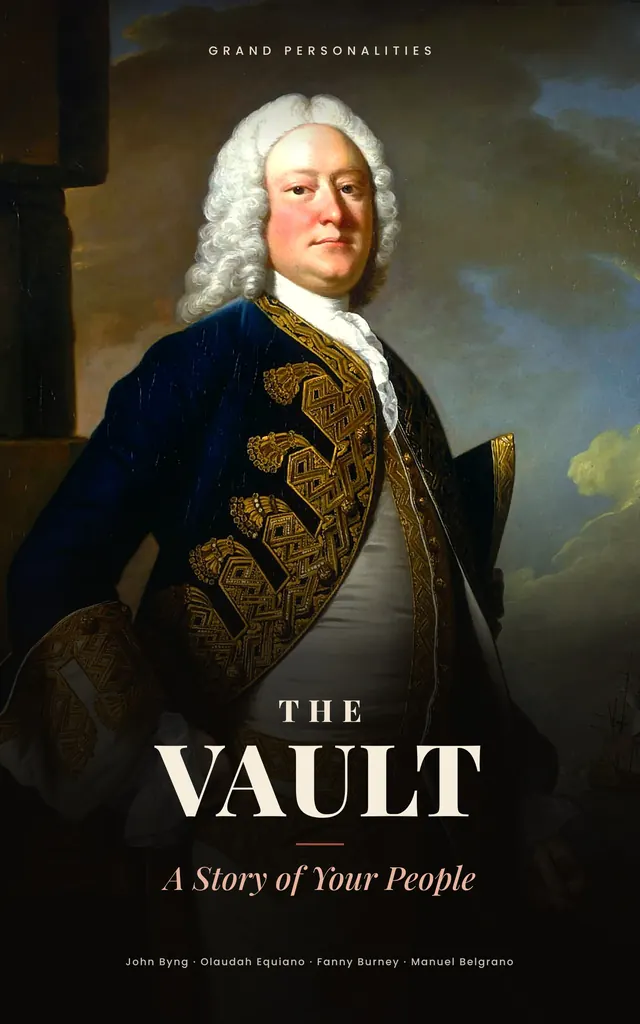
The book
The Vault: A Story of Your People
His story and fourteen more, from a palace library in Han dynasty China to a home in Franco's Madrid, grouped by the situations every Vault runs into: work, love, friendship, money, the body, purpose and power.
More famous Vaults
Questions people ask
What personality type was Manuel Belgrano?
His life fits the Vault, one of the houses at Grand Personalities: someone who holds the record, finishes what they started, and says almost none of it out loud. Closest four-letter code: ISTJ.
What did Manuel Belgrano do with his 40,000-peso reward?
In a letter of 31 March 1813 he gave it to endow four public primary schools, in Tarija, Jujuy, Tucumán and Santiago del Estero, and on 25 May he issued 22 articles of rules for them. The wartime state never paid the money in full, and the schools opened late.
Did Manuel Belgrano create the Argentine flag?
Yes. He first raised it at Rosario in February 1812, on his own initiative, and the government in Buenos Aires rebuked him for it.
Shown: the Vault house art.