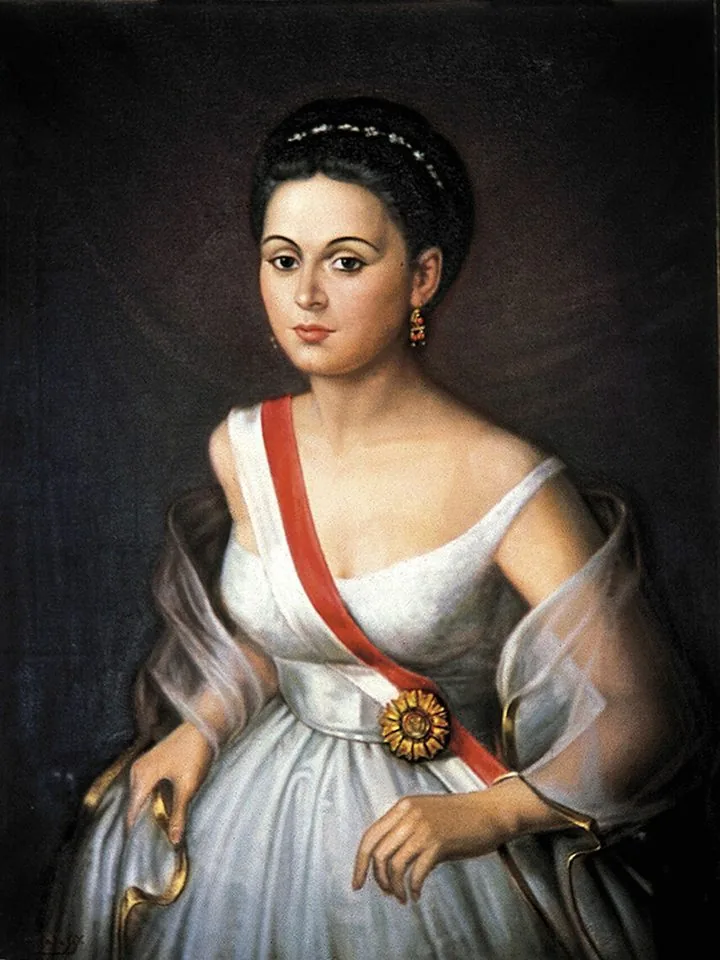
The story
First, get dressed
Around midnight on 25 September 1828, in the Palacio de San Carlos in Bogotá, Simón Bolívar's dogs began to bark hard. Manuela Sáenz, 30, heard them and woke him.
Bolívar was 45, the Liberator, the most powerful man in South America, and in bed with a cold. Armed men were already forcing their way into the palace. They had come to kill him.
She was born in Quito in 1797, married young to an Englishman, James Thorne, and met Bolívar at a ball in Quito in 1822. She was no ornament in his house. She had her own politics, and she had been warning him for some time that someone was coming for him.
His first move was a soldier's. He took up his sword and a pistol and went to open the door.
She held him back, she later wrote, and made him get dressed. He did it calmly and quickly.
Forges are often pictured as the ones who charge the door. Just as often they are the ones who see, in a second, that charging the door is the end. Beyond it were armed men in numbers nobody knew, and a sick man with one pistol.
Dressed, he asked what they should do now. She reminded him that he had once told a friend this very window was just right for a night like this. He agreed with himself at once. She had let the escape be his own idea.
She kept him at the window until the people passing in the street had gone. Then he dropped down and disappeared into the dark, and hid by the river until it was safe.
Then she turned and walked toward the men who had come to kill him, to buy him time.
They came in with daggers and a lantern and seized her. Where was Bolívar? In the council, she said. It was the first thing that came into her head, and it was perfect: dull, likely, and pointing away from the window. When they saw the window open, she told them she had opened it herself to see what the noise was.
They did not kill her. One of Bolívar's aides, William Ferguson, was shot dead that night, and she went to find the wounded, among them a young aide, Andrés Ibarra. Only at the end of her account, in one flat line, does she mention that she then ran a high fever. Forges tend to record the cost like that: briefly, and last.
“Libertadora del Libertador.”
The bill came later. Bolívar died in December 1830. In 1834 she was expelled from Colombia, and in 1835 Ecuador, her own country, would not let her come home. She settled in Paita, a small port on the coast of Peru, and sold tobacco there for 21 years. Years later, from exile, she wrote down her part of that night herself, plainly, while others were writing her out of it.
She died in Paita on 23 November 1856, at 58, in an epidemic of diphtheria. She had saved the head of a state, and spent her last two decades barred from her own country as a danger to it.
The Forge pattern in her life
- Reads danger in a second
- Two dogs barking at midnight were enough; she woke Bolívar before the killers reached his room.
- Steers people without slowing down
- She stopped him charging the door, got him dressed, and let the window be his idea.
- Bluffs calmly under the daggers
- Seized by armed men, she told them he was in the council and that she had opened the window herself.
The Forge: You move first, fix it live, and get bored of any meeting about the meeting.
Are you a Forge too?
Free, no email needed. Find out which house is yours.
Take the free test
The book
The Forge: A Story of Your People
Her story and fourteen more, from a desert kingdom in the first century to a Gestapo office in the south of France in 1944, grouped by the situations every Forge runs into: work, love, friendship, money, the body, purpose and power.
More famous Forges

Questions people ask
What personality type was Manuela Sáenz?
Her life fits the Forge, one of the houses at Grand Personalities: someone who moves first, fixes it live and gets bored of any meeting about the meeting. Closest four-letter code: ESTP.
How did Manuela Sáenz save Simón Bolívar's life?
When conspirators broke into his palace in Bogotá around midnight on 25 September 1828, she woke him, got him out through a window and then stalled the attackers by telling them he was in the council.
What happened to Manuela Sáenz after Bolívar died?
She was expelled from Colombia in 1834 and refused entry to Ecuador in 1835, so she settled in Paita, Peru, where she sold tobacco. She died there in a diphtheria epidemic on 23 November 1856.
Portrait: Marco Salas Yepes (1919-1994) copy of Tecla Walker, circa 1960 · Public domain · Source
