Famous Labyrinths
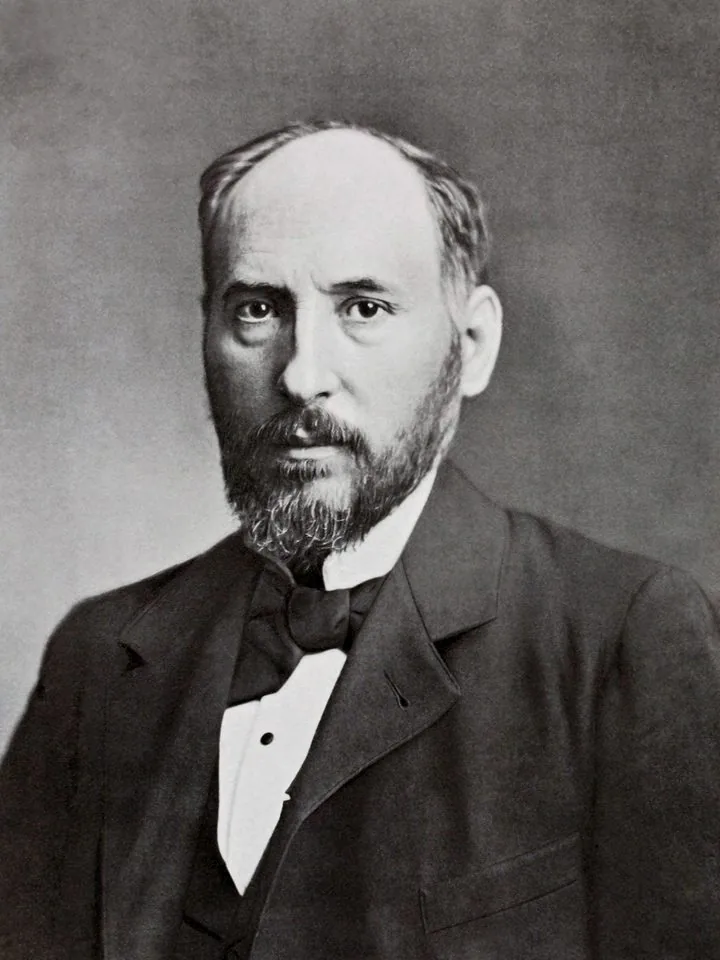
Santiago Ramón y Cajalthe LabyrinthINTP
Spain, 1852–1934 · neuroscientist, army doctor, Nobel laureate
The story
My enforced rest
In 1874, in a palm-roofed wooden hospital in the Cuban bush, a 22-year-old army doctor lay sick with malaria. Each time the fever let go of him, he reached for his English books.
Santiago Ramón y Cajal had landed in Havana on 17 June 1874 as a medical captain in the Spanish army. Cuba was in the middle of the Ten Years' War, fighting for its independence, and he never pretended the island wanted him there. He later called it, plainly, “that Cuba which loathed us.”
He was not a quiet young man by nature. Born on 1 May 1852 in Petilla de Aragón, in Navarre, the son of a country surgeon, he had been a restless, rebellious boy who preferred drawing and mischief to lessons. Cuba was about to make him sit still.
His first post was the infirmary of Vista Hermosa, near Puerto Príncipe: a huge wooden barracks with a palm roof and room for about 200 beds. Most of the men in it had malaria or dysentery. Later he ran another, at San Isidro, on the fortified line the army had built across the island, with some 300 sick men in his care.
It was only a matter of time. The fevers he had been treating in other men's bodies began to run their course in his own. The doctor and the case were now the same person.
“To crown my misfortune, dysentery was added to the malaria!”
Most people in that bed would simply wait to get better. Cajal used the waiting. Malaria comes in waves, fever and then a lull, and in the lulls he went back to his English. In his memoirs he called that time his forzoso reposo, his enforced rest. He did not call it suffering. He treated it as time.
It is a very Labyrinth thing to do. When the body stops them, the mind goes looking for something to take apart. It is a real strength, and it has a cost. A body treated as an instrument that will simply hold up does not always get looked after.
His did not hold up. In May 1875 the army discharged him with severe malarial cachexia, the wasting that long malaria brings, and in June he reached Spain a wreck. By his own wry account, the parasite he caught in his country's service left him first without blood and then without a fiancée.
He went back to anatomy. Over the next decades he stained thin slices of brain, drew what he saw under the microscope and showed that the nervous system is made of separate cells, the neurons, each one its own unit. In 1906 he shared the Nobel Prize.
That work meant keeping up with the science of the whole world, in whatever language it was written. One of those languages he had started on his back, between fevers, in a barracks in the Cuban bush.
Cuba took his health and very nearly his life. In the quiet hours between the fevers, he had taken something back.
The Labyrinth pattern in his life
- Turns forced stillness into study
- In every lull between malaria fevers, he went back to teaching himself English.
- Observes even himself like a case
- He watched his own body go through the diseases he had been treating, and later described it with a doctor's precision.
- Builds the picture piece by piece
- He mapped the nervous system one stained slice at a time and showed it is made of separate cells.
The Labyrinth: You take the idea apart because loving it isn’t the same as it being true.
Are you a Labyrinth too?
Free, no email needed. Find out which house is yours.
Take the free test
The book
The Labyrinth: A Story of Your People
His story and fourteen more, from a cave by an Ethiopian river to a monastery in Moravia and a radio laboratory in Sydney, grouped by the situations every Labyrinth runs into: work, love, friendship, money, the body, purpose and power.
More famous Labyrinths

Questions people ask
What personality type was Santiago Ramón y Cajal?
His life fits the Labyrinth, one of the houses at Grand Personalities: someone who takes the idea apart, because loving it isn't the same as it being true. Closest four-letter code: INTP.
What did Santiago Ramón y Cajal discover?
He showed that the nervous system is made of separate cells, the neurons, and mapped how they connect. He shared the 1906 Nobel Prize in Physiology or Medicine with Camillo Golgi.
What happened to Ramón y Cajal in Cuba?
He served as an army medical captain in 1874–75, during the Ten Years' War, running jungle infirmaries until malaria and dysentery broke his health. He studied English between fevers and was discharged in May 1875 with severe malarial cachexia.
Portrait: Anonymous photograph, 1899 · Public domain · Source
