The story
The book she was told to burn
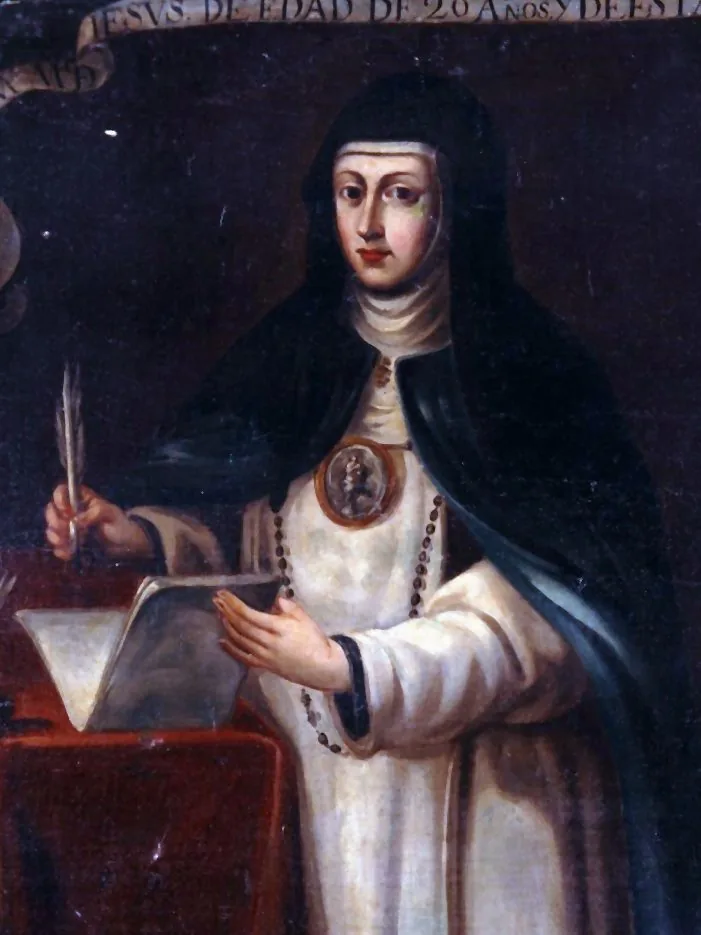
In the summer of 1643, King Philip IV of Spain, on his way to war, stopped at a convent in the small town of Ágreda and asked its abbess to write to him. She was Sor María de Jesús, known today as María de Ágreda, and she was 41.
She obeyed. For the next twenty-two years a nun who never left her cloister advised the King of Spain, in more than 600 letters between them. The letters were confidential, so one of the voices he trusted most stayed hidden from the world.
She had been born in Ágreda on 2 April 1602 and became abbess of its Franciscan convent at about 25. She was already famous for something stranger. In 1629 Jumano people in New Mexico told missionaries that a woman in blue had taught them, and she came to be called the Lady in Blue, said to have visited them without leaving her convent.
What she told the king was often stern. She believed a kingdom's fortunes followed the conduct of its ruler, and she told Philip so. She urged him to carry his own decisions instead of passing them to a favorite minister.
She carried his grief too. His queen died in 1644, and his son and heir in 1646. A nun who would never see the court answered a king's sorrow by letter, again and again.
She had no office, no army and no money of her own. What she had was a voice a king trusted, and she used it to tell him the truth. That is the kind of power Beacons hold most often.
At the same time she was writing a book of her own, the Mystical City of God, a long life of the Virgin Mary. It was the work of her life.
Then another confessor, by one account a stand-in while her own was away, told her it should be burned.
“Later on, in obedience to another confessor, she threw it and all her other writings, into the fire, without any apparent repugnance.”
Set the two halves of her life side by side. The King of Spain was asking her how to govern an empire. A single priest told her that her own book should not exist, and she fed it to the flames.
Beacons often know that shape from the inside. They speak boldly for other people's good and go quiet when the thing at stake is their own. The same obedience that made her trustworthy to a king left her work at the mercy of any man who claimed the right to judge it.
In 1655, at a confessor's command, she began it again, and she finished it in 1660. It was printed in Madrid in 1670, five years after her death, and it is still read today.
She died on 24 May 1665, aged 63, and the king followed her that September. She had spent twenty-two years telling him to own his decisions. The hardest one to own was her book, and in the end she let it stand.
The Beacon pattern in her life
- Speaks plainly to the powerful
- She told the King of Spain that his kingdom's troubles were tied to his own conduct.
- Carries other people's burdens
- When Philip lost his queen and then his heir, she answered his grief letter by letter.
- Stands up for others first
- Told by a confessor that her own book should not exist, she burned it without a fight.
The Beacon: You say the thing the room is feeling, then organize it into something people will follow.
Are you a Beacon too?
Free, no email needed. Find out which house is yours.
Take the free test
The book
The Beacon: A Story of Your People
Her story and fifteen more, from fourteenth-century Siena to twentieth-century Korea and from Hudson Bay to Buenos Aires, grouped by the situations every Beacon runs into: work, love, friendship, money, the body, purpose and power.
More famous Beacons
Questions people ask
What personality type was María de Ágreda?
Her life fits the Beacon, one of the houses at Grand Personalities: someone who says the thing the room is feeling, then organizes it into something people will follow. Closest four-letter code: ENFJ.
Who was the Lady in Blue?
It is the name given to María de Ágreda in New Mexico and Texas, where in 1629 Jumano people told Franciscan missionaries that a woman in blue had taught them. She said she had visited them in mystical journeys, though she never left her convent in Spain.
What is the Mystical City of God?
It is María de Ágreda's long life of the Virgin Mary. She burned an early version on a confessor's order, wrote it again between 1655 and 1660, and it was published in Madrid in 1670, five years after her death.
Portrait: Unidentified painter, 18th century · Public domain · Source
