Loading sample chapter…
Read the opening
You, taken all the way down
You can see the end state, specifically: the order of operations, who has to be where by when, which dependency will fail in month four if nobody names it today. You organize before anyone has asked you to, and you are frequently the reason an ambitious thing actually got finished. And more than once you have walked out of a room where everybody agreed with you and found out much later that nobody had.
People call you decisive, a natural in charge, impatient, blunt, sometimes cold. Most of that is roughly true, and none of it explains the part you live with: why the rooms you run go silent, why the people closest to you stopped arguing, and why a quiet month feels like a ruling on your whole life.
Most groups can describe a future. Almost none of them can convert one. Between a stated ambition and a dated sequence with names against it sits a translation step, and nearly every ambitious plan dies there.
That step is you. What you do is conversion: vision into sequence, sequence into a finished thing. Everyone enjoys the first and the last. The middle is where somebody has to name the date and the owner, and say that two of the five workstreams are decoration. That part is yours, which is why you're relied on and, in a way people find hard to admit, slightly resented. From outside, it looks like scheduling.
When you look at a plan, you see it running, months out, down to the approval budgeted at two weeks that will take six. You didn't decide to look. It arrives on its own, the way a musician hears a wrong note in a room where nobody else notices anything. And you can't sit with it. Watching something avoidable arrive slowly is close to physically uncomfortable.
So you act. You name the objective, set the sequence, start moving. The acting isn't ambition. It's relief: you were putting down something heavy, which is why being called power-hungry lands less as an insult than as a category error.
Everyone else lives in the present of a project. You're already standing at its end, watching the failure come, and that is where your impatience comes from: the specific fatigue of being early. By the time people react to a decision you're two decisions further on, and their objection arrives like a letter from last month. You answer it a little shortly because, for you, it's old. They hear the shortness. Nobody hears that the conversation ended for you days ago, alone, in your head.
And when you're proved right, nobody says so, because by then it feels obvious to them too. Being right early looks exactly like having had a normal opinion that later came true. You've told yourself you don't need the credit, which is mostly true and slightly not.
Put what you think you're doing next to what the people around you receive.
| What you think you're doing | What they receive |
|---|---|
| Naming the risk while it's still cheap | Being told, in front of people, that I missed it |
| Getting to the point | Skipping the part where I mattered |
| Moving on because it's settled | It's settled for you |
| Giving someone a real shot at something bigger | Being enlisted in your plan |
Both columns are accurate. You were careful and right, and what they took away was a smaller estimate of how much of the room belonged to them.
Underneath runs a low suspicion that what makes you valuable and what makes you hard to be around are the same thing, so fixing one would cost you the other. Every piece of feedback you've had says softer, slower, more collaborative, and none of it came with an instruction you could follow without getting worse at your job. The suspicion is half right. The speed and the cost come from the same place, but the cost comes from where in the process the speed gets spent, and moving it takes seconds.
You're at your best in the vacuum: the hour when a decision has been left to rot and everyone is waiting for somebody else to say it.
The Bridge Bible
What you’ll walk away with
Forty-nine pages on steering by what's ten years out, and on the people who feel every turn without ever seeing the rock.
One law, in full
LAW 01
You run a quiet month forward ten years, and trust the line.
One thing ships on a Thursday, your shoulders come down that afternoon, and the arithmetic you’d been doing at night for three weeks disappears: where you’ll be at forty-five at this rate, and who will have passed you. Nothing about your situation has changed.
You don’t experience a quiet month as a month. You run it forward, because seeing where a line goes is what your mind does with a line. One delivery couldn’t overturn a real verdict about a decade, so the verdict was only ever about whether anything had moved in the last seven days, dressed up as a projection so it would feel like analysis instead of mood. Your sense of your own worth has a refresh rate of about a week. You’d never let a colleague’s ten-year plan rest on a month of numbers.
You’d like to be valued even without the results, and you’d have no idea what to do with it, because being valued for nothing you did leaves you nothing to do in return. So praise slides off in a quiet month. The people who love you keep trying for a while, then stop. You don’t notice, because you weren’t counting their words. They notice.
The play
Hold the projection to your work standard. When you catch yourself drawing the line, decide what the next two months would have to show for the trend to be real, and refuse the projection until they’ve shown it.
All but one of the laws in the book are built like this.
Inside, in order
- 01The horizonWhat seeing ahead does to you.Laws 1–4
- 02The turnHow what you see comes out of you, and how it lands on everyone who didn't see it.Laws 5–7
- 03The deckThe people who feel the turn without ever having seen the rock.Laws 8–12
- 04Your power, at work and with moneyWhere the sight pays, and where it leaks.Work and money pages
- 05BecomingThe wake: the quiet version, the woman's penalty, the people who kept up, and what the years change.Laws 13–15
How to read your Bridge
What your partner, friends, parents and boss keep getting wrong about you, and what actually works with you.
If you’re dating one. They decide fast about everything except you, and the uncertainty is harder on them than they’ll show.
The Bridge Bible · $19 · 15 laws · 49 pages
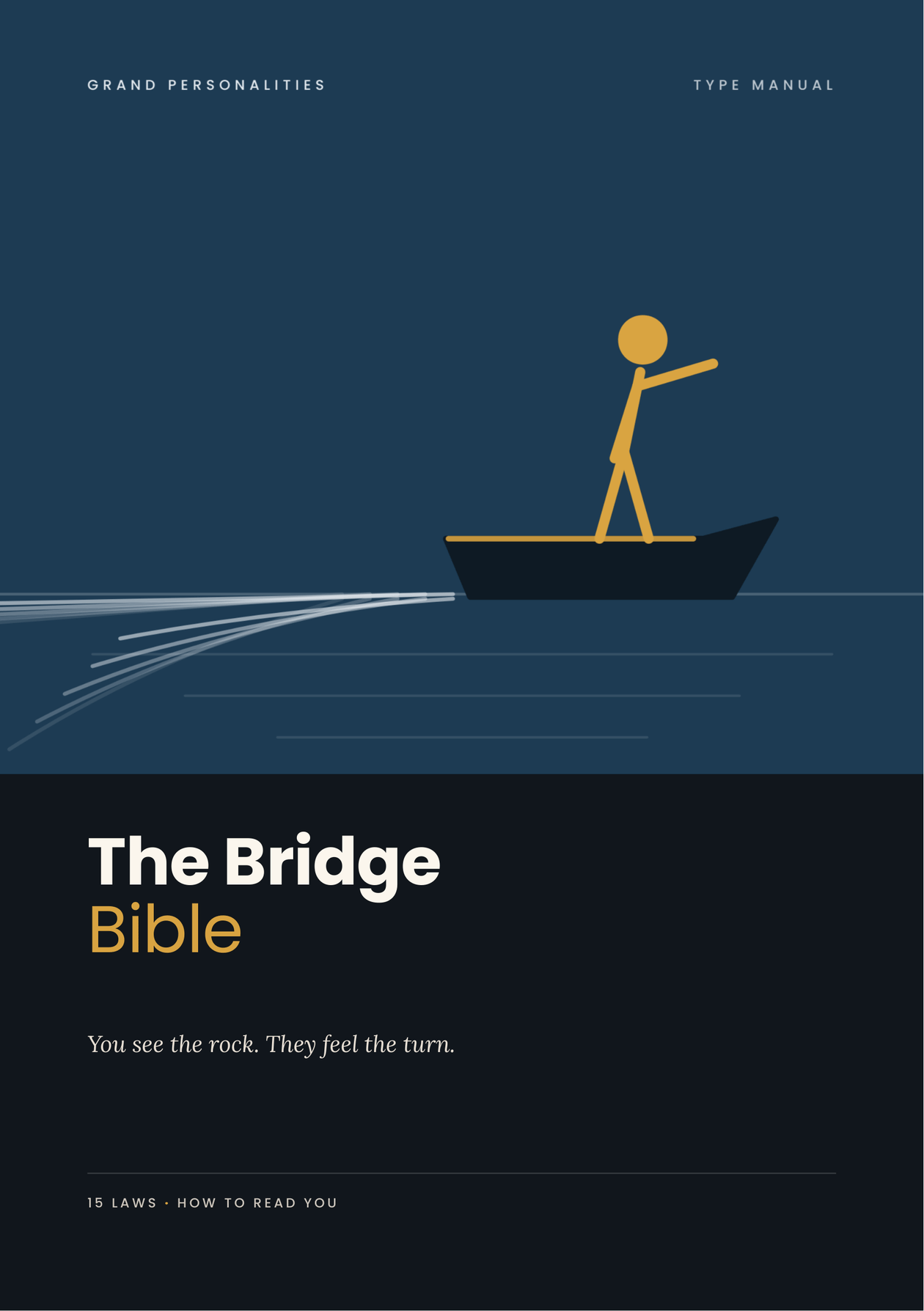
You’re not impatient. You just got there first. The conversation ended for you days ago.
What costs you is harder to see: people who stop arguing, and a quiet month that feels like a ruling on your life. Here are six of the fifteen laws, and what the book gives you for each.
Most Bridges learn it the slow way: help that left people a little smaller, old friends with no place in the fresh start, a goal planned four times and never begun.
Six of the fifteen laws
- LAW 01
Inside you
After a few quiet weeks, you spend nights working out where this pace leaves you in ten years. One thing gets done, and the forecast vanishes.
In the bookThat forecast was a mood dressed up as analysis. Your sense of your worth resets about once a week, and praise slides off until the people who love you stop offering it.
- LAW 08
People
Someone close nearly always says yes, and you knew they would. Once every month or two they say no. You argue it down, win, and sleep fine.
In the bookTheir rare no is the end of a long negotiation they held alone, not the start of one. What arguing it down costs, and the decision you’ll most want back.
- LAW 13
Who you become
Put you in charge of something and you’re as sure as anyone alive. At a party where you know two people, you find the kitchen and leave early.
In the bookYour confidence was never missing. It was waiting for a track record. What the quiet version of you checks before speaking, and how it has been steering all along.
- LAW 12
People
You redo someone’s plan overnight, and it really is better. Their thanks comes in a slightly tired voice, and you put it down to the late hour.
In the bookBeing improved by you can feel like being treated as a draft. What each upgrade quietly takes from them, and why they bring you their futures but keep their days for others.
- LAW 02
Your life
You’ve planned one thing in more detail every few months for years. Each version beats the last. Nothing starts, and at night you turn on yourself.
In the bookReplanning feels like progress and risks nothing. What a fourth plan usually means, how your values say no without arguing, and how to find out if the goal is still alive.
- LAW 04
Inside you
Some afternoons you remember exactly what you were aiming for and can’t see why it ever mattered. Nothing seems worth starting, and you can’t say what’s wrong.
In the bookYour worst stress isn’t sadness: it’s losing sight of what’s ahead. The first sign shows up in how you treat other people’s wishes, and they notice it long before you do.
And nine more laws
- Why effort can fix almost anything except love, and who quietly gets dropped when you start over. · Law 3
- How silence passes for agreement whenever the idea is yours, and where the objections turn up later, somewhere else. · Law 5
- Why something you explained twice still comes back wrong, and how one sharp minute teaches people to bring you nothing early. · Law 6
- The three things you do when a decision goes against you, and why even rescuing it takes it away from whoever made it. · Law 7
- How home turns into a project you’re always behind on, and what it does to anyone who shares it with you. · Law 9
- Why the hardest things you do for people get called cold, and the defense you build in your head and never deliver. · Law 10
- Why you tell your past like a report but guard your future, and why people miss the moment you let them in. · Law 11
- For women of this house: why deciding out loud costs you, and the quiet tiredness it leaves. · Law 14
- What keeping up with you costs the people who do it, and why they never get to arrive anywhere. · Law 15
Also in the book
- Work and money: where seeing ahead pays, where it leaks, and why the obvious reward can be a dead end. · Work and money
- Your decades: why you’re right about plans and wrong about people at first, and when that finally turns. · Your decades
- How to read your Bridge: what the people around you can learn, like why you hear disagreement as company. · For the people around you
If this chapter read you right, the book goes 49 pages further.
Order the Bridge Bible and get a second book free
 FREE
The Bridge Bible49 pages · $19
A Story of Your People14 true lives$9 free
The Bridge Bible$19
A Story of Your People$9
Bought separately$28
Yours today$19
49-page PDF, yours to download and keep. 30-day money-back guarantee. Read all of it. If it isn’t you, email us and you get every cent back.
Or get the House Set — the Bible, Romance Fits and Secrets of the Bridge — for $34 ($44 apart).
Not sure this is your house? Take the free test.