Personality typesIntrovert or extrovert
Where your energy comes from
Introvert, extrovert or ambivert?
By Grand Personalities · Updated
| Question | Introvert | Ambivert | Extrovert |
|---|---|---|---|
| Recharges | Alone, in quiet | Both ways, depending on the day | Around people |
| After a busy evening | Needs quiet to refill, even if it was fun | Glad they went, glad to be home | More awake than when they left |
| Talking | Thinks first, then speaks | Either, depending on the room | Thinks by talking |
| A long stretch alone | Content | Fine for a while, then reaches out | Restless or flat |
| The ideal weekend | One plan, or none | One plan, then a quiet day | Something on both days |
Find out which way you lean: take the free test →
The difference
What introvert and extrovert really mean
The words come from the psychiatrist Carl Jung, who used them in the early 1920s for where a person’s attention and energy flow: inward, to thought and reflection, or outward, to people and action. Psychology still measures extraversion today as one of the main personality traits.
The simplest check is what happens after a long, busy evening with people. An introvert, even one who had a good time, needs quiet to refill. An extrovert often comes home more awake than they left.
Shyness is something else. It’s fear of being judged, and it comes with either. A shy extrovert wants company and dreads it. A confident introvert is fine in a crowd and still needs the quiet afterwards.
Signs
Signs you’re an introvert or an extrovert
You lean introvert if
- You think before you speak, and the thought is finished before you say it.
- One long conversation beats a room full of short ones.
- After a busy evening you need quiet to refill, even when you enjoyed it.
- Small talk tires you faster than real talk.
You lean extrovert if
- You think by talking. The room is where the thought finishes.
- Busy places give you energy instead of taking it.
- Too long alone and you get restless or flat.
- You start conversations without having to work up to it.
If both lists sound like you, depending on the week, you’re likely near the middle.
The middle
What is an ambivert?
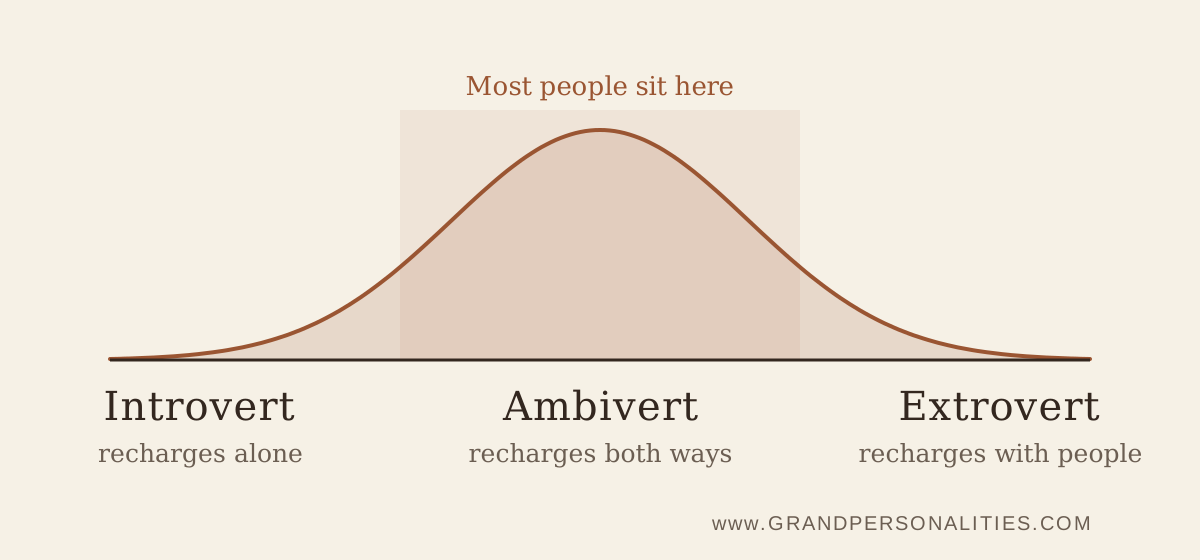
Extraversion isn’t a switch. Scores spread along a scale, and most people land near the middle. An ambivert has both sides in roughly equal measure: happy at the party, happy to leave it.
The middle has an edge. In a 2013 study of 340 call-center sales staff, the psychologist Adam Grant found that ambiverts brought in about 24% more revenue than introverts and 32% more than extroverts over three months. His reading: they were assertive enough to close the sale and still listened to the customer.
“Omnivert” is a newer internet word for someone who swings between the two ends, very social one week and very withdrawn the next. It isn’t a research term.
Even close to the middle, you still lean one way, and a personality type records that lean as its first letter.
Energy
What is a social battery?
“Social battery” is the everyday name for how much socializing you have in you before you need to recharge. It isn’t a clinical term, but the idea holds up. In a 2017 study, people logged their mood and behavior five times a day for twelve days. Being sociable lifted their mood at the time, and predicted feeling more tired about three hours later. That held for introverts and extroverts alike, and a later study found the same.
So everyone’s battery drains. What differs is how much of it people want and how they refill. Introverts tend to want less of it and refill alone, with quiet and one thing at a time. Extroverts tend to want more and refill with company. That is why the same Saturday can leave one friend buzzing and the other needing Sunday on the sofa.
A different trait
Introvert or highly sensitive?
Being a “highly sensitive person” is a separate trait, named by the psychologists Elaine and Arthur Aron in the 1990s. It’s about how strongly you react to what’s around you: noise, bright lights, crowds, other people’s moods, a tense room. By their scale, about 15 to 20% of people are highly sensitive. It isn’t a disorder.
The two often travel together, which is why they get confused. But introversion is about where your energy comes from, and sensitivity is about how much you take in. Aron estimates that about 30% of highly sensitive people are extroverts: they love company and still get overwhelmed by a loud, crowded room.
By type
Which personality types are introverts and extroverts?
Every type whose code starts with I leans introvert, and every type starting with E leans extrovert. In a large US national sample, they split about half and half. Each one has a full free profile.
Introverted types
- ISTJthe Vault: You hold the record, finish what you started, and say almost none of it out loud.
- ISTPthe Workbench: You solve it by handling it. Quiet, practical, allergic to a plan that outruns the facts.
- ISFJthe Hearth: You remember who takes their coffee how, and you carry more of the room than anyone logs.
- ISFPthe Riverstone: Unhurried, present, hard to rattle. You move when it matters and not one minute earlier.
- INTJthe Observatory: You build the whole model before you speak, then defend it like it cost you something. It did.
- INTPthe Labyrinth: You take the idea apart because loving it isn’t the same as it being true.
- INFJthe Lighthouse: Quiet, certain, and already three moves into a future you can feel but can’t prove yet.
- INFPthe Aurora: You feel the whole room and keep most of it. What you make of it comes out later, whole.
Extroverted types
- ESTJthe Garrison: You take the duty nobody wants, name the date, and hold the line after everyone else drifts.
- ESTPthe Forge: You move first, fix it live, and get bored of any meeting about the meeting.
- ESFJthe Harbor: You host, you organize, you notice who got left out, and you rarely get asked how you are.
- ESFPthe Bonfire: You raise the temperature of a room on purpose. Present tense, full volume, real warmth.
- ENTJthe Bridge: You see the end state, name the order of operations, and start moving people toward it.
- ENTPthe Arena: You argue to find out. Ten ideas an hour, and you were never attacking the person.
- ENFJthe Beacon: You say the thing the room is feeling, then organize it into something people will follow.
- ENFPthe Wildfire: Fast, warm, everywhere at once. You start the thing and someone else usually files it.
Look-alike types that differ on I and E
- INFP vs ENFP · I vs E
- INTJ vs ENTJ · I vs E
- INFJ vs ENFJ · I vs E
- ENTP vs INTP · E vs I
- ISFJ vs ESFJ · I vs E
- ISFP vs ESFP · I vs E
- ISTP vs ESTP · I vs E
- ISTJ vs ESTJ · I vs E
- INFJ vs ENFP · I vs E, J vs P
- ENFJ vs INFP · E vs I, J vs P
- ENTP vs INTJ · E vs I, P vs J
- ENFP vs INTP · E vs I, F vs T
- ENFJ vs ISFJ · E vs I, N vs S
The free test
How the free test reads it
The first part of the free test is about exactly this: how you recharge. Your answers place you on the outgoing or the reserved side, and that becomes the first letter of your type. The other three parts read what you trust as information, how you make decisions and what you do with an open loop.
It takes about ten minutes and ends with a full free profile for your type.
FAQ
Questions about introverts, extroverts and ambiverts
Am I an introvert or an extrovert?
Ask where your energy comes back. After a full day with people, do you need quiet to recover (introvert), or do you want more company (extrovert)? If both feel true depending on the day, you’re probably near the middle of the scale, which is what “ambivert” means.
What is an ambivert?
An ambivert sits near the middle of the introvert–extrovert scale: comfortable in company and comfortable alone, without a strong pull either way. Personality data suggest most people fall in this middle range rather than at either end.
What is an omnivert?
“Omnivert” is a newer internet word for someone who swings between the two ends: very social for a stretch, then very withdrawn. It isn’t a research term. An ambivert is moderate on both sides at once; an omnivert is described as extreme on each in turn.
Are introverts shy?
Not necessarily. Shyness is fear of being judged, and it can come with either. A shy extrovert wants company and dreads it at the same time. A confident introvert is at ease in a crowd and still needs the quiet afterwards.
What is a social battery?
It’s an everyday way to describe how much socializing you have in you before you need to recharge. It isn’t a clinical term, but research backs the idea: in a small study, people felt better while being sociable and more tired about three hours later, introverts and extroverts alike. Introverts tend to want less of it and recharge alone; extroverts tend to want more and recharge with company.
Why am I so tired after socializing?
Being around people takes effort even when you enjoy it: tracking faces, timing and what comes next. If you lean introvert, you’ll likely want to stop sooner and recharge alone, which is normal. If the tiredness comes with dread or low mood most days, it’s worth talking to a doctor, because that is more than a social battery.
Is a highly sensitive person the same as an introvert?
No. Being highly sensitive is about how strongly you react to what’s around you: noise, crowds, other people’s moods. Being introverted is about where your energy comes from. They often overlap, but the psychologist who named the trait estimates that about 30% of highly sensitive people are extroverts.
Can an introvert become an extrovert?
Your basic lean tends to stay fairly stable through adult life. Skills change a lot: introverts can learn to present, network and lead, and many do it well. They still need the time alone afterwards.
What percentage of people are introverts?
About half. In the large US national sample used on the rarest-type page, the introverted types add up to about 51% of people and the extroverted types to about 49%.
Which personality types are introverts?
The types whose code starts with I: ISTJ, ISTP, ISFJ, ISFP, INTJ, INTP, INFJ and INFP. Of these, the ISFJ is the most common and the INFJ the rarest. The types starting with E are the extroverted ones.
Introvert or extrovert? Find out which way you lean
Free, about ten minutes. The test names your type, then gives you a full free page for it.
Take the free test