Loading sample chapter…
Read the opening
You, taken all the way down
You are the person who has already tried the obvious fix while the room is still describing the problem. A week of planning for a two-hour job makes you want to leave the building. And at least once you've been told you don't care what anyone thinks, by the person whose problem you had just solved.
People hand you a short version of yourself: fearless, quick, great in a crisis, bored by anything slow. Some of it is even true. What it leaves out is everything under the speed. You're thinking the whole time, in a form nobody can see. You feel all of it, and handle it where nobody's watching. And the people who keep up with you are paying for it in a way neither of you has ever counted.
The usual order is understand, then act. You run it the other way: the action is how you understand. A quick try isn't a shortcut past the analysis; it is the analysis. Every move is a question put straight to the world.
So you and the people around you run on different clocks. You get from not sure to know by moving, which takes minutes. They get there by discussing, which takes days. And you have no beat between deciding and doing. Other people decide, pause, then move, and the pause is where they put the sentence, the check, the message to whoever should know. For you the deciding is the moving, one event, which is why twenty years of being told to say something first has never once worked.
What you think you're doing and what the room receives are both accurate, which is what makes it so hard to argue your way out.
| What you're doing | What the room receives |
|---|---|
| Finding out whether it works, cheaply, by trying it | A decision made without us, announced afterward |
| Solving the problem they brought you, immediately | Dismissing the thing they came to say |
| Being over it, honestly and completely, within the hour | Proof that it never mattered to you |
| Giving the true answer at normal volume, so it's useful | A verdict, delivered without care, in front of people |
| Adjusting the plan because conditions changed | Unreliability: you said one thing and did another |
One operation runs under most of these, and it's why you are read as not caring, on the evidence of being fine. The room reads what a thing cost you as a statement of what it was worth to you. Recovery was cheap, so the thing was small, so it didn't matter, so they didn't matter. The inference is wrong, and completely reasonable, because for nearly everyone else it holds.
This is why your apology doesn't work. It's instant, sincere and free, and the person receiving it can feel that it's free. They wanted it to cost you what the injury cost them. It cost you eleven seconds, and eleven seconds is what they heard.
And you know your own recovery to a fine tolerance: how long you're down after a bad one, usually hours, occasionally a day. You've tested that number many times. It's also the only such number you have, so you price every move at what it would cost you, which is nearly nothing, and you're honestly astonished when somebody presents a bill.
The bill arrives in the worst possible form: a judgment of your character instead of a number. You don't care, you're not reliable, you do whatever you want. All three are false, so you defend yourself, and defending yourself is exactly what someone who didn't care would do. The one piece of information that mattered, what it cost, whom, and for how long, never changes hands. You've had that conversation more than once. You have never come out of it knowing the number.
Nobody gives you the numbers because the cost of your speed is paid in a currency that leaves no record: somebody else's recovery time. The person paying it can't tell you, because the only available sentence sounds like complaining about something that already worked out. So they keep it to themselves, and one day they stop telling you about the problem on their desk. You never find out you've moved down their list, because that's invisible too.
You are called for the emergency. You are not called for the plan. You were almost never in the room six months earlier, when the decision got made that produced the emergency; in fairness, you've made it clear you'd rather be anywhere than in that meeting. So you're loved enormously in the moment, and very few people keep a record of you over time. When you rescue someone in the middle of the night, the debt lands and clears before morning: for you, because you don't carry debts, and for them, because you made it look like nothing. Twenty years of that and you can end up with an extraordinary number of people who would come if you called, and nobody at all who knows what this year has actually been like.
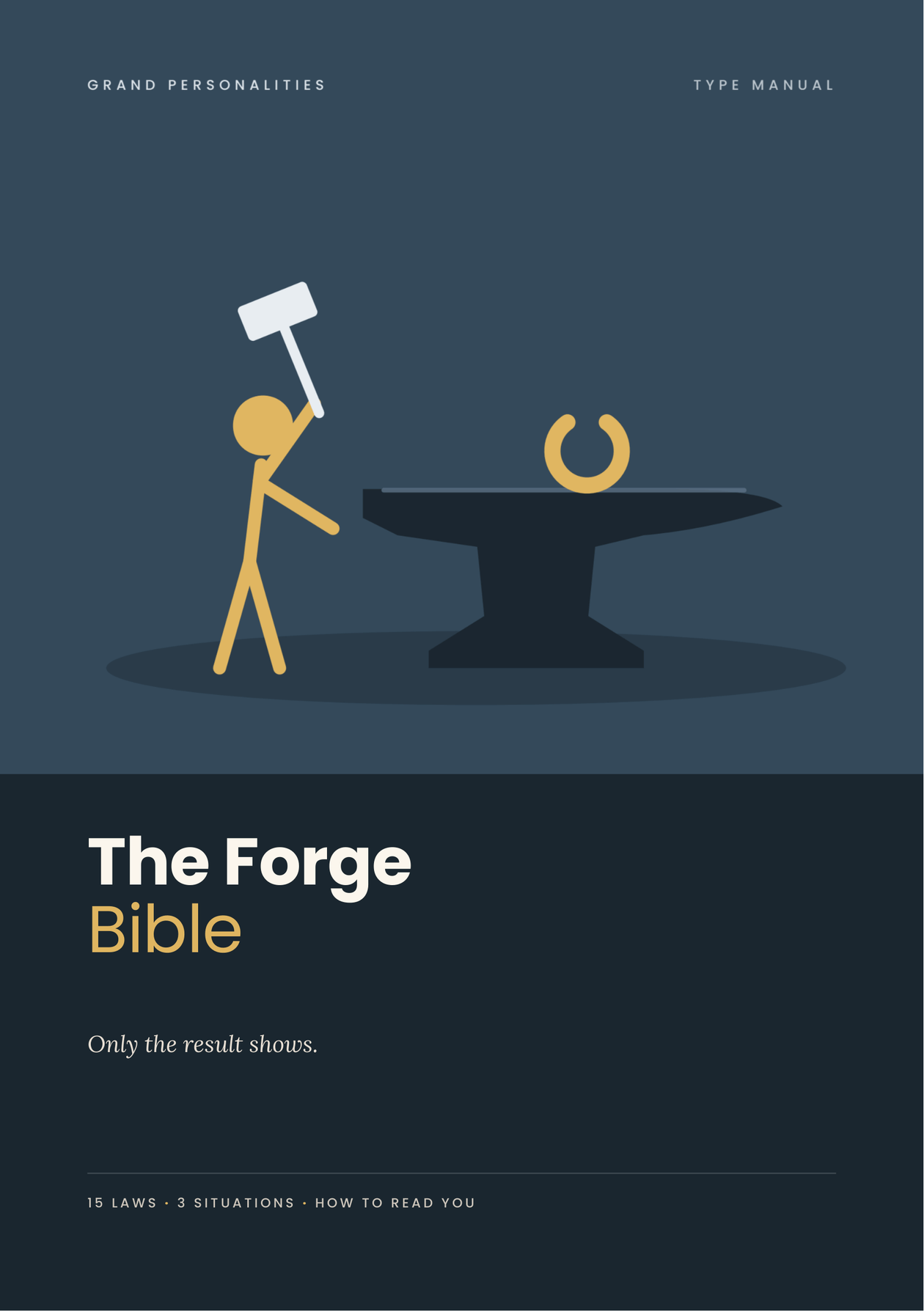
The Forge Bible
What you’ll walk away with
Fifty-three pages on the part of you nobody sees: the read before the move, the reset after it, and the slow months in between.
One law, in full
LAW 01
People see the move. They never see the read that aimed it.
You saw it first. Forty minutes into the meeting you knew which way it would go, and you said nothing, because you couldn’t have defended it in words. Twenty minutes later someone arrived at the same answer with three slides and got the credit. On the days you do move on what you saw and it works, somebody calls you lucky, and part of you has started to suspect they’re right.
Your own memory agrees with them. Your hits leave it almost as soon as they land, because you’re already on the next thing. The people around you store your misses in detail, because a miss cost them something. And the read happens without words, so the only outside verdict it ever gets is lucky. In the end there’s no record of the read anywhere, including inside you. So you stop trusting it where it matters most: in the big meeting, with the senior people, where you most need it and can least explain it.
Explaining looks like thinking; seeing doesn’t look like anything. By the time you moved, the noticing was done: who went still when the price came up, which deadline was the real one.
The play
Say the tell, not the conclusion. The moment you notice something, say that one observation out loud with no verdict attached. An observation is hard to argue with and easy to add to, and said before the result it gives the result a visible cause.
Give your call to one person before the room hears it. Before the big meeting, or a launch people will watch, tell one colleague you trust how you think it’ll go and what would tell you you’re wrong. When it lands, someone other than you holds the record. When it doesn’t, they watched a test with an exit instead of a gamble. Over a year, that person becomes what you’ve never had: a memory of your read.
Every law in the book is built like this.
Inside, in order
- 01What ShowsThe move, and what people decide it means.Laws 1–3
- 02What Doesn't ShowThe read before the move, and the reset after it.Laws 4–8
- 03IdleThe danger is the weeks where nothing moves, not the hard ones.Laws 9–12
- 04On the ClockYour speed at work and with money.Work and money pages
- 05The Next MoveThe quiet version of you, the true sentence, the cleanup, and the decades.Laws 13–15
3 situations
- You’ve put money into something big, and your partner doesn’t know yet
- A child you love is sad, and there’s nothing to fix
- Someone close hasn’t done anything of their own in months
How to read your Forge
What your partner, friends, parents and boss keep getting wrong about you, and what actually works with you.
Friend. The jab means you’re in. And if the teasing stops, they’re running low.
The Forge Bible · $19 · 15 laws · 53 pages
Getting over things fast isn’t the same as not caring. You feel all of it, and handle it alone.
What costs you never shows: the thinking behind every move, and the time other people take to recover from it. Here are six of the fifteen laws, and what the book gives you for each.
Most Forges learn it the slow way: apologies that sounded free, good calls written off as luck, plenty of people who’d come if called but nobody who knows what this year was like.
Six of the fifteen laws
- LAW 05
Inside you
Something hits you hard and you get through it alone, fast. That night the person closest to you hears nothing. Next morning, unasked, you tell them everything.
In the bookTo you there was nothing to tell: it was already over. Why that shuts out the people who’d drop everything for you, and what helps on nights too big to finish alone.
- LAW 04
People
You’re warmer with someone you met an hour ago than with the people closest to you, and you’ve never said why, even to yourself.
In the bookYou know how charm can be aimed, so turning it on someone you love feels like playing them. What they conclude instead, and why your big gestures come out stiff.
- LAW 01
Inside you
You often see how something will go before anyone else, but can’t explain it. When you act on it and it works, people call you lucky.
In the bookYour good calls slip from memory as they land, while others keep your misses in detail. So you stop trusting what you see just where it matters most. The book shows how that changes.
- LAW 13
Who you become
At a friend’s party you’re mixing the drinks, the easiest person there. Among strangers, with nothing to hold or do, your hands feel wrong and you leave early.
In the bookYou may have spent years deciding you’re a quiet person. Why your attention needs something to hold, what happens when it turns back on you, and which of the two is really you.
- LAW 06
People
A friend calls you selfish as a joke, and you laugh along. You forgive them completely, and move them one place further from the center of your life.
In the bookA hit you can answer, you settle the same day. One dressed as a joke stays. Why it stays, and the friendship you’re ending without ever telling them.
- LAW 09
Your life
In your worst stretch, every day was full, so you told everyone you were fine. You were short with people, and nothing actually moved.
In the bookBusy reads to you as fine, even in weeks where nothing moves. When you finally feel it, it looks like the wrong life, and your worst decisions get made there.
And nine more laws
- Why you push on rules to see whether anyone will hold them, and what you feel when someone close gives way. · Law 2
- What your teasing really tests when someone new arrives, and the solid people who fail a test they never knew they took. · Law 3
- How your worst line in a fight lands so exactly, and why you honestly can’t remember saying it. · Law 7
- The real reason you stop teasing people, and how a loud stretch can pass for you at your best. · Law 8
- Why you poke at someone close once you’ve read them all the way through, and the part of them you never actually see. · Law 10
- How a dark hunch in a slow month feels just like your best instincts, and what it drives you to do when someone close is late. · Law 11
- The calm life you choose after a big win, and why it can go flat without anyone noticing, least of all you. · Law 12
- Why your energy makes people expect you to go along, so your honesty breaks a promise you never made. · Law 14
- Why the cleanup after your fast moves lands on the people slowest to recover, when it would cost you a fraction as much. · Law 15
Also in the book
- Three situations no single law covers, like someone close saying they haven’t done anything of their own in months. · Situations
- Work and money: why you’re wrong more often than careful people but for far less time, and where that wins. · Work and money
- Your decades: how this changes with age, from speed that peaks early to instincts that keep sharpening for thirty years. · Your decades
- How to read your Forge: for the people around you, starting with why being teased by you means they’re in. · For the people around you
If this chapter read you right, the book goes 53 pages further.
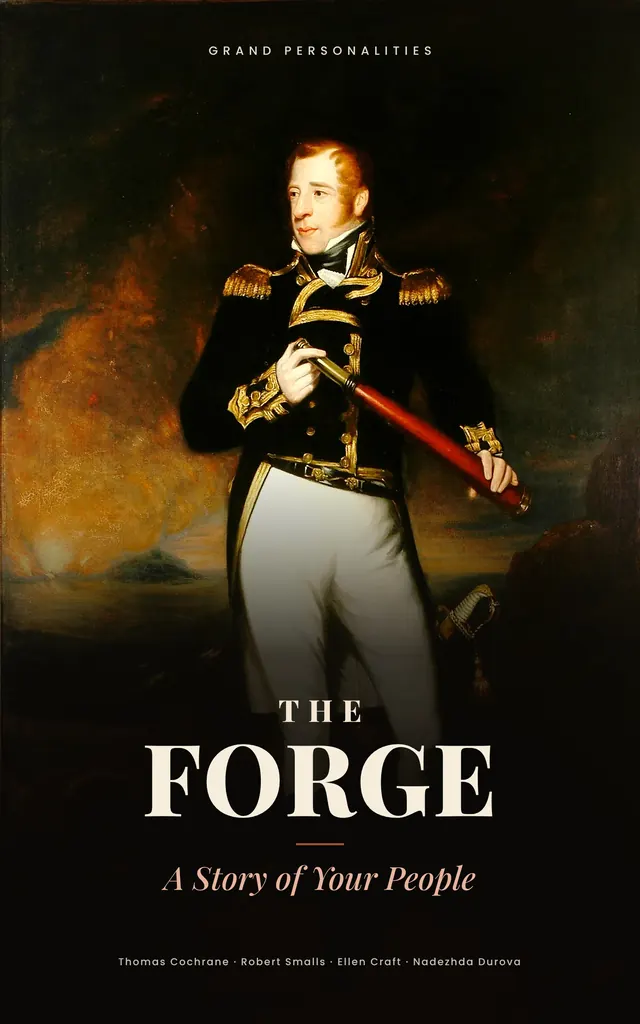
Order the Forge Bible and get a second book free
 FREE
The Forge Bible53 pages · $19
A Story of Your People15 true lives$9 free
The Forge Bible$19
A Story of Your People$9
Bought separately$28
Yours today$19
53-page PDF, yours to download and keep. 30-day money-back guarantee. Read all of it. If it isn’t you, email us and you get every cent back.
Or get the House Set — the Bible, Romance Fits and Secrets of the Forge — for $34 ($44 apart).
Not sure this is your house? Take the free test.