Famous Riverstones
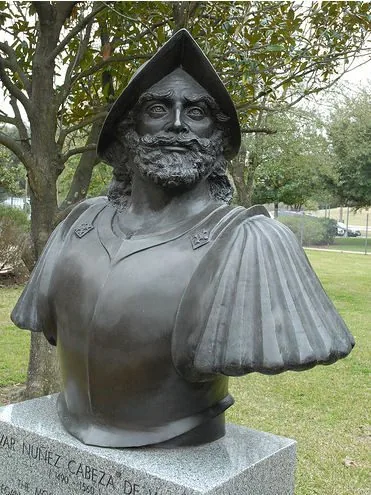
Álvar Núñez Cabeza de Vacathe RiverstoneISFP
Spain and North America, c. 1490–c. 1559 · castaway, healer, writer
The story
A line in the palm
Around 1535, in a village of many houses beside a river, far north of the lands Spain then held, people brought Álvar Núñez Cabeza de Vaca a man with an arrowhead lodged in his chest. Cabeza de Vaca was about 45. He had no ship, no rank and no money. He had a knife.
Eight years earlier, on 17 June 1527, he had sailed from Spain as royal treasurer of an expedition led by Pánfilo de Narváez. The expedition landed in Florida in 1528 and fell apart. By November he was shipwrecked on an island near today's Galveston, Texas.
For about six years he lived among the peoples of that coast, at times as a slave, later as a trader. Then he and three other survivors slipped away and walked west: two Spaniards, Andrés Dorantes and Alonso del Castillo, and Estevanico, an enslaved man from Azemmour in Morocco.
Along the way, people began bringing the four their sick. Healing became how they ate and how they were passed safely from one people to the next. A healer who failed could lose everything.
So the man was brought in. Long before, an arrow had struck him in the right side of his back, and its point now lay over his heart. He said it hurt a great deal and made him suffer all the time.
Cabeza de Vaca did what Riverstones tend to do in a crisis. He went to the body first. “I touched him and felt the arrowhead,” he wrote. With a knife he happened to have, he opened the chest to the spot. The point would not come. He cut further, worked the tip of the knife under it, and at last drew it out.
His only comment is about the thing in his hand: “It was very long.”
“With a deer bone, I practiced my trade as a physician and gave him two stitches.”
He stopped the bleeding with hair scraped from an animal skin. Then the people asked him for the arrowhead, and he gave it to them. The whole village came to see it, and it was sent on inland with dances and feasts. He did not keep the proof. The arrowhead did his talking for him.
The next day he cut the stitches, and the man was well. The cure, he wrote, gave the four “such standing throughout the land” that people valued them to their utmost.
He was no saint. He served a conquest, wrote his account to win royal favor, and never named the man whose chest he opened. In 1536 the four reached Mexico City. Years later his own settlers at Asunción, the South American colony he had been sent to govern, seized him and shipped him home for trial. He died in Spain around 1559.
Yet his best pages are those of a man still looking closely at the world in front of him, after it had taken everything else.
He came back the morning after the cut to check his work. The incision, he noted, now looked “only like one of the lines in the palm of one's hand.” He had lost his ship, his rank and his plan. His hands still knew what to do, and his eyes still caught the small things that Riverstones notice.
The Riverstone pattern in his life
- Goes to the body first
- Brought a man in pain, he touched the chest, felt the arrowhead and cut, with no speech beforehand.
- Lets the result speak
- He gave the arrowhead away, and it traveled inland from village to village, telling his story for him.
- Notices the physical detail
- His only comment on the surgery was that the arrowhead “was very long”.
The Riverstone: Unhurried, present, hard to rattle. You move when it matters and not one minute earlier.
Are you a Riverstone too?
Free, no email needed. Find out which house is yours.
Take the free test
The book
The Riverstone: A Story of Your People
His story and eleven more, from Ming China and Habsburg Madrid to the Arctic ice and the South Pacific, grouped by the situations every Riverstone runs into: the body, work, family, friendship, money, power and the long question of who you are.
More famous Riverstones
Questions people ask
What personality type was Cabeza de Vaca?
His life fits the Riverstone, one of the houses at Grand Personalities: someone unhurried, present and hard to rattle, who moves when it matters and not one minute earlier. Closest four-letter code: ISFP.
How did Cabeza de Vaca survive in North America?
After the Narváez expedition collapsed and he was shipwrecked near today's Galveston in 1528, he lived for years among the coastal peoples as a slave and then a trader. He then walked west with three other survivors, living as a healer, until they reached Mexico City in 1536.
What surgery did Cabeza de Vaca perform?
Around 1535 he cut an old arrowhead out of a man's chest with his knife and closed the wound with two stitches made with a deer bone. The next day he removed the stitches, and he wrote that the man felt no pain at all.
Portrait: Photo: Ealmagro, 1 April 2009 · CC BY-SA 4.0 · Source
