Famous Riverstones
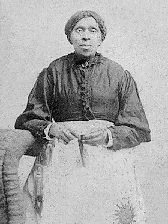
Harriet Powersthe RiverstoneISFP
Georgia, 1837–1910 · quilter, storyteller, folk artist
The story
Wrapped twice
One afternoon around 1891, Harriet Powers came into Athens, Georgia, in an ox-cart. She was in her early fifties. On her lap, wrapped in a clean flour sack and then again in a coarse crocus sack, was the quilt she had once refused to sell.
She had made it in the mid-1880s: eleven panels of Bible stories, stitched by hand and machine, a little over six feet by seven. At the 1886 cotton fair in Athens, a young art teacher from the Lucy Cobb Institute, Jennie Smith, saw it and asked to buy it. Smith thought her style bold, close to the Impressionists. Powers said no. By Smith's account, the quilt was not for sale at any price.
For a woman born into slavery, with little money, that was not a small refusal. Riverstones often put what they cannot easily say into what they make. The quilt held her faith and her stories, panel by panel, and she would not part with it.
She had been born on 29 October 1837, near Athens, enslaved. She lived to see freedom come in 1865. She could read and write, whatever some newspapers later claimed, but her real language was cloth.
Four years after the fair, hard times came, and Powers let Smith know the quilt could now be bought. Smith was short of money herself that year. The next year she sent word that she would buy it.
So the quilt came to town on Powers's lap, wrapped twice, the way you might wrap a child against the cold. She said nothing about what it meant to her. The two sacks said it.
She asked ten dollars. Smith had only five. Powers went outside to her husband, Armstead, who was waiting with the cart. He said she had better take the five, and she did.
Then she did the most important thing in her story. Before she left, she went through the quilt scene by scene and explained every one to its new owner. Smith remembered how earnestly she did it. Powers had been paid half her price for the thing she would not sell, and she made sure it would go understood.
She came back to Smith's house several times to visit it. By Smith's account, the only thing that consoled her a little was a promise of the leftover scraps of fabric. The loss would be survived by making.
And she kept making. Around 1898 she finished a second great story quilt, now called the Pictorial Quilt, mixing Bible scenes with things she had seen or heard told. Her own descriptions of its panels survive, with an eye for the funny and the terrible side by side. Of one bitter winter's day: “A man frozen at his jug of liquor.”
“The independent hog which ran 500 miles from Georgia to Virginia, her name was Betts.”
She died on 1 January 1910, at 72. The quilt she sold for five dollars is now in the Smithsonian's National Museum of American History. The second hangs in the Museum of Fine Arts, Boston.
Smith wrote down what Powers told her that afternoon, and those notes are still how the first quilt is read today: one scene at a time, the way its maker explained it before she let it go.
The Riverstone pattern in her life
- Speaks through what she makes
- Her quilts carried her faith and her stories, panel by panel, more fully than words could.
- Quiet about the price
- Offered half of what she asked, she stepped outside to ask her husband, then took the five dollars without a scene.
- Makes sure the meaning survives
- Before handing over the quilt, she explained every scene to the buyer, and came back several times to visit it.
The Riverstone: Unhurried, present, hard to rattle. You move when it matters and not one minute earlier.
Are you a Riverstone too?
Free, no email needed. Find out which house is yours.
Take the free test
The book
The Riverstone: A Story of Your People
Her story and eleven more, from Ming China and Habsburg Madrid to the Arctic ice and the South Pacific, grouped by the situations every Riverstone runs into: the body, work, family, friendship, money, power and the long question of who you are.
More famous Riverstones

Questions people ask
What personality type was Harriet Powers?
Her life fits the Riverstone, one of the houses at Grand Personalities: someone unhurried, present and hard to rattle, who moves when it matters and not one minute earlier. Closest four-letter code: ISFP.
How much did Harriet Powers sell her Bible Quilt for?
Five dollars. She asked ten, but the buyer, the Athens art teacher Jennie Smith, had only five, and Powers's husband advised her to take it.
Where are Harriet Powers's quilts today?
Her two surviving story quilts are in museums: the Bible Quilt at the Smithsonian's National Museum of American History in Washington, and the Pictorial Quilt at the Museum of Fine Arts, Boston.
Portrait: Unknown author, 1901 · Public domain · Source
