Famous Riverstones
Fletcher Christianthe RiverstoneISFP
England, 1764–1793 · sailor, mutineer, Pitcairn settler
The story
I am in hell
Just before sunrise on 28 April 1789, off the island of Tofua in what is now Tonga, Fletcher Christian walked into his captain's cabin with armed men and seized him in his bed. Christian was 24. It was his watch.
They tied William Bligh's hands behind his back and took him on deck. The others carried muskets and bayonets. Christian, Bligh noticed, “had only a cutlass in his hand.”
The two men knew each other well. Bligh was 34. This was the third voyage Christian had made with him, and Bligh wrote that he had been on “the most friendly terms” with the younger man. He had been something close to a patron.
Now the patron asked whether this was “a proper return for the many instances he had received of my friendship.” Christian, he wrote, “appeared disturbed at my question, and answered, with much emotion”.
“That,—captain Bligh,—that is the thing;—I am in hell—I am in hell.”
Read it slowly. Five broken phrases from a man who had held something in for weeks and had run out of words for it.
By the ship's master's account, he had tried words once. In the days before the mutiny, John Fryer heard him tell Bligh: “Sir your abuse is so bad that I cannot do my Duty with any Pleasure.” He added that he had been in hell for weeks. Nothing changed. The night before the mutiny, Christian excused himself from supper with Bligh “on pretence of being unwell.” He was due to dine with him the next day.
This is the hard edge of a pattern Riverstones know well. They are patient and hard to rattle. They keep the peace, say it's fine, and accept the dinner invitation. On a small ship half a world from home, there was no one above the captain to take a grievance to. So the silence built until it came out as a cutlass.
Even the man he overthrew could see what it cost him. Bligh thought he looked to be “meditating instant destruction on himself and every one,” and wrote that “the remembrance of past kindnesses produced some signs of remorse in Christian.”
The price was enormous, and other people paid most of it. Bligh and eighteen men were put into a launch “twenty-three feet long from stern to stern,” with no chart, while men on deck shouted “Huzza for Otaheite.” Bligh brought them across more than 3,500 nautical miles of open sea to Timor. Three mutineers were later hanged.
Christian took the Bounty to remote Pitcairn Island with a few mutineers and men and women from Tahiti, and on 23 January 1790 the ship was burned there. The mutineers treated the Polynesian men as servants, and the violence that followed killed Christian, probably on 20 September 1793. He was 28.
By one account he had said it plainly once, to the one man who could change it, and the one man who would not hear it.
The Riverstone pattern in his life
- Slow to complain
- He kept the peace for weeks and pleaded unwell rather than sit through another supper with Bligh.
- Feels it before he says it
- When the words finally came, they were five broken phrases: “I am in hell—I am in hell.”
- Moves all at once
- After weeks of silence, he took the ship in a single dawn watch.
The Riverstone: Unhurried, present, hard to rattle. You move when it matters and not one minute earlier.
Are you a Riverstone too?
Free, no email needed. Find out which house is yours.
Take the free test
The book
The Riverstone: A Story of Your People
His story and eleven more, from Ming China and Habsburg Madrid to the Arctic ice and the South Pacific, grouped by the situations every Riverstone runs into: the body, work, family, friendship, money, power and the long question of who you are.
More famous Riverstones

Questions people ask
What personality type was Fletcher Christian?
His life fits the Riverstone, one of the houses at Grand Personalities: someone unhurried, present and hard to rattle, who moves when it matters and not one minute earlier. Closest four-letter code: ISFP.
Why did Fletcher Christian lead the mutiny on the Bounty?
No one can say for certain. By the ship's master's account he had told Bligh that his abuse was so bad he could not do his duty, and on the morning of the mutiny he told Bligh, “I am in hell.”
What happened to Fletcher Christian after the mutiny?
He sailed the Bounty to Pitcairn Island, where the ship was burned on 23 January 1790. He was killed there in September 1793, probably on the 20th, at the age of 28.
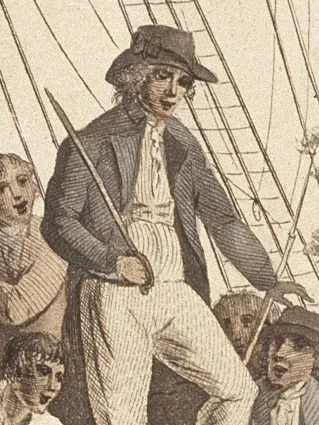
Portrait: Robert Dodd, 1790 (detail) · Public domain · Source
