Famous Riverstones
Mary Anningthe RiverstoneISFP
Lyme Regis, 1799–1847 · fossil hunter, collector, palaeontologist
The story
None of the advantages
On 11 October 1833, Mary Anning wrote to her friend Charlotte Murchison that the cliff at Lyme Regis had come down on her dog. She was 34.
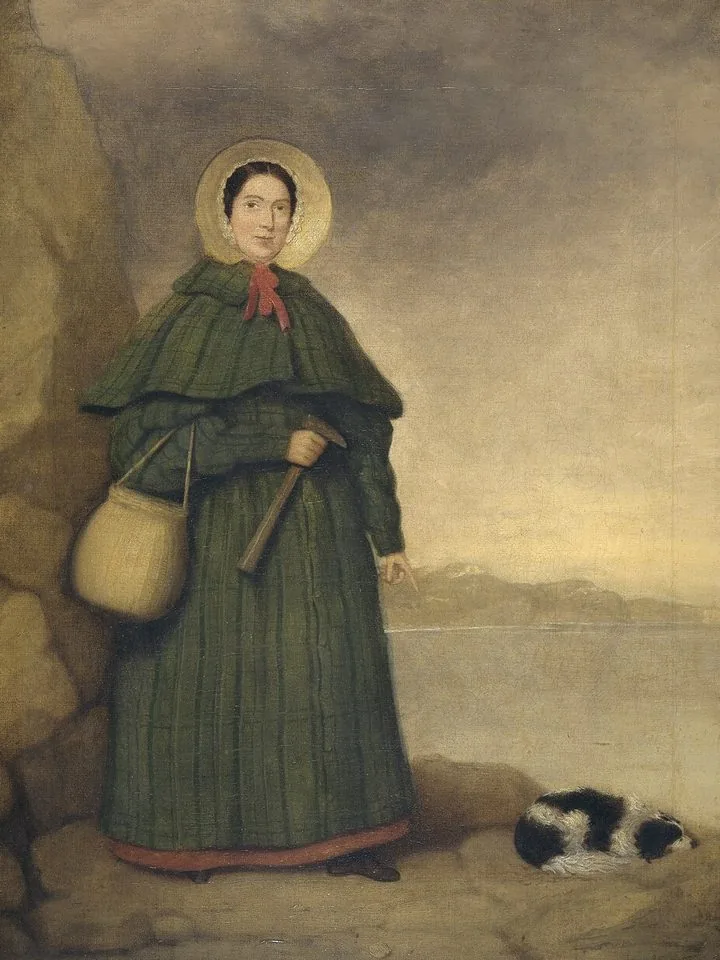
Tray went with her on the shore while she worked, and he is in her portrait. The fall killed him “in a moment before my eyes, and clost to my feet,” she wrote.
“Perhaps you will laugh when I say that the death of my old faithful dog quite upset me … it was but a moment between me and the same fate.”
Look at the order. First an apology for being upset at all. Then the facts. Only at the very end, how close it had been. Riverstones often put the biggest thing last, after the apology, where it is easiest to miss.
Then she went back to the cliffs. They were her living. She was born at Lyme on 21 May 1799, and when her father died in 1810 the family went on poor relief. They had no land and no savings. They had the shore, where storms brought down soft rock full of creatures from an ancient sea, and where a rockfall or a fast tide could kill you.
At 12, after her brother Joseph found its skull, she found the rest of an ichthyosaur, a great sea reptile. At 24 she found the first near-complete plesiosaur. A visitor in 1824 wrote that “the moment she finds any bones she knows to what tribe they belong.” That is the Riverstone eye: the thing itself, known at a glance by someone who has handled thousands like it.
The descriptions were another matter. The learned papers on her finds were written by gentlemen-geologists. The Geological Society did not admit women, so she could never join the body where her work was discussed. Her name might appear in a paper, or it might not.
Most people found her quiet. On walks along the shore in the early 1830s, with a young friend named Anna Maria Pinney, she said what she thought. Pinney set it down in her journal. The world had used Anning ill. “These men of learning have sucked her brains,” and made money and names from books whose contents she supplied, “while she derived none of the advantages.”
By her friend's account, what money Anning did make went to her family, or to anyone else who needed it.
Both things were true at once. Calm with most of the world, blunt with one trusted friend, and generous every day without anyone thinking to mention it. Many Riverstones know that mix from the inside.
Recognition came late and small. In 1839 a few lines from one of her letters appeared in a natural history magazine, the only words of hers printed in her lifetime. She died at Lyme on 9 March 1847, at 47.
Eighteen years later, a London magazine said what she had only ever said on a beach: “The carpenter's daughter has won a name for herself, and has deserved to win it.” She had won it with her own hands, long before anyone wrote it down.
The Riverstone pattern in her life
- Knows by eye and hand
- A visitor wrote that the moment she found a bone, she knew “to what tribe they belong.”
- Calm on a dangerous shore
- After the cliff killed her dog at her feet, she went back to collecting.
- Fierce with one trusted person
- On walks with a young friend, she said the men of learning had “sucked her brains.”
The Riverstone: Unhurried, present, hard to rattle. You move when it matters and not one minute earlier.
Are you a Riverstone too?
Free, no email needed. Find out which house is yours.
Take the free test
The book
The Riverstone: A Story of Your People
Her story and eleven more, from Ming China and Habsburg Madrid to the Arctic ice and the South Pacific, grouped by the situations every Riverstone runs into: the body, work, family, friendship, money, power and the long question of who you are.
More famous Riverstones

Questions people ask
What personality type was Mary Anning?
Her life fits the Riverstone, one of the houses at Grand Personalities: someone unhurried, present and hard to rattle, who moves when it matters and not one minute earlier. Closest four-letter code: ISFP.
Why didn't Mary Anning get credit for her discoveries?
The papers describing her finds were written by gentlemen-geologists, and the Geological Society did not admit women, so her name was often left out. She told a friend the men of learning had “sucked her brains.”
How did Mary Anning's dog Tray die?
In October 1833 a cliff fall at Lyme Regis killed Tray at her feet. She wrote to a friend that “it was but a moment between me and the same fate.”
Portrait: Portrait, before 1842 · Public domain · Source
