Loading sample chapter…
Read the opening
You, taken all the way down
You don't hurry and you don't panic, and people find that either deeply calming or maddening, with almost nothing in between. You have values that don't move, and you've almost never announced them. You'll absorb a great deal without complaint, and then one day the answer is no, and it isn't an opening position, and nobody saw it coming, because you were busy being easy to be around. You're good at that. If you're honest, you also hide behind it.
People have been telling you who you are all your life. Quiet until people earn the other version. Easygoing. Good with your hands, with animals, with anything in front of you right now. Allergic to five-year plans and to being told how. Gifted in a way people keep calling artistic, though you'd call it getting a thing right. None of it is wrong, and none of it has ever helped you, because it describes the stone as it looks from the bank and never what it costs you to be one.
You have something close to a physical intolerance for being rushed into a position you haven't felt out, because you won't hold a view you haven't checked against your own experience. The catch is that your method leaves no trail. Someone who thinks out loud leaves the half-formed opinion and the changed mind; you leave a settled position with no working shown. From outside, either you had no view and then suddenly did, which looks arbitrary, or you had it all along and kept it to yourself, which looks like withholding. Neither is what happened.
Meanwhile the room doesn't experience your stillness as a process running. It experiences the absence of objection as agreement. A plan is described and you didn't object, so the plan is yours too. A price is named and you went quiet, so the price is accepted. Nobody is being careless; a person who disagrees usually says so. That's the misread that costs you most: your calm is read as consent. And because the agreement was never given, it can't be withdrawn.
You're the only person who knows there's a line, and somewhere along the way you decided that knowing it was the same as having said it.
It's so obvious to you. It feels less like a preference than a physical fact about how you're built, a temperature you can't be comfortable outside of, and facts that obvious feel like the ground. So you've never said them, not to your partner and not to the person who's worked next to you for six years. The most load-bearing facts about you are the ones you've never spoken aloud, and the people who love you are navigating by a map with the walls left off.
There's a steadiness in you that people lean on without noticing. You're the same person in every room. Your yes is believable because your no exists. Your strictness points inward, at your own conduct, so people feel unjudged with you and bring you the real problem instead of the presentable one. And there's a loneliness that comes with it. You're the thing others steady themselves against, and almost nobody checks the thing they're leaning on. When you've needed someone, you generally haven't mentioned it, because mentioning it would take a performance of distress you can't produce on demand. You can be surrounded by people who love you and still be running on nothing, because every one of them has concluded, from everything they can see, that you're fine.
You've been handed two pieces of advice your whole life, and neither works. The first is to speak up more. It's a volume instruction with no content: it doesn't say which thing, at which moment, to whom. So you nod, nothing changes, and after enough years you've reasonably concluded the advice is empty. It is. The second is to stop being so passive, and it's worse, because it puts the fault in your character and mistakes the gift, your refusal to manufacture urgency, for the defect.
There's a third option. It asks for neither volume nor speed. It asks for one sentence, early, while it's still cheap. Whatever you've been told, you're not weakest at honesty or at caring. You're weakest at saying a true thing during the window in which saying it would cost nothing. Almost everything expensive in your life was decided inside that window, while it was open and quiet.
The Riverstone Bible
What you’ll walk away with
Forty-nine pages on a self that lives in what you do rather than what you say, and how to let the people around you read it.
One law, in full
LAW 01
Asked to sum yourself up, you go blank. You were never stored in sentences.
Asked to tell someone about yourself, you say you’re pretty easygoing, a word you have never once used about yourself in private. That night you think of eleven better answers, and not one of them is an adjective.
The question sounds like an invitation, but it asks for a summary: a few ready sentences that stand in for you. Most people keep one, worn smooth from use, by the door with the keys. You don’t, and you aren’t hiding it. Your self isn’t stored that way. It lives in what you do, make, keep and refuse, and a summary is made of adjectives, which are conclusions about yourself you’ve never had a reason to draw. Ask that self to stand still as a paragraph and nothing comes. Ask what you’re making at the moment and you’ll talk for twenty minutes.
The real cost comes later. Say you don’t know who you are often enough and you start to believe it, and then you go looking for a self to borrow: someone else’s style, someone else’s plan for the next ten years. You wear each one for a season. None fits, and each misfit seems to prove there’s nothing in there. It proves the opposite. Only someone with a very definite shape can tell within weeks that a borrowed self is wrong.
The one or two people who really know you didn’t ask; they watched. They stood beside you long enough to see what you fix without being asked and what you won’t do even when it would be easier. The rooms that decide things, like the interview or the first date, give nobody that long.
The play
Answer with things, not adjectives. Before a room that will ask for a summary, pick three things you’ve done, made or kept going this year. Say them in plain order and stop. People draw better conclusions from three facts than from any adjective, and they remember the facts.
Offer the visit instead of the paragraph. With anyone worth knowing, skip the description and bring them to where your hands are busy. Ten minutes there does what an hour of description can’t.
Every law in the book is built like this.
Inside, in order
- 01The stoneWhat you hold, and how it looks from the bank.Laws 1–3
- 02The handHow you know things, and how you reach the people you love.Laws 4–7
- 03The currentWhat time and pressure do to a calm surface.Laws 8–11
- 04Your power, at work and with moneyWhere your kind of attention pays, why it gets priced low, and how to change the price.Work and money pages
- 05BecomingAcross the decades, in a quiet life, as a man or a woman, and with the one who loves you.Laws 12–14
How to read your Riverstone
What your partner, friends, parents and boss keep getting wrong about you, and what actually works with you.
If you’re their friend. When they vanish, they’re usually fixing something. And when they say they don’t mind, there’s often one option they’d hate.
The Riverstone Bible · $19 · 14 laws · 49 pages
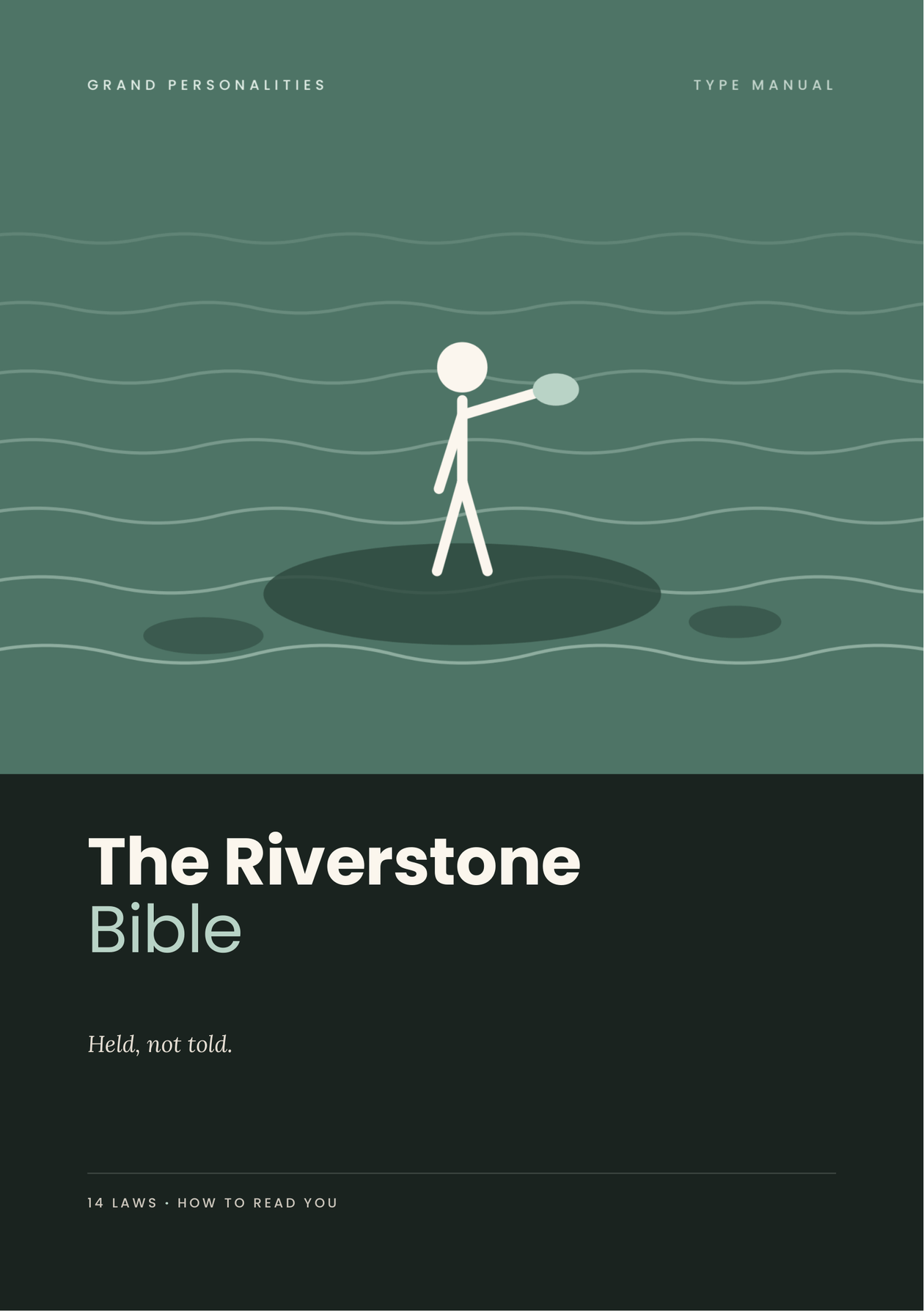
You’re not passive, whatever you’ve been told. Your calm keeps getting mistaken for a yes.
What costs you is the line only you know is there, and the true thing left unsaid while it was still easy to say. Here are six of the fourteen laws, and what the book gives you for each.
Most Riverstones learn it the slow way: plans people quietly stopped suggesting, a calm nobody believes any more, a year’s worth of things let go that comes out as two small complaints.
Six of the fourteen laws
- LAW 01
Who you become
Asked to tell someone about yourself, you go blank and say you’re pretty easy-going. That night you think of eleven better answers.
In the bookYour self lives in what you do and make, not in sentences. Why you end up borrowing other people’s styles and plans, why none of them fit, and what that proves.
- LAW 08
Inside you
At night you write out everything that’s bothered you, four fair paragraphs, then delete it. Months later, asked what’s wrong, you can name two small things.
In the bookPeople assume you don’t mind, because you let each thing go for a good reason. So it builds a grain at a time, and what you were right to bring up comes out small.
- LAW 05
People
You notice what someone close needs, make or fix it, and hand it over with a cover story: it was on sale, it was lying around.
In the bookWith a cover story, criticism lands on the thing. Without one, it lands on you. Why each correction thickens the next story, and why the people you love most see it’s you least.
- LAW 03
People
In an argument you say okay just to end it, and change nothing. Weeks later, with nobody pushing, you quietly come round and never say so.
In the bookYou can be persuaded, just never mid-argument. Because nobody sees the empty okay or the quiet change, people push harder and earlier, exactly when you move least. The book shows how to break it.
- LAW 04
Inside you
When something gets hard to explain, you say you’re not the clever one before anyone else can. It lands as a joke, and you still believe it.
In the bookAnywhere people get graded, it’s your speed with words being measured, not what you know. Why marking yourself down first feels safer, and why, years on, you still apologize before you share it.
- LAW 12
Your life
Someone asks what you’ve been up to. You say not much, and mean it as good news, then watch them decide you’ve given up.
In the bookYour freedom moved from where you go to how you do things, and only you can see it growing. Why kind people keep trying to rescue you, and how to tell stuck from content.
And eight more laws
- Why people close to you steer well clear of lines they can’t see, and the plans they quietly stop suggesting. · Law 2
- What happens when you hide one struggle until it’s fixed, and why your calm stops counting as proof you’re fine. · Law 6
- What a strong feeling needs before you can talk about it, and who it lands on when your usual outlet disappears. · Law 7
- How your anger can be over in an hour while what you learned about the other person quietly stays. · Law 9
- The certain, order-giving version of you that appears under strain, why it feels like the real you, and why its rules stay. · Law 10
- Why you can’t choose from a description, only by standing in it, and the one thing your calm gets wrong about waiting. · Law 11
- For men of this house, why people trust your hands but not your heart; for women, why every no gets paid back in yeses. · Law 13
- How you became the easy one, and who has quietly been doing the difficult part for you. · Law 14
Also in the book
- Work and money: why the best thing you do goes uncounted, and three roles that look right for you and aren’t. · Work and money
- Your decades: how this pattern shifts with the years, and when your calm finally reads as authority. · Your decades
- How to read your Riverstone: what their calm is really saying, and what helps on the week they seem like a stranger. · For the people around you
If this chapter read you right, the book goes 49 pages further.
Order the Riverstone Bible and get a second book free
 FREE
The Riverstone Bible49 pages · $19
A Story of Your People12 true lives$9 free
The Riverstone Bible$19
A Story of Your People$9
Bought separately$28
Yours today$19
49-page PDF, yours to download and keep. 30-day money-back guarantee. Read all of it. If it isn’t you, email us and you get every cent back.
Or get the House Set — the Bible, Romance Fits and Secrets of the Riverstone — for $34 ($44 apart).
Not sure this is your house? Take the free test.