Which one are you?
INFJ vs INTP: the Lighthouse or the Labyrinth
By Grand Personalities · Updated
The difference: F vs T, J vs P
INFJ vs INTP: the one difference that matters
INFJs and INTPs share two letters and a reputation for being the deepest person in the room. Picture a friend asking both for advice about a job offer abroad. The INTP (the Labyrinth on this site) asks twenty questions, spots the clause in the contract nobody read, and answers honestly: probably, and it turns on two things. The INFJ (the Lighthouse) asks one question, “Do you actually want the life that comes with it?”, and already knows from the friend’s face that they won’t take it. Both were right. They were looking at different things.
Both think hard and mostly out of sight. The difference is the subject. INFJs put small signals about people together, a change in how someone says a name, an apology that comes too fast, until it adds up to one calm certainty about where that person is heading. INTPs take ideas apart to see if they hold, starting with the ones they like best, and care about the exact word: when someone says “always” and means “twice”, it bothers them. INFJs like questions answered and plans kept. INTPs will leave a hard question open for weeks rather than accept a neat wrong answer.
Friends notice the difference when someone cries. The INFJ moves toward them, often already knowing why. The INTP goes still, their mind blanks, and they reach for the one practical thing in sight, a tissue or a glass of water. They feel it at full strength; tears just give their mind nothing to work on.
Side by side
INFJ and INTP, compared
| INFJLighthouse | INTPLabyrinth | |
|---|---|---|
| Mostly thinks about | People, and where they’re heading. | Ideas, and whether the reasoning holds. |
| Gives advice as | One quiet question that names what you really want. | An exact read on the flaw in the plan. |
| An open question | Settles into one calm certainty. | Stays open for weeks rather than take a wrong answer. |
| Plans | Fixed and kept. | Loose; resists a shared calendar. |
| Asked for a yes | Gives one, and means it. | “Probably, and it turns on two things.” |
| Stops trusting someone | After a long, quiet file of small letdowns. | After one moment that made no sense. |
| Under long strain | Tightens: invitations declined, everything cut back. | Fog: the same paragraph read four times. |
| Misread as | Mysterious or judgmental. | Contrary, cold or superior. |
Quick test
INFJ or INTP? A six-question test
Pick the answer that sounds more like you. Each one shows which way it points.
- 01
- 02
- 03
- 04
- 05
- 06
0 of 6 answered
See which answer points to which type
- 01 If you look at them, what they’re feeling, what they want and what they aren’t saying, you’re probably the INFJ. If you look at the problem, its logic, its assumptions and where it breaks, the INTP.
- 02 If it’s mostly working out people, why someone said what they said and where they’re heading, you’re probably the INFJ. If it’s mostly working out how something works, like why one corner of a street floods and the other doesn’t, the INTP.
- 03 If you give a clear answer and stand by it, you’re probably the INFJ. If you give the honest shape of it, probably, with two conditions, because a flat yes would be inaccurate, the INTP.
- 04 If you like them fixed, and a plan that slips midweek bothers you until there’s a clean restart, you’re probably the INFJ. If you resist structure like a shared calendar, and leave things nearly finished once you understand them, the INTP.
- 05 If you move toward them and usually know what they need, you’re probably the INFJ. If your face freezes and you reach for something practical, and replay the moment for days afterward, the INTP.
- 06 If it happens after many small letdowns, filed quietly until the door has closed, you’re probably the INFJ. If it happens in one moment, when they defend something with “because I said so”, and their opinions simply stop reaching you, the INTP.
Mistyping
Why INFJs and INTPs get mixed up
These two get mixed up because both are introverted, private, intellectual and drawn to deep questions about people and ideas. INFJs have a strong analytical streak, and INTPs care more than they show, so each can look like the other on a given day. Questions about whether you’re a deep thinker, value privacy or love understanding things can’t separate them. Both say yes.
The useful question is what you’re thinking about and how you close it. The INFJ thinks mostly about people and arrives at a calm conclusion. The INTP thinks mostly about how things work and keeps questions open until the reasoning is airtight. A second clue is comfort: the INFJ moves toward someone in distress, the INTP freezes and reaches for something practical. Types are patterns, not destiny; if both fit, ask a close friend which one sounds like you.
Love
The INFJ and the INTP in love
The INFJ chooses slowly and would rather be alone for years than settle. When they choose, they love by understanding: they remember what their partner said early on about the life they wanted, and help them build it. When an argument heats up, the INFJ steps out to think, which to them is the opposite of a fight and to their partner can feel like the fight.
The INTP falls for a mind first, usually after a conversation that went somewhere unexpected, and their curiosity about a partner doesn’t wear off. Their questions are how they show affection. Trouble rarely comes from disagreement; it comes from absence, the evening the INTP was in the room but their mind was on a problem. And when a partner brings a feeling after a long day, the INTP’s instinct to ask what caused it can sound like cross-examination.
Work
The INFJ and the INTP at work
The INFJ does best where understanding people over the long run is the job: strategy, developing people, writing, design, care work, advising. They can do almost any job well for a while, but only a job they believe in for years.
The INTP is most useful early, when a problem has no shape yet, and late, when something’s broken and nobody knows why: debugging, analysis, writing, investigation. Give them the problem and trust them with the method. Their risk is leaving things nearly finished, because once they understand how something works, finishing it feels like copying out.
Together
When an INFJ meets an INTP
Neither is the other’s best match on this site: the Lighthouse’s is the Bonfire (ESFP), and the Labyrinth’s is the Beacon (ENFJ). Together they share a strong mental pull and long, late conversations. The strain is that neither is good at raising a hurt, and the INTP’s questions can sound to the INFJ like a verdict on their feelings.
FAQ
Questions people ask
What is the difference between INFJ and INTP?
The difference between INFJ and INTP is what they think about. INFJs read people: what they want, where they’re heading, what they aren’t saying. INTPs test ideas: whether the reasoning holds and where it breaks. Both are private, deep thinkers who love hard questions.
How do I know if I’m INFJ or INTP?
Notice whether you look at the person or the problem when someone asks for help, and whether you like questions settled or left open. INFJs foresee; INTPs examine. The free test on this site can help settle it if both still sound like you.
Is INFJ or INTP rarer?
INFJ is rarer: about 1.5% of people in a large US national sample, against about 3.3% for INTP. Rarity says nothing about which type is better; it only says how many people share the pattern. Every type is ranked on this site’s rarest personality type page.
Why do INFJs sometimes test as INTP?
INFJs use Ti, private logic, as their third function, so many are analytical, precise and drawn to systems. If a test leans on questions about logic and ideas, an analytical INFJ can come out as INTP. The tell is that the INFJ’s analysis is usually in service of understanding people.
Which is more logical, INFJ or INTP?
INTPs lead with logic: checking reasoning is what their mind does first. INFJs are often very logical too, but they use it to test an insight they’ve already reached about people or the future. Neither is less intelligent; they start from different places.
What are the cognitive functions of INFJ vs INTP?
INFJ runs Ni-Fe-Ti-Se and INTP runs Ti-Ne-Si-Fe. Both use Ti and Fe, in different places: the INFJ has Fe second and Ti third, while the INTP leads with Ti and keeps Fe last. That is why the INFJ reads the room first and checks the logic later, and the INTP does the reverse.
Every type ranked, rarest to most common →
Still torn between INFJ and INTP?
The free test settles it in about ten minutes.
Take the free testThe Bibles
Read both openings. Yours is the one that reads like your week.
Each type has its own Bible: the patterns that type keeps repeating, and the plays that answer them. The opening chapter of every Bible is free to read.

If you’re the INFJ
The Lighthouse Bible
The beam goes far. The base stays dark.

Free with the BibleThe Lighthouse: A Story of Your People. 15 true lives of people who think like you, 130-page illustrated PDF.
If you’re the INTP
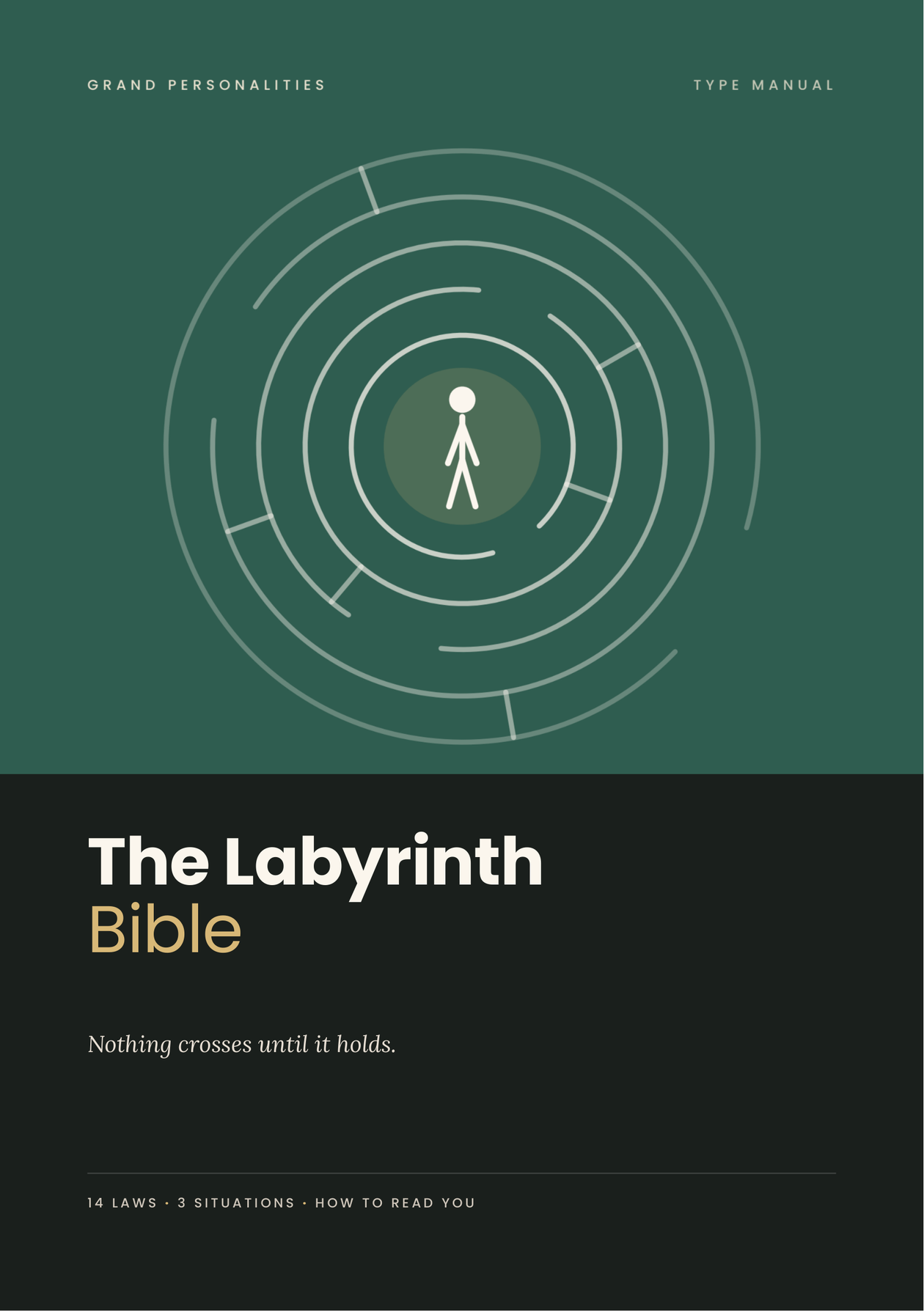
The Labyrinth Bible
Nothing crosses until it holds.

Free with the BibleThe Labyrinth: A Story of Your People. 15 true lives of people who think like you, 135-page illustrated PDF.
- The LighthouseINFJQuiet, certain, and already three moves into a future you can feel but can’t prove yet.Read the free INFJ profile
- The LabyrinthINTPYou take the idea apart because loving it isn’t the same as it being true.Read the free INTP profile
Famous INFJs in historyINFJFamous INTPs in historyINTP
Also compared
Compatibility